Rosés Deserve To Live A Little: 2021 Rosés in Full Bloom, Show Character And Dimensions With Two Years of Maturity … 13-Bottle Pack $299 (Limited)
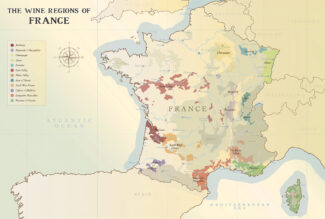
Any remaining stigma attached to rosé remains within the dark soul of the stigmatized; those of us on the right side of wine appreciation understand that rosé is enjoying the fruits—quite literally—of its historical labor. This is especially true in France, where the past several decades have seen rosé coming into its own.
Since 2000, white wine sales in France have plateaued while rosé’s have doubled; over that same timespan, red wine has declined in popularity at such a staggering rate that even if rosé does not win over a single new fan, it may well surpass red wine sales in France in the future.
As a springboard to spring, we will offer a fresh look at this old style through a series of French rosés that span the country from north to south in a 13-bottle package for $299.
Start With Red Grapes
Of the five thousand or so red wine grapes on the planet, the number that are unsuitable for making rosé is precisely zero. And yet, in France, more than 40% of rosé production comes from Provence—an appellation that alone accounts for more than 5% of rosé production worldwide. And in Provence, wine production is dominated by four grapes: Cinsault, Grenache, Mourvèdre and Syrah. The other rosé-producing appellations (as can be surmised) use the red grapes best suited to their terroirs.
Often considered the benchmark rosé in France, Provence has four appellations that each yield distinct wines; Coteaux d’Aix en Provence allows Cabernet Sauvignon to be added to the blend and this results in arguably the most structured rosé from the appellation.
In Bordeaux, Cabernet’s ancestral and spiritual ground zero, the rosé tradition is less pronounced; the AOP for pink production is slightly under nine thousand acres, about half the area for white and a fifth that of red. In Bordeaux, however delicious, rosé is definitely an afterthought. Unsurprisingly, the pink wine is also made from Merlot and Cabernet Franc.
Loire makes its own claim on the style, and is certainly the preference of many. Rosé de Loire and Val de Loire cover Anjou and Touraine, where—taking advantage of the cool climate—the quality is uncompromised; lightly textured, immediately drinkable with raspberry and red currant flavors. Anjou rosés, grown near the Atlantic, are made from Grolleau, Gamay, Cabernet Sauvignon, Cabernet Franc, Malbec and Pineau d’Aunis.
From the icy limits of the north to the sweltering extremes of the south, styles of rosé are determined by many factors but there is certainly a strong case to made for them all.
Making A Rosé With The Capacity To Age, To Evolve, To Stand Up To Food
Even rosé’s most ardent fans may think of it as fun and festive springtime beverage; a crisp quaff meant to be consumed chilled within a year or two of vintage, and for the most part, they are not wrong.
There is a second style, however—one deserving not only of notice, but of understanding: The age-worthy rosé.
All wines have a unique dynamic created by a combination of terroir and target. In other words, a winemaker is bound by soil but not by motive; a number of factors go into the rather complex process of creating a rosé, beginning in the field and carrying through to the cellar. In order to create a wine that has the capacity to mature and improve, decisions are often made before the first vine is planted. Some grapes seem to have a natural affinity for aging—acidity and tannin levels are a large part of it, and so is a susceptibility to noble rot, since a concentration of sugars acts as a natural preservative. In making rosé, neither palate-parching tannin nor botrytis are particularly desirable, but acidity—in balance with natural fruit-forward dryness—is key.
So is having a full, unadulterated, un-doctored body: According to Nicole Rolet of Chêne Bleu in Vaucluse, “Some love-’em-and-leave-’em rosés are made with additives like tartaric acid to achieve the pale color and crisp flavors. That’s the stuff that’s generally going to condemn your wine to a short shelf life. It separates out over time, and the wine will fall apart and lose its aging potential.”
The inconvenient truth, however, is there are no surefire indicators of which rosés are meant to improve with age and which are meant for tonight; color can fool you and so can price; both are indicators that the product may be suited for the long-haul, but is not reliable enough to be fail safe. Color of the bottle may actually be a better gauge than color of the varietal since a producer will not package a seriously-structured rosé in a clear bottle.
The best strategy is to trust your purveyor, so naturally, you can safely assume that the wines offered below are the product of winemakers who took time and care to craft their wares, whenever you choose to drink them.
The 2021 Vintage: A Moment To Celebrate Classical Freshness And Moderate Alcohol Levels?
Something that can be said for certain about Vintage 2021 in France: Every region except Provence registered an output decline. Yields were 13% lower than the average of the last six vintages and 20% lower than the 2020 harvest, while the hardest hit AOPs (Loire Valley, Burgundy, Savoie and the Jura) were down 34% over 2020. This is the result of the worst French frost-related agricultural disaster since systematic record-keeping began in 1947, with 98% of the country affected and the wine industry given a particularly brutal wallop. Neither did the summer do its part; it was wet and cool in the north, dry and hot in the south.
And now the silver lining: Low yields may be a financial hardship on wineries, but they can be a quality godsend for consumers. Cool weather often leads to enhanced acidity (freshness) and lower sugar content, translating to lower alcohol-by-volume.
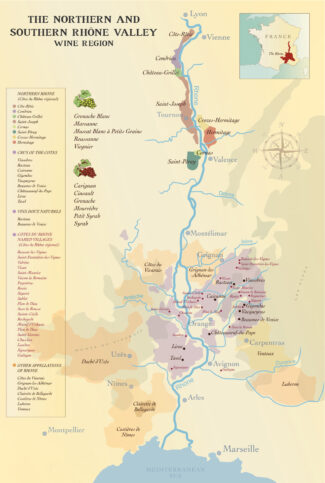
THE SOUTHERN RHÔNE
So dark in color are some of the Southern Rhône’s most celebrated rosés that they nearly defy the ‘blush’ concept. Of the vivid ruby tones found in Tavel, for example, Thomas Giubbi (co-president of the Syndicat Viticole de l’Appellation Tavel winemakers association) said, “We think of our wines as light red wines.”
But that isn’t fair to the category. In its very soul, rosé qualifies as neither red wine nor white wine. It may be (although rarely is; the practice is frowned upon) a blend of the two, but in nearly all cases, it is produced by crushing red-skinned, white-fleshed grapes and allowing a period of maceration lasting from a few hours to a couple days in which the juice is ‘dyed’ to a specific level; alternately, there is méthode saignée, which is essentially fermented free-run juice from red wine pressings.
Gigondas
Like nearby Châteauneuf-Du-Pape, Gigondas depends heavily on Grenache. Based on appellation laws, both the reds and the rosés must be made from up to 80% Grenache, with at least 15% comprised of Syrah and Mourvèdre. The grapes are grown at a higher elevation than Châteauneuf’s, often in terraced vineyards threaded with limestone under the looming Dentelles de Montmirail, with rocky, sandy, free-draining soils on the flatter, lower-lying land to the north and west. Although rosé only accounts for a scant 1% of the production in the entire appellation, it tends to be noteworthy stuff—serious and gastronomic a wine that recalls the rosés of yore that drank well into the years that followed.
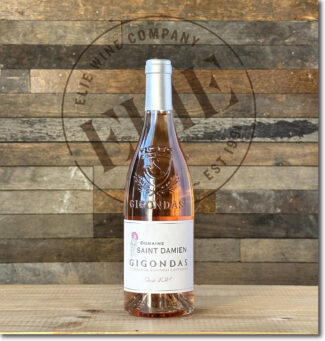 1 Domaine Saint Damien, 2021 Gigondas Rosé ($33)
Spreading over 112 acres, of which around 40 are in Gigondas, Domaine Saint Damien is the brainchild of Joël Saurel and his son Romain, who have lifted the estate—named for the patron saint of doctors—from humble roots to becoming one of the most reputable domains in Southern Rhône. This especially true in his superlative Gigondas, where fruit is drawn from the lieux-dits of Le Gravas, Pigières, La Louisiane, Les Souteyrades, La Moutte and La Tour.
80% Cinsault (planted in 1970) and 20% Syrah (planted in 2000) in the organically-farmed lieu-dit of La Moutte, this small production wine undergoes cold maceration for six hours followed by slow pneumatic pressing and fermentation in stainless steel tanks with occasional lees stirring. Delicately tinted, it shows rose petal, honeydew, lychee, pineapple and garrigue with a hint of pepper and crushed rock on the finish.
Côtes-du-Rhône
Côtes-du-Rhône is one of the largest single appellation regions in the world, covering millions of acres and producing millions of bottles of wine of varying degrees of quality. In Southern Rhône, it encompasses the majority of vineyards and includes hallowed names like Gigondas, Vacqueyras and Châteauneuf-du-Pape. The latter wines prefer to use their individual, highly specific ‘Cru’ names, but the truth is, many generic Côtes du Rhônes may come from plots just outside official ‘Villages’ boundaries—some only across the road or a few vine rows away from top vineyards—and among them, you can find wines with nearly the same level of richness at a fraction of the cost.
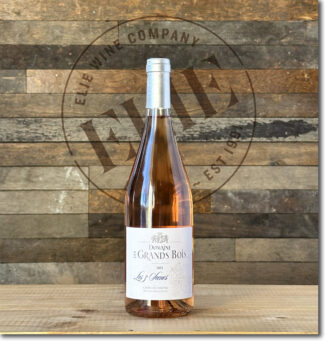 2 Domaine Les Grands Bois, 2021 Côtes-du-Rhône Rosé ($16)
If more sommeliers became vignerons, the world might see more low-yield, unfiltered gems like those of Marc Besnardeau, who worked as a wine steward in Paris before following his dream into the vineyard. With wife Mireille Farjon, he took over Domaine Les Grands Bois, whose vines were planted in 1929 by Mireille’s grandfather. The estate is well-situated between St. Cecile and Cairanne, and after selling initially to négociants, the couple began bottling at the estate in 1997. They replanted some fields with Syrah and Mourvèdre, bought new vineyards, and expanded their holdings to its current size, 116 acres spread across seven communes: Sainte Cécile les Vignes, Lagarde-Paréol, Suze la Rousse, Tulette, Cairanne, Rasteau and Travaillan.
60% Grenache, 30% Syrah and 10% Carignan grown on chalky clay and harvested from vines ranging in age from 15-60 years. The wine shows black raspberries, cassis and clementine in a spicy package that highlights anise and honey up front, and with aeration shows deeper savory notes of fresh earth, mushrooms, wildflowers and crushed stone.
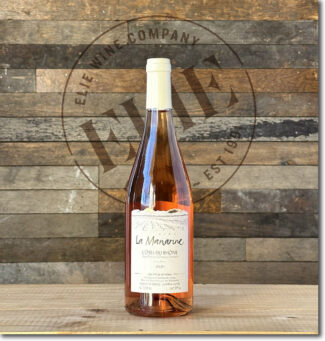 3 Domaine La Manarine, 2021 Côtes-du-Rhône Rosé ($22)
Created in 2001, Gilles Gasq established both the winery of Domaine La Manarine and the vineyards on a plateau northeast of Orange within the commune of Travaillan. He has expanded his holdings ever since, and now works with over eighty acres situated largely on ‘Le Plan de Dieu’—a terroir universally heralded for its deep, layered soils consisting of more than 60% hard limestone ‘galets’ which giving a unique minerality to the wines. Gasq says, “Our climate is typically Mediterranean: Relatively hot and dry with rains coming in the form of thunderstorms in late August; this helps provide the vines with the water necessary to finish the maturation process. Grenache is our main grape variety as it performs particularly well on this type of soil and gives wines more elegance and aroma than is otherwise common.”
60% Grenache, 40% young-vine Mourvèdre and 10% Syrah produced solely via direct-press and aged in stainless steel and concrete vats on fine lees prior to being bottled in the early spring following harvest. It is a friendly wine, full of spring berries and pink flowers with a fresh acidity that makes it a refreshing quaff as well as a potentially age-worthy bottle.
Ventoux
Ventoux is a large wine region in the far southeast of the southern Rhône, 25 miles northeast of Avignon and bordering Provence. Covering 51 communes, the vines are planted on the western slopes of Mt. Ventoux, a sort of ‘stray’ Alp removed from the range and towering over the landscape for miles around. Ventoux terroir and varieties are typical for Rhône, although noteworthy are the region’s Muscat produced for table grapes, which has its own AOP—Muscat du Ventoux.
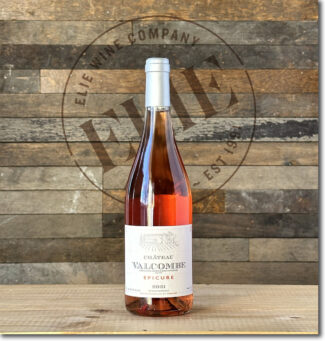 4 Château Valcombe ‘Epicure’, 2021 Ventoux Rosé ($22)
Originally owned by Paul Jeune of Domaine Monpertuis, he opted to sell to Luc and Cendrine Guénard who worked under Jeune’s tutelage during the transition period. They now are proudly independent vignerons with a compulsion to further improve this jewel; their first efforts can be seen and tasted in the 2009 vintage. Certified organic in 2013, the 70 acres of Valcombe are situated in the shadow of the mountain, reaching one thousand feet. Four red grape varieties (Syrah, Carignan, Grenache and Cinsault) balance four white grape varieties (Clairette, Grenache Blanc, Roussanne and Bourboulenc); many vines over sixty years old, although parcels of Carignan and Grenache were planted in 1936. Soils are essentially limestone covered with the area’s famous galets, although deep in the subsoil, an unusual blue-inflected clay helps define the unique characteristics of Valcombe wines.
Vinified via the direct press method from a blend of 60% Grenache, 20% Cinsault, 10% Carignan and a touch of Clairette; all vines are of an average age of 40 years. It has a rich, focused plush texture with strawberry and peach in the foreground and an earthy and intriguing dose of eucalyptus behind.
Luberon
The list of grape varieties permitted in the relatively youthful Luberon appellation (created in 1988) is long, but Syrah and Grenache dominate plantings and must both be present in reds from here. Mourvèdre is also considered a primary red grape. Rosé represents about half the region’s output, and are generally made from the permitted red grapes, although they may legally incorporate up to 20% of white varieties, primarily Grenache Blanc, Clairette, Bourboulenc, Ugni Blanc and Vermentino.
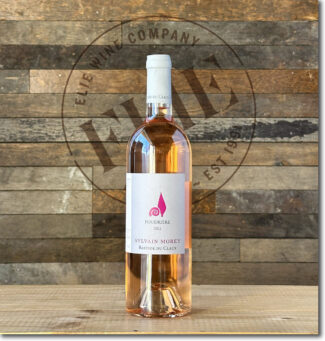 5 Domaine de La Bastide du Claux ‘Poudrière’, 2021 Luberon Rosé ($25)
Domaine de La Bastide du Claux was born in 2002 when Sylvain Morey—whose family’s roots in Chassagne-Montrachet goes back 400 years—uprooted. In the hills of Luberon, he chose to transplant some of his Burgundian know-how to Provence’s up and coming appellation. In the heart of the Luberon Natural Park, Morey cultivates a fragmented vineyard spread over 42 acres. Finding Luberon’s rich combination of soils, climates and exposures suited to a number of different grapes, he planted 14 varieties, each location chosen with circumspection. “When I arrived, there were not many growers bottling their own wines,” he says. “The vast majority of the production in Luberon was made by local cooperatives, and many of them valued quantity over quality and began to replant vineyards so that they could produce the maximum amount of grapes possible and save money with machine harvesting. These trends made it possible for me to affordably purchase interesting, low-yielding old-vine parcels that were no longer valued.”
50% Grenache from 55-year-old vines, 30% Cinsault, and 20% and Syrah, from south facing vines around the villages of Peruis and Ansouis. The grapes were pressed directly, the majority without maceration, with a portion of Grenache and Cinsault spending six or so hours on their skins after the pressing. Everything is done in cement and the wine ferments naturally, resulting in a great mineral character that shows its soil influence clearly and offers subtle red fruits and vigorous acidity along with a salty tang that typifies Mediterranean rosé.
PROVENCE
Tucked into the southeastern corner of France, Provence covers 125 miles of coastland—no vineyard in the appellation is more than 25 miles from the Mediterranean. And as suits the French Riviera, 3000+ hours of sunshine annually (paired with strong Mistral winds to keep things dry), allow vines to thrive in a hot, maritime climate without risk of fungal disease. Even so, as conditions become even hotter, a new way of thinking has begun to animate this deeply traditional region: Older varietals like Carignan, Barbaroux and Calitor being replaced by more commercially viable grapes like Grenache, Syrah and even Cabernet Sauvignon, although native standbys Mourvèdre, Tibouren and Vermentino continue to hold their ground.
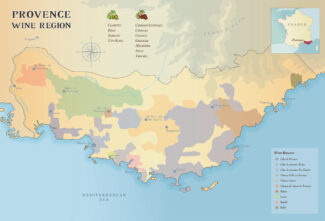
There are pockets of well-received red and white wines throughout Provence, but the name of the game is pink; 82% of the Provençal output is rosé, nearly all crisply acidic and bone dry and in color, ranging from pale coral when made predominantly from Grenache to more deeply tinted Syrah-based wines. In fact, each shade has an official name based on a color chart developed by the Centre de Recherche and d’Expérimentation sur le Vin Rosé: Peach, Melon, Mango, Pomelo, Mandarin and Redcurrant.
Bandol
Conventional wisdom has taught us that wine grapes fare best in places where nothing else will grow; rocky, water-starved soil on precipitous hillsides make vine roots work harder, ramifying and branching off in a search of nutrients and, in consequence, producing small grapes loaded with character. Cue Bandol, the sea-and-sun-kissed region along the French Riviera, which is not only good country for grapes, it’s good country for the soul. Made up of eight wine-loving communes surrounding a cozy fishing village, Bandol breaks the Provençal mold by producing red wines that not only outstrip the region’s legendary rosé, but make up the majority of the appellation’s output. In part that’s due to the ability of Bandol vignerons to push Mourvèdre—generally treated as a blending grape in the Côtes-du-Rhône and Châteauneuf-du-Pape —to superlative new heights.
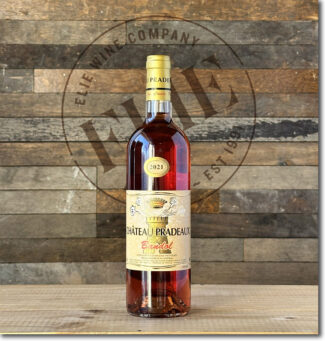 6 Château Pradeaux, 2021 Bandol Rosé ($41)
Situated on the outskirts of the town of Saint Cyr-sur-Mer, directly on the Mediterranean between Toulon and Marseilles, Château Pradeaux has been in the hands of the Portalis family since the French Revolution. In fact, Jean-Marie-Etienne Portalis helped draft the Napoleonic Code and assisted at the negotiation of the Concordat under Napoleon the First. Today, the domain is run by Cyrille Portalis, who continues to maintain the quality traditions of his forbears, assisted by his wife Magali, and their sons Etienne and Edouard. Although vineyards are planted almost exclusively to old-vine Mourvèdre, Château Pradeaux Bandol Rosé is composed of Cinsault as well.
Although the skin contact during a slow, gentle press only lasts about 24 hours, that is plenty of time for the perfectly ripe Mourvèdre to work its magic, and the addition of Cinsault (about half the cépage) creates an ideal structure that will allow this wine to evolve with grace. Layers of wild strawberry, blood orange and an herbal undertow of garrigue unfold beautifully.
Cassis
The entire vineyard area of Cassis is under five hundred acres, but most of the properties overlook the sea, which moderates the heat and creates an ideal climate for vine growing; the commune is known primarily for its herb-scented white wines, principally from Clairette and Marsanne (about 30% of Cassis production is rosé) and despite its name, it does not produce Crème de Cassis.
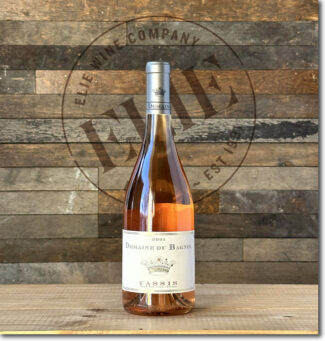 7 Domaine du Bagnol, 2021 Cassis Rosé ($41)
Sitting just beneath the imposing limestone outcropping of Cap Canaille, 700 feet from the shores of the Mediterranean, Domaine du Bagnol is the beneficiary of the cooling winds from the north and northwest and as well as the gentle sea breezes that waft ashore. Cassis native Jean-Louis Genovesi and his son Sébastien run the 18-acre estate.
Grenache, Cinsault and a touch of Mourvèdre combine to produce a wine that is perfumed with red-currant and strawberry aromas and provides a crisp and refreshing wash of citrus and crushed stone/slate minerality on the palate.
Côtes-de-Provence
The massive Côtes-de-Provence sprawls over 50,000 acres and incorporates a patchwork of terroirs, each with its own geological and climatic personality. The northwest portion is built from alternating sub-alpine hills and erosion-sculpted limestone ridges while to the east, and facing the sea, are the volcanic Maures and Tanneron mountains. The majority of Provençal vineyards are turned over to rosé production, which it has been making since 600 B.C. when the Ancient Greeks founded Marseille.
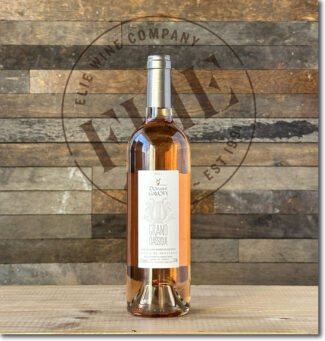 8 Domaine Gavoty ‘Grand Classique’, 2021 Côtes-de-Provence Rosé ($30)
Roselyn Gavoty (the eighth generation of Gavoty to helm her family’s Roman-era farm; her ancestor Philémon acquired it in 1806) is on the cutting edge of viticulture. Situated along the Issole River in the northwestern corner of the Côtes-de-Provence, surrounded by oak and pine forests, the Gavoty family has worked the land without synthetic chemicals for decades, obtaining organic certification in recent years. The vineyard covers 150 acres in the commune of Cabasse (‘harvest field’ in the old Provençal language). Roselyn says, “Our vines are planted on clay-limestone soil, and produce a majority of rosé by the saignée method, involving bleeding off a portion of red must to create structure and depth.”
‘Grand Classic’ contains Grenache and Cinsault in roughly equal proportions, with Carignan playing a minor role. Rather than being pressed immediately after harvest, the wine macerates for several hours, and the saignée and first-press juice are vinified separately and blended until the wine displays its uncanny equilibrium—racy acidity wed to gleaming fruits and just the right amount of earthiness.
Bouches-du-Rhône
‘IGP’ (Indication Géographique Protégée) is a Europe-wide category that focuses on geographical origin rather than style and tradition, giving winemakers greater stylistic freedom than ‘AOP’ (Appellation d’Origine Protégée). As such, the boundaries of Bouches-du-Rhône are geographical, with the Durance river delimiting the north and the Rhône river making up the western border. The soils of the region tend to be poor, free draining and made up of anything from limestone-clay to gravel and sandstone; the lack of water forces vines to produce more concentrated grapes, leading to more concentrated and flavorful wine.
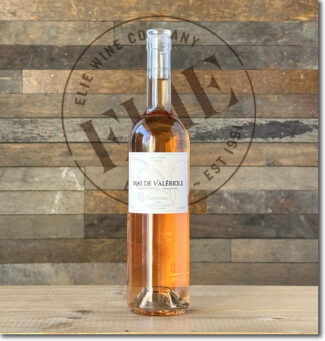 9 Mas de Valériole ‘Grand Mar’, 2021 IGP Bouches-du-Rhône – Terre de Camargue Rosé ($25)
Mas de Valériole’s eighty-acre vineyards reflect diversity in multiple soil types: sand, clay, limestone, and alluvial loam deposited by the Grand Rhône. The reliably steady mistral wind blowing in from the Mediterranean mitigates the heat and facilitates the domain’s chemical-free approach to farming while ensuring modest alcohol levels in the wines. The property was acquired by the Michel family in the late 1950s and is now run by Jean-Paul and Patrick Michel. Produced from a variety of cépages, including Cabernet Sauvignon and Merlot, plus crossings like Caladoc (Grenache and Malbec) and Marselan (Grenache and Cabernet Sauvignon) which are particularly well-suited to the Camargue’s climate, Mas de Valériole’s wines combine the breezy freshness of Provence with a sense of wildness and an underlying salinity that is representative of Bouches-du-Rhône.
‘Grand Mar’ Rosé is 100% Caladoc, fermented with indigenous yeasts (unusual for rosé production) in stainless steel tanks to preserve freshness. The wine is enticing with vibrant notes of ruby-red grapefruit and white peach behind crackling acidity—a wine that never met a salmon dish it did not love.
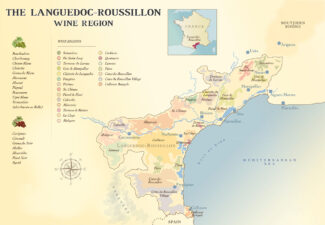
LANGUEDOC-ROUSSILLON
Sun-baked and sensual, threaded with rivers and capped by the mountains of Corbières, Languedoc-Roussillon relies on over a hundred grape varieties to produce more than a third of all French wine. Historically, this wine was copious, inexpensive and rather forgettable—everyday wine for the tables of ordinary people. Since the mid-twentieth century, however, with the advent of irrigation in the foothills and coastal plains of Southern France coupled with improved techniques, the region now boasts fewer vines that produce wines of increasing quality. A jigsaw of soils and a broad swath of microclimates creates ideal terroir for the warm-weather, full-bodied varietals often associated with the Rhône, while sharp diurnal shifts allow for the preservation of aroma and natural acidity, resulting in wines of extraordinary balance. A further plus is that Languedoc-Roussillon’s hot, dry climate discourages the growth of mildew and fungi, making synthetic pesticides and herbicides less necessary. As such, it has become a proving ground for organic and biodynamic producers.
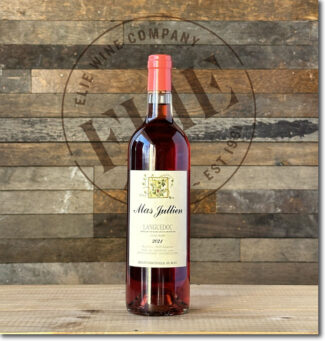 10 Mas Jullien, 2021 Languedoc Rosé ($35)
Among the early pioneers of the modern ‘Larzac style’ is Olivier Jullien: His forty terraced acres, with two distinct soil types—calcaire and argilles—was established in 1985, and his domain, Mas Jullien, is a paradigm of the region. Having witnessed first-hand Languedoc’s tradition of over-cropping to produce bulk wine, he recognized that the economic plight of local independent farmers may have failed to take advantage of the appellation’s promise. With a degree in enology to shore up his conviction that the area had the potential to produce world-class wine, he showed his iconoclastic hand early by pulling out vineyards and re-planting trees in an effort to restore balance to the local ecosystem. His wines are delightful examples of this balance, imbued with the distinct characteristics permitted by elevation and proximity to the sea.
A saignée rosé made from juice that is bled off the skins of red grapes from Jullien’s vineyards on the Terrasses-du-Larzac. A blend of Cinsault, Carignan and Mourvèdre, though the blend can change from vintage to vintage. Fermentation takes place in stainless steel with native yeast, aging in Stockinger foudres of mixed ages. It is a structured and somewhat wild wine of deep, earthy complexity showing garrigue and wet stone behind strawberry and watermelon.
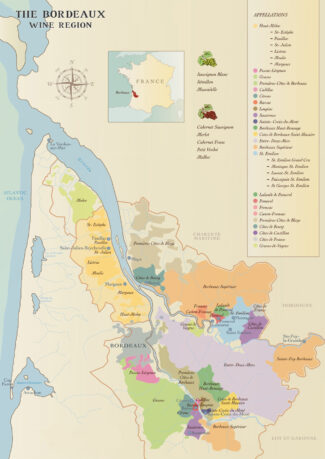
BORDEAUX
Today, rosé is a serious wine in Bordeaux, but still, ‘serious’ must be viewed on a sliding scale compared to the reds. Even this is an improvement; in days not too long ago, it was not only uneconomical to turn red wine grapes into pink, it was generally only made in weaker vintages, when juice might be bled off reds to make a ‘weak red’ or darker pink or from fruit from vines too young to make viable reds. In 2010, the Bordeaux Wine Board reviewed its marketing strategy and the role of Bordeaux in the international market and started to actively encourage Bordeaux rosé as a means of attracting younger drinkers to old-guard wines. In part, the campaign has succeeded, and sales of rosé (as opposed to ‘clairet’, the darker red version that is often the product of saignée rather than direct-press) have grown. Fresh Bordeaux rosés remain a unique beast in that they have a blue tinge, with no hints of orange-salmon in their youth, although with age, they fade toward this hue.
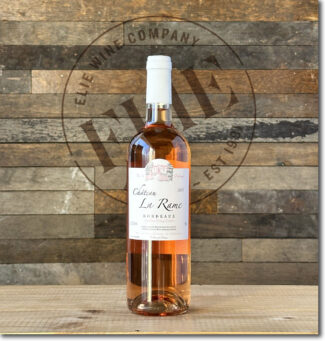 11 Château La Rame, 2021 Bordeaux Rosé ($24)
La Rame’s fifty acres overlook the Garonne; they face south and the vineyards are planted in clay-limestone with an exceptional substratum marked by fossilized oyster shells dating from the Tertiary era. Further down the slope, where sandier soils predominate, the estate’s Cabernet Sauvignon and Merlot thrive. The property was purchased by the father of the current owner, Yves Armand, at a time when the appellation had fallen out of favor. The family has undertaken to re-establish their Sainte-Croix-du-Mont AOP as an appellation to rival the great estates nearby.
A relatively new addition to the Rame portfolio, the grapes (80% Cabernet Sauvignon and 20% Merlot) are sourced from a five-acre parcel of younger vines on the flanks of a hill that descends towards the Garonne. The wine is produced via the direct-press method and is fermented in temperature-controlled vats for six months before it is bottled. It shows fine aromatic persistence with notes of red currant, raspberry and pear with a hint of banana. About 15,000 bottles are produced annually and only a few thousand are exported to the USA.
THE LOIRE VALLEY
Rosé de Loire adds yet another dimension to French blush. Extending across the Anjou and Touraine AOPs, it covers about 2000 acres and is responsible for more than a million gallons of rosé every year. Its color lends itself to dramatic descriptors ranging from ‘flamingo pink with a hint of poppy’ to ‘gleaming raspberry pink with a glimmer of violet.’ These wines are generally dry, but there is a subset that is off-dry and another subset, Crémant, that sparkles. There is even a ‘Primeur’ (or ‘Nouveau’) style, a much fruitier wine that is almost entirely free of tannins—a result of being fermented using the Beaujolais method of carbonic maceration. Like the red wines of Loire, the principle grapes used in the rosé are Cabernet Franc, Cabernet Sauvignon, Grolleau (Noir and Gris), Pineau d’Aunis, Gamay and/or Pinot Noir. Beyond color, Rosé de Loire is delightful elegance in a glass; Rosé d’Anjou in particular is noted for its reflection of terroir.
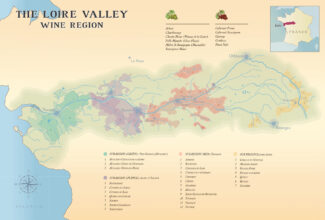
Saumur
As a fair representation of the Middle Loire, Saumur—radiating outward from the town center into neighboring administrative departments of Vienne and Deux-Sèvres—is primarily Chenin country, with a strong tradition of producing sparkling wines, for which the geology is particularly well suited. The town sits on a mound of tuffeau—the porous, sandy-yellow rock which underpins several of the central Loire’s top vineyard areas. Many miles of underground cellars have been cut directly into this soft rock, providing a cool, temperature-moderated environment perfect for storing méthode traditionelle wines during their lees aging. The reds, making up around 20% of the output, are built around Cabernet Franc, although Cabernet Sauvignon and Pineau d’Aunis can figure into the blend in minor quantities. Rosé gets afterthought focus and is only around 5% of total output; the appellation for rosé wines ‘Cabernet de Saumur’ has the same borders as Saumur AOP and is reserved for off-dry wines with at least 10 grams per liter residual sugar.
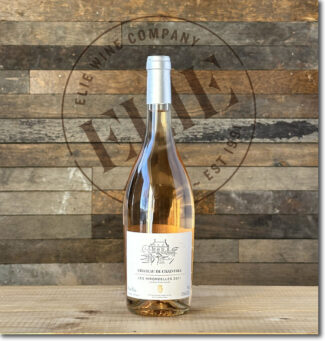 12 Château de Chaintres ‘Les Hirondelles’, 2021 Saumur Rosé ($32)
The de Tigny family has not only owned this property since 1938, a good number of the vines planted back then are still in production. In 2017, the estate hired Jean-Philippe Louis as cellar master, and he immediately began to transform the vinification philosophy with a precise, intuitive and non-interventionist hand. The property’s tuffeau makes for Chenin of vigorous acidity and penetrating precision as well as transparent Cabernet Franc, which thrives in the heat-retaining sand that covers the limestone, possessing a complexity and longevity that extends far beyond its fresh, finesse-driven profile.
100% Cabernet Franc, pressed directly, fermented spontaneously, and aged in steel with a bare minimum of sulfur. Floral up front with rose petal and geranium notes that meld into strawberry and mandarin flecked with flint over a chalky framework.
Anjou
Anjou sprawls across 128 communes, mostly south of the towns of Angers in the west and Saumur in the east. Monasteries played the largest role in developing Anjou’s wine trade, as each enclave had its own walled vineyard. But it was French royalty who secured the region’s reputation, beginning nearly a thousand years ago when Henry Plantagenet became King Henry II of England. Anjou’s terroir is a matter of black and white: it’s divided into two subsoils as different as day and night. First, Anjou Noir, composed of blackish, dark, schist-based soil along the south-eastern edge of the Massif Armoricain, then, Anjou Blanc, lighter-colored soils made up of the altered chalk at the south-western extremity of the Paris Basin.
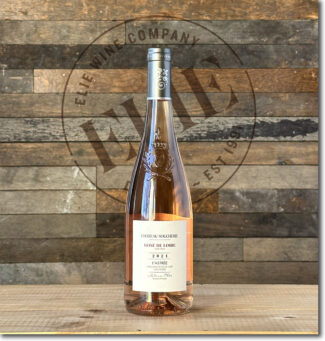 13 Château Soucherie ‘L’Astrée’, 2021 Rosé-de-Loire ($30)
Perched on a rise overlooking the Layon river, Soucherie is considered one of the most beautiful domains in Anjou. Roger-François and Pascal Beguinot have transformed 90 acres of limestone, clay and schist into multiple lieux-dits spread across Anjou, Chaume, Coteaux-du-Layon and Savennières. Around the winery, 54 acres are planted on a southern hillside sheltered from the winds; the 11 acres in Chaume contain vines over 70 years old while the four acres in Savennières (Clos des Perrières), loaded with shale, produce wines noted for their minerality. Maître de chai Thibaud Boudignon is leading the charge towards 100% organic viticulture through the principles of ‘agriculture integrée’—a ‘whole farm’ management system intended t deliver more sustainable agriculture by combining modern technologies with traditional practices according to a given site and situation.
The wine is dry and mineral-driven, produced from 70% Grolleau and 30% Gamay planted to clay, sandstone and schist soils. A ‘direct press’ rosé with élevage in cuve and bottling in April of the spring following harvest. The nose of white peach is underscored by herbal notes of dandelion greens and pineapple sage are complimented by a palate juicy with strawberry and watermelon notes.
- - -
Posted on 2024.03.22 in Anjou, cassis, Bandol, Luberon, Ventoux, Terrasses du Larzac, Gigondas, Côte-de-Provence, Rosé de Loire, France, Bordeaux, Wine-Aid Packages, Languedoc-Roussillon, Loire, Provence, Southern Rhone | Read more...
Gigondas Steps Out of Châteauneuf-du-Pape’s Shadows: A Dozen Southern Rhône Producers Make The Case Gigondas 2021 & 2020 Ten-Bottle Pack For $399 + A Rhône With Substance, But No Pretense 12-Bottle ‘Cairanne’ Pack For $159 (Limited)
The long shadow cast by Châteauneuf-du-Pape over Southern Rhône is bit like Mount Doom’s shadow over Mordor, only with a bit more garrigue and spice. So synonymous has the powerhouse cru been with style and standing in the region that nearby appellations cannot escape comparisons—generally to the unfavorable side—and until recently, could not really compete.
As such, it is high time somebody challenged the CdP supremacy, and Gigondas seems the appellation best poised to make a clean break from its glossier embossed cousin.
It’s a struggle that began in 1971, when Gigondas became the first of the Côtes du Rhône Villages appellations to be elevated to Cru status. Gigondas vineyards are found along the base and slopes of the first Dentelles de Montmirail foothills, where the combination of limestone soils on the Montmirail slopes to the east, and rocky, sandy, free-draining soils on the flatter, lower-lying land to the north and west create an ideal terroir across a multitude of microclimates, each with its own distinct claim to fame.
Southern Rhône River Crus
The Rhône is generally divided into north and south; but they are by no means equal in either style or output. Whereas the north contains some heavy-hitting Crus (Côte-Rôtie and Hermitage, to name a couple), it only represents 5% of the Rhône’s total production. In Northern Rhône, the sole red wine grape allowed is Syrah.
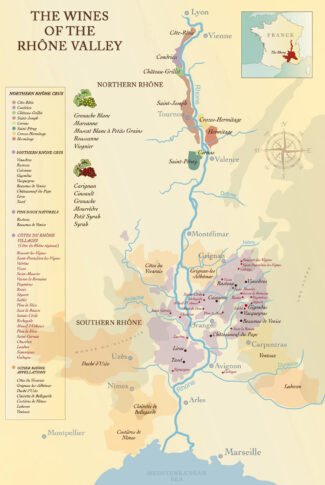
The south, fanning out from both banks of the Rhône River, is not as Syrah-focused, relying on a cornucopia of other varieties—Grenache, Carignan, Mourvèdre and Cinsault for reds and for whites, Marsanne, Roussanne, Bourboulenc, Clairette and Viognier, although many reds from the region—depending on AOP regulations—make use of white grapes in red wine blends to add floral highlights and soften harsh tannins.
The south is further divided into nine individual Crus—Beaumes des Venise, Cairanne (elevated in 2016), Châteauneuf-du-Pape, Gigondas, Tavel, Cairanne, Rasteau (changed in 2009), Vacqueyras and Vinsobres. Each has its own legion of fans, and each expresses the multiple terroirs of the south with individual interpretations: Tavel, of course, is known for its dry rosé, Vinsobres for it’s vividly acidic reds, Cairanne for its fleshy, Grenache-dominant quaffers, Lirac for its juicy, complex reds and fresh, floral whites. Southern Rhône’s most famous appellation, however, is Châteauneuf-du-Pape, and for good reason: These wines are impressively structured, deep in black fruits and spice with hints of roasting meats and occasionally a dash of funk; top examples run an equally impressive price tag.
Which brings us to Gigondas. Once referred to as ‘the poor man’s Châteauneuf-du-Pape’, quality improvements have been so striking over the past decade or so that it is high time we started thinking of it Châteauneuf-du-Pape affordable equal, perhaps ‘the smart man—and woman’s—Châteauneuf-du-Pape.’
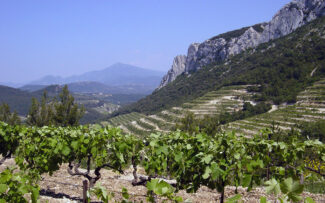
Gigondas vineyards at the Dentelles de Montmirail foothills.
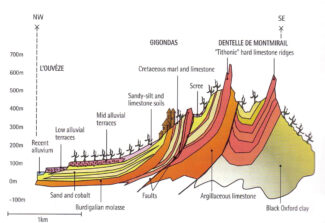
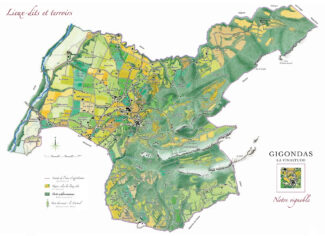
Geological map of the Dentelles de Montmirail formations. The town of Gigondas is in the middle. (Courtesy of Gargantuan Wine)
Gigondas, A Red That Takes You Into The Woods And To The Shore
Bastien Tardieu is the lead oenologist at family-operated négociant Tardieu-Laurent, which works with more than 100 growers throughout the Rhône Valley.
He’s also one of Gigondas’ most vocal flag-wavers: “Quality has improved immeasurably the last ten years,” he says. “Advances can be attributed to Cru appellations like Gigondas being held to the same restrictive regulations as Châteauneuf-du-Pape. Topography also plays a role: Gigondas, along with neighboring Vacqueyras and Beaumes de Venise, sits along the slopes of the Dentelles de Montmirail, the ragged limestone formation that towers above the Southern Rhône. The outcrops of the Dentelles protect against the morning sun and extend the growing season. Its altitude allows for a wide day-night temperature range that maintains acidity and balance in the grapes.”
The ideal Gigondas displays a bouquet evoking fresh forest berries, classic potpourri and botanical herbs that are complemented by exotic spice notes that build in the glass. The wine should stain the palate with intense raspberry, cherry cola and lavender pastille, flavors that steadily deepen with aeration.
Like most of Southern Rhône, Grenache is the appellation’s backbone, augmented by Mourvèdre and Syrah and—minus Carignan—a handful of other traditional Rhône varieties are ‘blend-approved.’
But the unique flavors of Gigondas extend beyond the familiar garrigue, which takes herbal hints from the nearby woodlands and native scrub bushes—wild thyme, sage, rosemary and lavender. According to Louis Barruol, owner of Château de Saint Cosme, a Gigondas estate that dates to the 15th century, “There is an unmistakable freshness about Gigondas wines—a quality that does not arise from altitude or acidity alone. It is a saltiness and minerality reminiscent of the sea.”
Gigondas 2021 & 2020: Ten-Bottle Package For $399
The producers featured in this week’s package (10 bottles 2021 and 2020 Gigndas, numbered below) are sensitive to the traditions of their appellation and the nuances of their terroir, and are convinced that a return to the herbal essence of Southern Rhône—something occasionally lost amid Châteauneuf-du-Pape’s pursuit of power and ultra-ripe fruitiness—should be their signature distinction.
Domaine de Font-Sane
As in much of modern Gigondas, especially among forward-looking producers, sustainable agriculture has become less an option and more a mandate. Such is the case at Domaine de Font-Sane, where Véronique Cunty-Peysson and her husband Bernard run the160-year-old estate.
“Fertilization is done every year by adding organic compost,” says Véronique. “These natural products help maintain the humus levels and promote good exchanges between the soil and the plant, and quality is always preferred over quantity.”
Having recently completed his Master’s degree in International Wine Business, their son Romain has joined the team and speaks to the unique quality of the 40 acre estate: “We have the advantage of a rich variety of soils boasting five unique terroirs—clay-limestone, pebbly, sandy, alluvium, sandy loam. The blending of these makes for a complete wine enriched by the multiple characteristics that each soil type gives.”
In 2020, Font-Sane obtained a new certification called HVE (High Environmental Value); this a program awarded to wineries who take a ‘lutte raisonnée’, or reasoned approach, from wine cultivation to bottling, by promoting environmentally friendly practices.
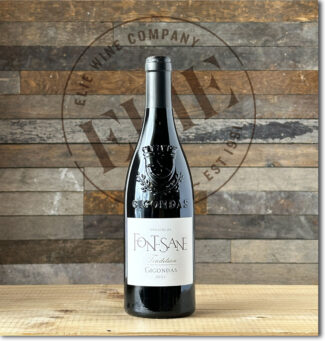 1. Domaine de Font-Sane ‘Tradition’, 2021 Gigondas ($25)
An exhuberant and youthful wine, full of fiery red fruit, savory complexity and fine-grained tannins. Three-quarters Grenache blended with around 25% Syrah and small amounts Mourvèdre and Cinsault, it’s big wine at 15% abv., but one which is quite well integrated and does not seem to need a lot of cellar time—drink to enjoy tonight.
Domaine des Pasquiers
“Provence is naturally a land of vine,” says Philippe Lambert, who along with his brother Jean-Claude and their children, Matthieu and Perrine, run des Pasquiers, founded by their grandfather in 1935. The sprawling estate, over 200 acres, stretches across multiple appellations including IGP Vaucluse, Côtes du Rhône, Côtes du Rhône Villages ‘Plan de Dieu’, Côtes du Rhône Villages ‘Sablet’ and Gigondas.
“Our situation is at the foot of the Dentelles de Montmirail,” Jean-Claude explains, “where terraces of red clay are covered by pebble stones which reflects the sun’s heat at night and keep coolness during day. The slopes of Sablet are gentle and the sandy soil and gravel brings finesse and mineral qualities to the wine. Finally, Gigondas, where the soil, combination of the Secondary to the Quaternary Periods, produces structured and unique terroirs for very complex wines.”
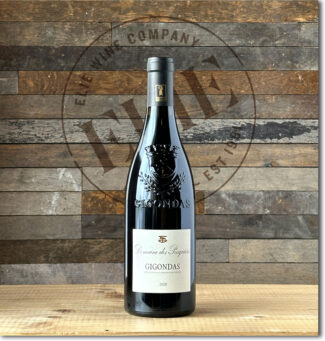 2. Domaine de des Pasquiers, 2020 Gigondas ($30)
50% Syrah and 50% Grenache, with a pure Provençal style replete with blackberries, sandalwood, garrigue and white pepper. Tannins are ripe and the acids striking, but both are beautifully integrated into the flesh of the wine and create a backbone that suits both early drinking and long-term cellaring.
Pierre Amadieu
Amadieu family roots have been digging into Gigondas soils for nearly a hundred years, but with each new generation comes a new focus.
For Pierre Amadieu Jr. it is paramount to improve wine quality every year: “We look for elegance, length on the palate and a ‘Burgundy’ freshness in our wines. A careful parcel selection allows us today to elaborate different cuvées of Gigondas which express each of our exceptional terroirs in its own way.”
The family affair includes three of his cousins: Henri-Claude, the eldest son of Claude and Muriel, who heads the sales department, his brother Jean-Marie—an agricultural engineer and oenologist, who works closely with Pierre in the winery, and their sister Marie who caters to their private customers. With production at over 50,000 cases annually, there is work enough to go around.
The Amadieu situation inspires a bit of eno-envy. It is located on north/northwest-facing hillsides in the north-east Gigondas where altitudes range from 750 and 1600 feet. With 338 acres surrounded by garrigue and holm oaks, Amadieu is the largest landowner in the appellation.
Strolling the vineyard, Claude Amadieu waxes philosophically on these beautiful acres: “Our exposure gives a perfect aeration to vines and avoids an excessive period of sunshine in full summer. It brings our wines freshness and allows long maturation without risking drought or bitterness. The expression of Grenache, Syrah, Mourvèdre, Cinsault (for rosé) and Clairette (for white wine) on these terroirs among the highest of the appellation, is very personalized—our wines are powerfully spiced.”
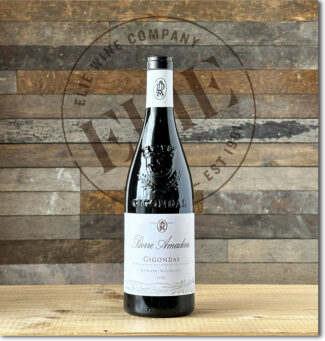 3. Pierre Amadieu ‘Romane Machotte’, 2021 Gigondas ($31)
80% Grenache, 20% Syrah from 45-year-old vines grown on hillside terroirs of limestone and marl. An expressive wine with blackberry, boysenberry and smoked plum notes laced with violet and white pepper on the nose while the palate shows dusty earth, sweet tobacco and charred mesquite.
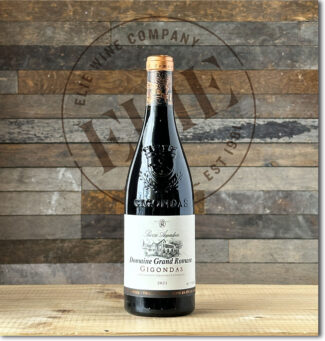 4. Domaine Grand Romane ‘Cuvée Prestige – Vieilles Vignes’, 2021 Gigondas ($36)
65% Grenache, 20% Mourvèdre, 15% Syrah. Domaine Grand Romane is a unique vineyard located on the highest part of Amadieu estate, 1600 feet above sea level, where the pebbly limestone terroir is poor and forces the vines to put down deep roots. Black fruits and cinnamon appear in the bouquet, and the silken mouthfeel is washed with generous creamy berries, pepper and vanilla with a long finish showing flavors of grilled meat.
Domaine Saint-Damien
With well over a hundred acres spread between Gigondas, Plan de Dieu, Côtes-du-Rhône Villages appellations, IGP and Vin de France, the terroir at Saint-Damien is varied. But in Gigondas, the focus is on plot specific sites, including the lieux-dits Gravas, Pigieres, La Louisiane, Les Souteyrades and La Moutte.
Joël Saurel, along with his wife Amie and winemaking son Romain, runs the estate in its modern incarnation, but the Saurel family had been tending vineyards her since 1821, selling to négociants. Joël began producing wine in 1996, and in 2012, the vineyards were certified by Agriculture Biologique.
Gigondas remains the flagship of the estate; Romain says of the family’s Gigondas acres: “Most of the vines are quite old and cropped low. The wines are aged in large, traditional concrete vats and old foudres and usually bottled on the young side to preserve freshness.”
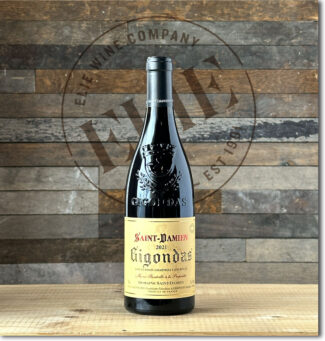 5. Domaine Saint-Damien ‘Vieilles Vignes’, 2021 Gigondas ($41)
80% Grenache planted in 1964, 20% Mourvèdre planted in 1977 in several lieux-dits located on the lower terraces of the Dentelles de Montmirail. The grapes are hand-harvested and fermented on skins in large concrete vats for five weeks before ageing another year in old foudres. The wine shows a touch of cedary oak on the nose alongside the black cherries and subtle garrigue notes ending in a gentle wash of dusty tannins and a hint of licorice.
Domaine des Florets
Jerome Boudier has owned the 20-acre Domaine des Florets since 2007—and he followed a circuitous path to get there. After advising CAC companies for 25 years on environmental protection and sustainable development, he wanted to launch a second career in direct contact with nature and make wine by integrating sustainable development concepts into the art of vinification.
He is almost zen in his approach: “In winemaking, as in all pursuits in life, there are no ready-made solutions. We must constantly seek the right balance and identify the necessary compromises to build a sustainable and benevolent model. My mission goes far beyond making good wine, but it must also be well-made wine that honors sacred nature.”
In the field, he puts this philosophy into practice by choosing an environment favorable to species beyond grape vines, developing the rich biodiversity inherent in terroir. He has nice spot with which to work—the top of the Dentelles de Montmirail at an altitude of 1650 feet, on steep terrain protected by high limestone rocks.
The same deep thinking attends Boudier in the cellar: “Throughout the winery, I strive to limit inputs and limit consumption as much as possible. Beyond the water and biodiversity aspects, a low-carbon and eco-responsible approach is favored from planting to packaging. We have a duty to help reduce greenhouse gas emissions through our practices and the carbon storage capacity of our soils.”
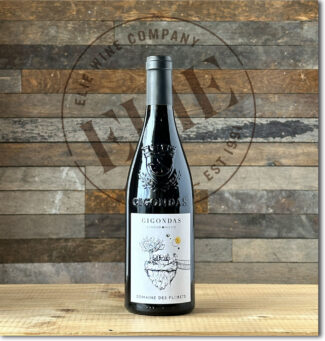 6. Domaine des Florets ‘Synchronicité’, 2020 Gigondas ($53)
From a mountaintop vineyard, the grapes (95% Grenache and 5% Syrah) undergo a gentle cold maceration, and a two-to-three-week long vatting punctuated by pigéage, following which the wine is aged for a year in oak. It shows crushed red fruit up front—strawberries, raspberries and pomegranate—and then with aeration, savory notes appear as subtle cocoa powder and pie spice.
Domaine Raspail-Ay
Aÿ is a name irrevocably linked to Champagne; remove the umlaut and the story becomes Gigondas. Domaine Raspail-Ay is run by single-minded producer Dominique Ay, whose portfolio is limited to a single bottling of Gigondas—no more than 6000 cases annually—and a handful of rosés, consistently rated among the most iconic wines of the region.
Ay’s are traditionally produced wines; classical blends given classical treatments in concrete vats and aged in large oak foudres. With the imposing rock formations of the Dentelles de Montmirail (the last outcrop of the mighty Alpine chain) looming as a backdrop, this estate represents the embodiment of the old adage, “If it ain’t broke, don’t fix it.”
His plantings are 70% Grenache, 20% Syrah and 10% Mourvèdre, all on the plain in front of the quaint village of Gigondas; old vines and limited yields are responsible for naturally high level of ripeness and concentration.
Ay describes the process after harvest: “We destem entirely and ferment in cement vats, filling each with a mix of the three varieties as they ripen during the harvest, keeping track of what parcels and varieties wind up in each vat with a small chalkboard on the wall. There’s a modest single pump-over per day, some pigéage before the vats settle on their own. The assemblage is done soon after malo, and the wine is then racked off into a range of large foudres and some demi-muids as well as a portion that remains in cement.”
In the last several years, as the domain achieves near cult-like status, Dominque’s son Christophe and daughter Anne-Sophie have joined him in the endeavor.
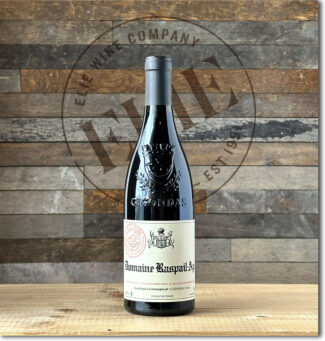 7. Domaine Raspail-Ay, 2020 Gigondas ($51)
The 2020 vintage produced many superlative wines, and this is one of them: 70% Grenache, 20% Syrah and 10% Mourvèdre, destemmed and aged in concrete vats, 600-liter oak casks and large, neutral foudres, it offers upfront notes black raspberry, kirsch, and garrigue mingled with exotic spices and subtle hints of violet.
Domaine de Cabasse
The three-star hotel at Domaine de Cabasse, housed within a traditional Provençal ‘mas,’ may garner more press, but the working winery’s 90 acres of vines (30 of which surround the hotel) produce world class Gigondas. The name Cabasse comes from the Italian ‘Casa Bassa,’ meaning ‘the house under the village’—a reference to the14th century when the pope used to live in Avignon.
In 1991, the Haeni family, originally from Switzerland, acquired the domain to focus on the vineyard, their true passion. It is currently run by the gregarious Benoît Baudry and his wife Anne.
Branching beyond Gigondas into Séguret and Sablet and Gigondas, the varietal selection covers the gamut of Southern Rhône standbys—Syrah, Grenache, Mourvèdre, Counoise, Carignan, Clairette along with a host white grape varieties, which Cabasse bottles as Côtes-du-Rhône Villages appellation. The plots are not overly large and are surrounded by hedges and trees that protect the vines from the cold mistral which can blow violently from the north. The soils are mainly composed of weathered limestone with varying clay, sand and stone.
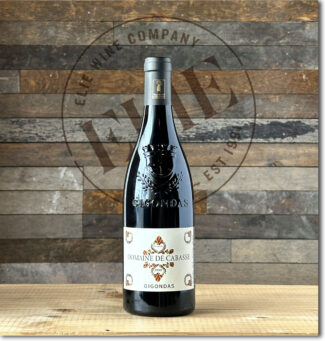 8. Domaine de Cabasse ‘Jucunditas’, 2020 Gigondas ($51)
A traditional blend of 80% Grenache, 10% Syrah, and 10% Mourvèdre; red cherry syrup and raspberry compote appear up front in both aroma and palate, with blackberry, plum, and pepper rounding out a long finish that whispers garrigue.
Domaine Les Pallières
Woven into the foothills of the brooding Dentelles de Montmirail, Les Pallières has been a force in Gigondas requiring reckoning since the fifteenth century. And up until the end of the last century, it was in the hands of the same family.
In 1998, Daniel and Frédéric Brunier of Vieux Télégraphe were convinced to take a shot at reviving Les Pallières from a couple decades of neglect, and the Pallières’ renaissance soon followed. The raw material was superb, with vineyards ranging from a few hundred feet to over one thousand in altitude, with varying proportions of sand and clay interwoven with limestone scree that has descended from the Dentelles. Among the improvements seen to immediately were reinforced terraces to allow for better water retention and a new winery building capable of receiving harvested parcels individually in gravity-fed tanks. The many lieux-dits, once blended into a single cuvée, have been separated into two in an effort to best express two remarkable personalities. Cuvée ‘Terrasse du Diable,’ encompasses the low-yielding vines from the higher altitudes while Cuvée ‘Les Racines’ highlights the vineyard parcels surrounding the winery—the origin of the domaine with the oldest vines—with the emphasis on freshness and extravagant cornucopian fruit.
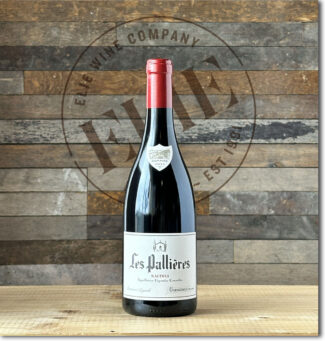 9. Domaine Les Pallières ‘Les Racines’, 2021 Gigondas ($58)
Les Racines is a parcel-selection of the oldest vines in the lieu-dit Les Pallières. 80% Grenache, 15% Syrah and Cinsault (co-planted) and 5% Clairette; the palate is high-toned and elegant, lush with black cherries, garrigue, olives and crushed stones.
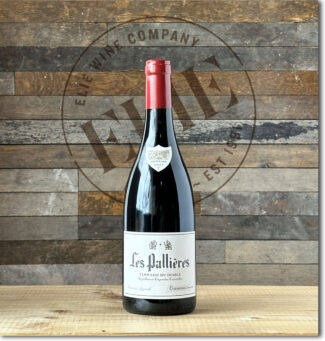 10. Domaine Les Pallières ‘Terrasse du Diable’, 2021 Gigondas ($53)
90% Grenache, 5% Mourvèdre, 5% Clairette from a 25-acre vineyard site of red sandy clay, limestone and scree—vines average 45-years-old. A very representative array of Provençal high-notes, plum, cherry and forest berries wreathed in black olive, licorice, mint, eucalyptus and rosemary.
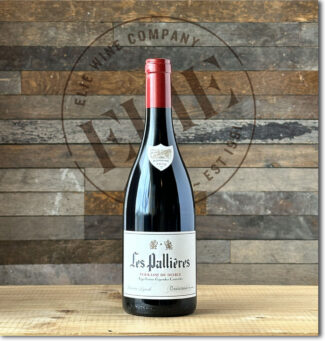 Domaine Les Pallières ‘Terrasse du Diable’, 2018 Gigondas ($58)
90% Grenache, 5% Mourvèdre, 5% Clairette. A blend of rustic elegance, with elements of smokey plum near the surface and chalky tannins beneath the surface.
Domaine Santa Duc
At Santa Duc, in the verdant environs of Gigondas, heritage is as deep as the iron-rich soils. Six generations have leapfrogged each other as caretakers of the storybook estate at the foot of the Dentelles de Montmirail hills and each has brought to the party a unique respect for terroir and tradition. Yves Gras, Domaine Santa Duc’s winemaker for 32 years, became a standard bearer for innovation with his elegant wines; he replaced barrels with 3600-liter casks to tone down the oak and championed a greater percentage of Mourvèdre used in cuvées. His ongoing quest for cooler terroirs capable of producing great wines ultimately took him from the plateau of Gigondas to Châteauneuf-du-Pape (10 miles to the southwest), where he was able to purchase several choice parcels.
With the 2017 vintage, Yves’ son Benjamin Gras took over the domain and quickly proved himself to be as much a visionary as his father, switching immediately to biodynamic agriculture and building a state-of-the-art winemaking facility on the property. Benjamin has the passion, the Gras DNA, but also the educational pedigree to buoy his future: After obtaining a diploma in oenology at the University of Bourgogne in Dijon, he spent time at Domaine de la Romanée-Conti and Bodega Vega-Sicilia, and the OIV MSc in Wine Management program gave him the unprecedented opportunity to visit more than two dozen wine producing countries and study their techniques, their terroirs, and their traditions.
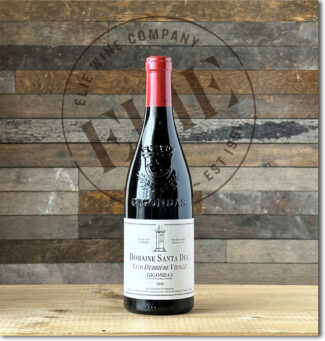 Domaine Santa Duc ‘Clos Derrière Vieille’, 2018 Gigondas ($57)
An iron butterfly, with both weight and lyrical lightness from the limestone-rich clos behind the village of Gigondas; 80% Grenache and 10% each Mourvèdre and Syrah, the wine is resinous with orange peel, pomegranate and raspberry. smoked garrigue, fresh thyme and lavender.
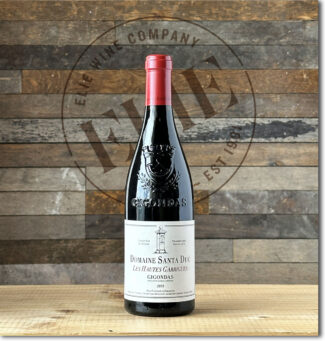 Domaine Santa Duc ‘Les Hautes Garrigues’, 2018 Gigondas ($73)
50% Grenache, 50% Mourvèdre—this is Santa Duc’s flagship, a biodynamic gem sourced from 75-year-old vines planted on the sandy soils of the Les Hautes Garrigues lieu dit. It offers a brilliant bouquet of ripe wild strawberries, dried plums, blueberries, ground pepper, garrigue and sweet leather with a long, mineral-driven finish.
The Pinnacle
Domaine des Bosquets
“Since Julien Brechet took control of his family’s 64-acre estate in 2006, Domaine des Bosquets has been moving steadily up the Gigondas hierarchy, and in 2016 they produced not only some of the best wines of the appellation but of the entire southern Rhône.”
That song of praise, well-deserved, is from Antonio Galloni’s widely read ‘Vinous’ and reflects the spirit of the Domaine des Bosquets estate. Prior to taking over, Julien Brechet apprenticed at Château de Vaudieu under Philippe Cambie, and at Bosquets, he begun to map out his terroirs through careful studies and micro-vinifications. Rather than rob his Villages-level Gigondas of its best parts, his parcel wines are only made in limited quantities. Among the lieux-dits Julien farms are Jasio, La Colline, Le Plateau, Les Bosquets, Roche, Les Routes, and Les Blânches, where the planting principal grape variety is Grenache (70%), with 20% Syrah, 8% Mourvèdre, and 2% Cinsault with tiny percentages of other permitted varieties, both red and white.
His estate is now certified organic, a process he started in 2015, and he’s begun implementing biodynamically practices. Cover crops are encouraged and are plowed under to provide nutrients to the soils and ensure the vines penetrate deep into the subsoil. The average age of his vines is 50 years, and the soils range from sand to various gravels and types of clay – some with high levels of chalk. Average yields are 23 hl/ha for vines destined for the village Gigondas, while it drops down to as low as 15 hl/ha for some of the parcel wines. Harvests are manual to ensure a strict selection of fruit, and fermentations are now entirely with indigenous yeasts.
With these farming changes, Julien has noticed better stem maturation at harvest and uses up to 30% whole clusters. His Gigondas wines are aged for two winters in French oak barrels ranging in size from 228 liter to 2300 liter. He prefers seasoned barrels to new and ages his parcel wines entirely in neutral French oak.
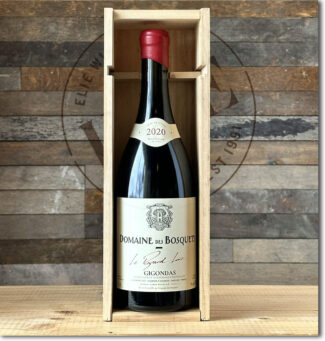 Domaine des Bosquets ‘Le Regard Loin’, 2020 Gigondas ($288)
The culmination of Julien Brechet process of strict selection and micro-cuvée blending fruit from La Colline, Le Plateau, Les Routes, and Les Roches lieux-dits. 70% Grenache with 20% Syrah, 8% Mourvèdre and 2% Cinsault with tiny percentages of other permitted varieties, both red and white, the wine spends 12 months in second-fill oak barrels before blending, then another 12 months in sandstone amphorae before bottling. A nice mix of black raspberries, blueberries, licorice, and herbes de Provence.
RECENT ARRIVAL
Cru ‘Cairanne’: The Birth Of A New Cru In Southern Rhône
Cairanne picked up Cru status in 2016, and with the stroke of that bureaucratic pen, no longer had to label itself a Côtes du Rhône Villages. Found east of Orange, the soils of Cairanne are predominantly built of alluvial limestone from several local rivers and streams; red, iron-rich earth over sandstone bedrock is also found throughout the appellation. Topography ranges from the glacial plateau to the south of the town to the slopes of the Dentelles de Montmirail foothills to the north and west.
“This new appellation status was only made possible thanks to the passion, determination and high expectations of a bunch of local enthusiasts,” says Denis Alary, president of the local winegrowers syndicate, told Wine Spectator. “No decision could better illustrate Côtes du Rhône-Villages dynamism.”
Cairanne is often called ‘the gateway to the Southern Rhône’, combining the typically northern Syrah grape with the much heat-loving Grenache and Mourvèdre. The Mediterranean is dry with plenty of sunshine, and most importantly, vineyard health is heavily influenced by the Mistral wind.
Domaine Alary
Cru Cairanne
Denis Alary of Domaine Alary considers himself a perfectionist as well as a grand idealist; his seventy acres of vineyard, entirely in Cairanne, is where he goes to relieve the stress that accompanies the loftiness of his ambitions …
“Alone,” he says: “Without a cell phone.”
As he took over the estate from his father Daniel, the oenologist is now passing responsibility to his son Jean-Étienne who brings an international reputation to this dry, dusty corner of France, having vinified at New Zealand’s Seresin, Australia’s Henschke and in France at Confuron-Cotetidot in Burgundy.
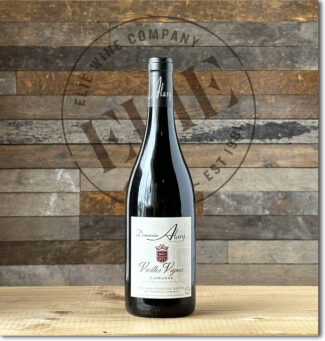 Domaine Alary ‘Vieilles Vignes’, 2020 Cairanne ($23)
From old vines grown on the terraces of the Dentelles de Montmirail; grapes are hand-harvested separately, sorted and a separate vinification of each different grape variety is made. Bottled without fining, the wine shows profusion of black fruit flavors and soft spices on the nose and a rich full-bodied palate sustained by a mineral touch.
A Rhône With Substance, But No Pretense: Buy A Dozen For $159
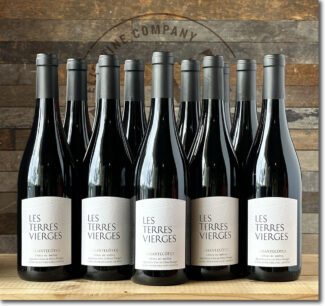 Cave de Cairanne Chantecôtes ‘Les Terres Vierges’, 2019 Côtes du Rhône (A Dozen for $159)
First, the difference between a ‘cave’ and a ‘domaine’: Created in 1929, the Vaucluse-based Cave de Cairanne is a collective of 65 winemakers who work over 1300 acres of vines in the Côtes du Rhône, Côtes du Rhône Villages, Villages Plan de Dieu, Cru Cairanne and Cru Rasteau. Chantecôtes is located in Sainte Cécile Les Vignes; the wine is 50% Grenache, 40% Mourvèdre, 10% Syrah showing macerated raspberries, a round and racy palate filled with spice and smoke.
Southern Rhône Vintage Journal
2021 – Classic and Fresh
After six blessed harvests in a row, 2021 brought earth back to earth: Temperatures were unpredictable throughout the growing season, without heat spikes, and random thunderstorms later in July served to test vignerons, including a torrential downpour in mid-September right at harvest-time. Early-budders like Syrah, having been jeopardized by spring frost and the late-ripening grapes also found themselves under threat. Despite this, Mourvèdre, Cinsault, and Carignan fared well, while the quality of Grenache was mixed, some of it (almost unaccountably) particularly good. The best of 2021 wines focus on red rather than black fruit, on lean but elegant tannins rather than any attempts to overcompensate with an ambitious extraction regime or indulgent use of oak.
2020 – Silky and Tender
Fingers were crossed after a brief frost followed an early bud-break, but damage was light; flowering began in mid-May, two weeks earlier than 2019. Amenable conditions continued with hot weather from June, July and August, with the Mistral causing a bit of early damage, but ultimately breathed freshness over the vines all summer. A period of drought culminated in temperatures that peaked at 107°F on August 1. As might be expected, harvest came early, and overall, 2020 will be remembered as one of Southern Rhône’s finest. Sophie Armenier of Domaine de Marcoux (Châteauneuf-du-Pape) comments, “The maturity, the degrees of ripeness, the quantity and the sunshine—everything just came together!”
2019 – Rich and Balanced
Southern Rhône kept a nervous eye on heavy winter rains but in spring, precipitation remained at normal levels. The Mistral, which had been disquietingly calm in ’18, blew strongly in January and February, drying the leaves and removing concerns about mildew. Pleasant weather graced both March and April, the Mistral came back with a vengeance at the beginning of May, resulting in a few damaged leaves but otherwise aerating the vineyards and keeping the vines healthy. An even flowering in late May followed by a successful fruit set in June suggested, much to the growers’ relief, a vintage where yields would be normal. Then came the heatwave, with temperatures as high as 111°F in June, without much nighttime respite. With the lack of rain, this might have proved disastrous but for the high winter rainfall which had filled underground water reserves.
2019 is considered a heat-wave vintage in the Southern Rhône. Those who managed the vines correctly during the excess temperatures of the summer made superlative wines since the hot and dry conditions resulted in small berries with intensity and—crucially—freshness, thanks to the concentration of the grapes’ natural acidity. Growers who worked organically and biodynamically did especially well in ’19, as their vines are so well adapted to manage nature’s whims.
2018 – Supple and Perfumed
2018—largely remarkable throughout France—was hit and miss in Southern Rhône. Although the winter and spring were wet and mild and further rainfall in June caused difficulties with mildew throughout Southern Rhône. Producers sprayed, but a large amount of the crop was still lost, and Grenache, the south’s mainstay grape, is particularly prone to rot and the result was devastating. Winemakers who typically used Grenache as a dominant component of their blends had to shift the focus onto others, chiefly Mourvèdre. Eventually, the damp weather dried up and a hot, dry summer took its place, and by the time it came to harvest, temperatures were high and producers had to work quickly when managing the grapes.
The wines tended to be more densely concentrated than typical with strong fruit flavors and structure. The reds of Châteauneuf-du-Pape, Vacqueyras and Gigondas were especially good. The whites suffered slightly from low acidity but still had good fruit character and are generally best suited for early drinking.
- - -
Posted on 2024.03.05 in Gigondas, Cairanne, Côtes-du-Rhône, France, Wine-Aid Packages, Southern Rhone | Read more...
Champagne Haute Couture: Jean-François Clouet, An Outstanding Practitioner of Pinotism, Stitches Together Bouzy’s Finest Parcels into Grand Expressions
In any assemblage, individual grape varieties will find their niche; each performs according to its purpose and potential, whether it is power, perfume or polish. In Champagne, the Big Three—Chardonnay, Pinot Noir and Meunier—jockey for position in the hearts of Chefs de Cave, and although quality depends on location, the ability to eke out or find these locations is an indispensable tool in the belt of vignerons and the pinnacle of Champagne as an artform.
Jean-François Clouet, who was not only born and raised in Bouzy, but still lives in the 18th century village house built by his ancestors, is an example of this ideology at its finest. He says, “The vineyards are like beautiful fabrics, each one contributing textures and colors that once assembled, are transformed into a designer gown. Successfully pieced together, it is Haute Couture.”
The following wine selection represents Clouet’s slice of Champagne, a cellar where Pinot Noir rules but does not monopolize; it is terroir with the standing and privilege of its winemaker, and when it comes to Pinot-based Champagnes, an Eden for expression.
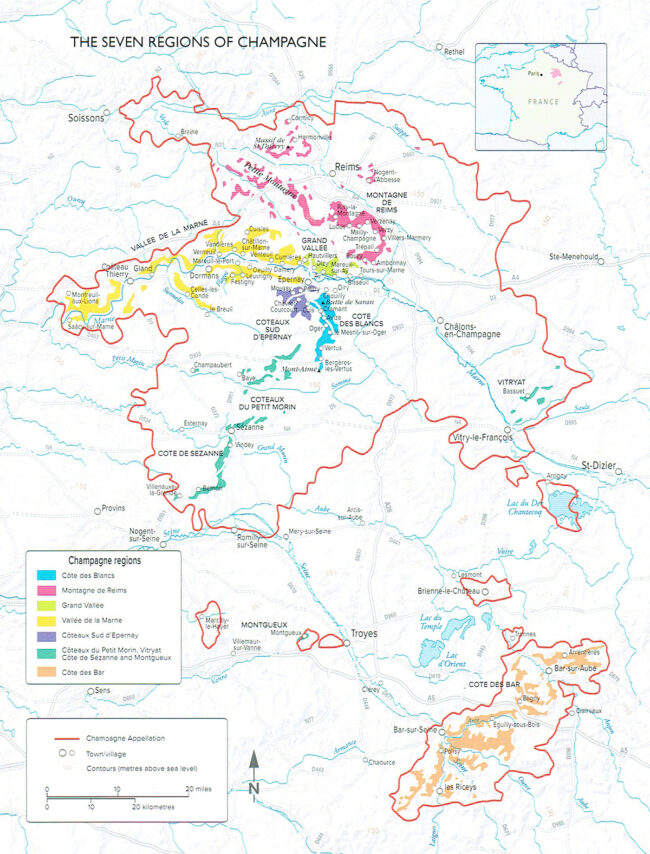
The Montagne de Reims: Pinot Noir Country
Located between Reims and Épernay, the Montagne de Reims is a relatively low-lying (under a thousand feet in elevation) plateau, mostly draped in thick forest. Vines find a suitable home on the flanks, forming a horseshoe that opens to the west.
So varied are the soils, topography and microclimates here that it is not possible to speak of the region in any unified sense. Grande Montagne de Reims, which contains all of the region’s Grand Cru vineyards, covers the northern, eastern and southern slopes of the viticultural area, and Pinot Noir plantings dominate at 57%, followed by Chardonnay (30%) and Meunier (13%). Its vineyards face a multitude of directions, and soil type varies by village, giving rise to a breadth of Pinot Noir expressions, as well as exceptional Chardonnay.
To the west, the Grande Montagne de Reims gives way to the Petite, whose bedrock is chalk, but softer than the chalk found further south on the Côte des Blancs. This sort, called ‘tuffeau’, is an extremely porous, sand-rich, calcium carbonate rock similar to what is found in wine regions of the middle Loire Valley.
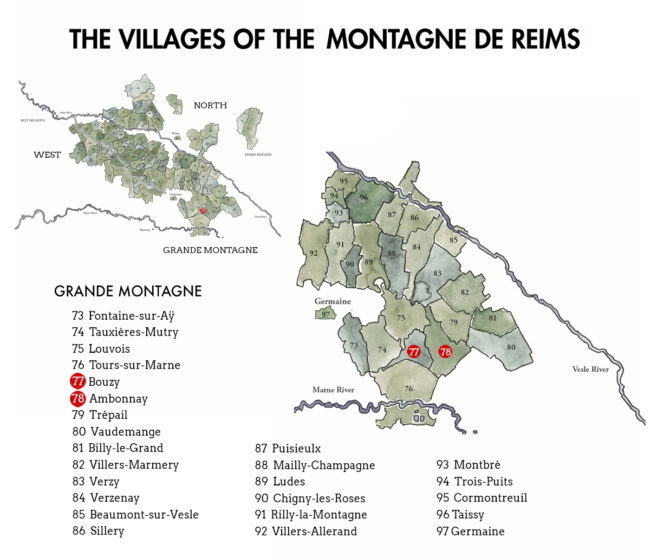
Grand Cru Bouzy: The Epicenter Of Pinot Noir
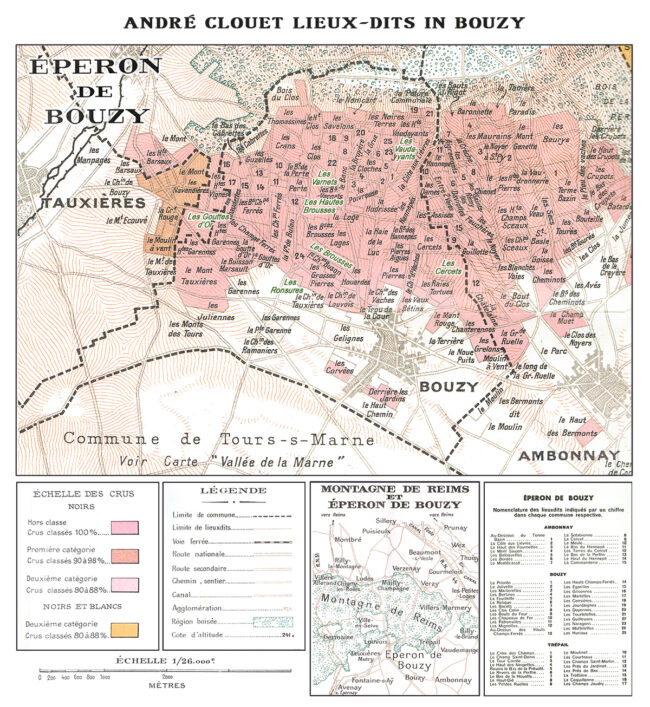
A village known for its alcohol production named Bouzy? Almost as perfect as its situation on the south-facing side of the Grande Montagne de Reims. This exposure is ideal for ripening Pinot Noir, as its sister village Ambonnay—less than half a mile away—can also attest. Chalky soils provide stimulating freshness as well as housing the deep, cool cellars essential to aging Champagne.
Bouzy has more vineyard acres than citizens (924 to 850) and 87% of the former are Pinot Noir. On the now-defunct ‘échelles des crus’, Bouzy was rated 100%, which make it a Grand Cru village. In recent years, more emphasis has been placed on individual named-sites, either vineyards or portions of vineyards; each lieu-dit is said to possess its own personality which may be exhibited as such, or blended with the others to highlight specific qualities.
The Rare And Demanding Blancs de Noirs
All Champagne is food wine, but not many are ‘gastronomical.’ Meaning, of course, that the ethereal qualities of effervescence, along with high levels of acidity and a small amount of sugar, complement elements in almost any food, from simple poached salmon to red-hot Thai. But few Champagnes are powerful enough in aroma and palate potency to assert themselves as equals in complexity to gourmet dishes.
Many Champagnes are simply about the bubbles; in Blanc de Noir, we see the true emergence of Champagnes that are about great wines that happen to have bubbles.
Blanc de Noirs is made from Pinot Noir, Meunier, or both. The former brings bouquet and body; the latter, supple fruit and roundness. Both grapes, of course, have white flesh and are generally used to make white wine. With Blanc de Noir, a period of maceration on the skins allows the juice to soak up color, and with it, some of the character we associate with Burgundian Pinot Noir—especially, the ability to mirror qualities found in the particular soil in which it grows.
Upon release, a well-made Blanc de Noir is characterized by mouthfeel—a rich and structured texture—but perhaps even more so, powerful aromatics reminiscent of stone fruits, spices, honey, mocha, smoked wood and even a touch of leather. With vintage Blanc de Noir, allowed cellar time, tertiary notes emerge—coffee, cocoa, dried cherry and more mature yeast flavors of brioche and toast.
Champagne André Clouet
Haute Couture Viticulture
In the imagination of most casual drinkers, Champagne is typified by the Grandes Marques, and especially, the Cuvée Prestige bottles. 24 names have enjoyed a marketing monopoly for many decades; brand loyalty, as in all commodities, is built on reputation and unyielding allegiance.
Somewhat less prominent are Champagne’s grower-producers; farmers who make wine. And compared to the Les Grandes Marques (Billecart-Salmon, Bollinger, Krug, et al), Champagne André Clouet has been around longer.
The Clouet family traces its Bouzy roots to 1492 and at one time was the official printmakers for the court of King Louis XV; the classically pretty labels that grace their Champagne bottles today pay homage to their aesthetic history. Clouet grapes are sourced exclusively from 20 acres of coveted mid-slope vineyards in the Grand Cru villages of Bouzy and Ambonnay.
Jean-François Clouet
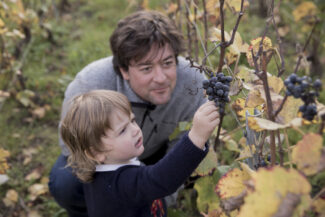
Born and raised in Bouzy, Jean-François Clouet still lives in his family’s 18th century home; with inimitable wit, he refers to himself as ‘a combination of winemaker and circus ringmaster.’ In fact, the French refer to him as ‘Chef de Cave’—the cellar master. He is arguably the region’s most qualified historian and insists that, without acknowledging the role that the past has played on his winemaking decisions, you can’t truly appreciate his wines.
“To understand Champagne as a whole you need to understand its political history,” he says. “Attila the Hun, the Crusaders, the Templars and Marie Antoinette have all walked here; the birth of the monarchy and the Battle of the Cathalunian Fields took place nearby. In 1911, my great grandfather designed the label that graces our bottles today; I like the idea of the work of human hands in pruning, performing the same actions as my grandfather and even the Romans, who planted vines here 2000 years ago.”
 Champagne André Clouet ‘Silver’, Grand Cru Bouzy Brut Nature ($51)
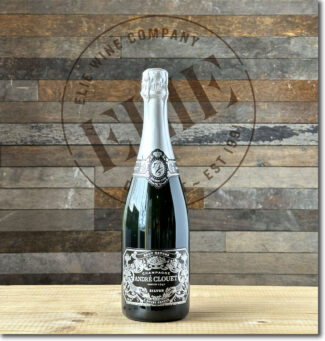
Clouet’s ‘Silver Label’ Champagne is made entirely with Pinot Noir from the Grand Cru village of Bouzy, mostly from the 2010 vintage (so that it has a lot of age and complexity to it already). While this cuvée has no dosage, it was aged in a former Sauternes barrel and bottle-aged for longer than the standard, resulting in additional richness. The wine displays notes of brioche and cream with buttered pastry, citrus, and a lightly oxidized apple note.
*click photo for more info
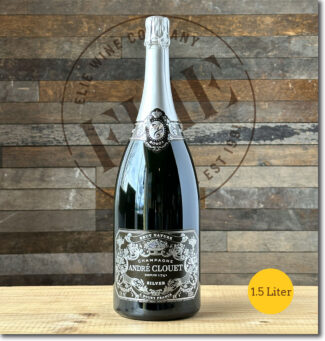 Champagne André Clouet ‘Silver’, Grand Cru Bouzy Brut Nature ($99) 1.5 Liter
A little bit of sugar is unnecessary to help this medicine go down, but a smaller ratio of cork to vino is definitely beneficial. The magnum version of the Silver Label.
*click photo for more info
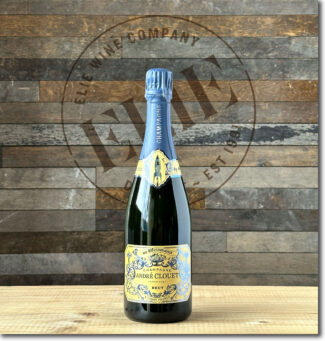 Champagne André Clouet ‘The V6 Experience’, Grand Cru Bouzy Brut ($58)
According to Jean-François Clouet, “Pinot Noir does not mature directly, in linear fashion. Upon reaching its sixth year, it passes into a phase known as ‘The Whirlwind.’ Propelled by an unseen force it reaches outward, taking on another dimension. The wine becomes charged with energy and vibrations.”
V6—with a rocket on the label—refers to this mysterious sixth year; the wine is a blend of 80% Pinot Noir aged between 72 and 90 months on the less and 20% Pinot from the solera. It is dosed at 5 gram per liter, based on a liqueur of barrel-aged Chardonnay and refined sugar.
*click photo for more info
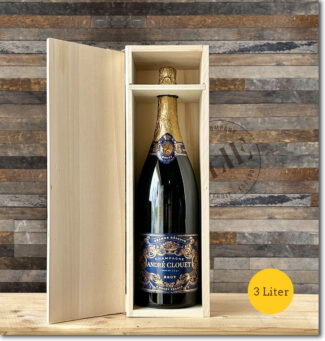 Champagne André Clouet ‘Grand Réserve’, Grand Cru Bouzy Brut ($370) 3 Liter
100% Pinot Noir from Bouzy. There’s nothing poetic about the term ‘3 liter’, but in Champagne parlance, this is a Jeroboam. It shows fresh, fine aromatics of apricot and yeast with a fruit-intense palate and a chalky-minerality and salty finesse on the finish with a nice jolt of lemony acidity.
*click photo for more info
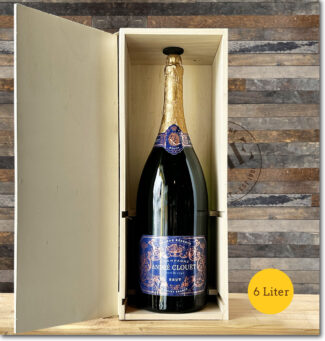 Champagne André Clouet ‘Grand Réserve’, Grand Cru Bouzy Brut ($650) 6 Liter
Who’s your daddy? 6 liter is a Methuselah—not the largest bottling format made in Champagne, but the biggest that mere mortals are likely to encounter.
*click photo for more info
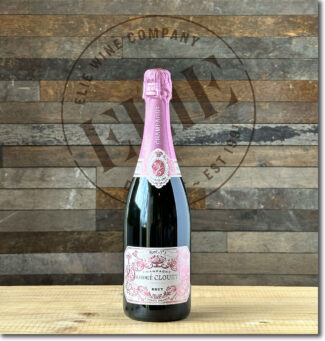 Champagne Andre Clouet ‘No 3’, Grand Cru Bouzy Rosé Brut ($58)
92% Pinot Noir, 8% vin rouge from Bouzy; the ‘3’ represents the style of the wine on an odd Clouet scale (inspired by Coco Chanel) where 1 is the lightest wine and 10, the richest. Driven by the chalky minerality of the terroir, the wine offers seductive notes of wild strawberry, raspberry, pomegranate, cherry blossoms, fresh red and pink flowers, crushed chalk, and orange zest.
*click photo for more info
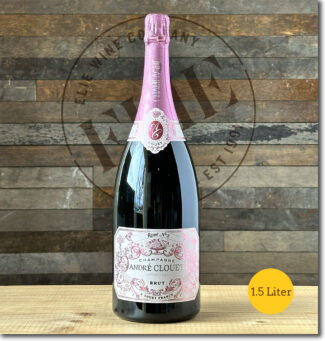 Champagne Andre Clouet ‘No 3’, Grand Cru Bouzy Rosé Brut ($110) 1.5 Liter
The magnum format of the above.
*click photo for more info
Champagne d’Auteur: Deeply Rooted, Daringly Innovative
It’s an interesting perspective: Terroir, not only as a sense of place, but as a sense of self. But of all the various elements that combine to make a wonderful bottle of wine—soil and sunshine, rain and rootstock—perhaps the most significant touch is the human one. Give two winemakers identical grapes, and they will make two different wines.
Says Jean-François Clouet, “A signature wine is one which expresses the philosophy or personality of a winemaker working in conditions of freedom and creativity. When surrounded by high quality fruit, and when dedicated to small volume production, the hand of the winemaker will be very present. Such a professional is free to play according to his own criteria, pampering the wine and trying methods that is, in many cases, outside the rules and production guidelines.”
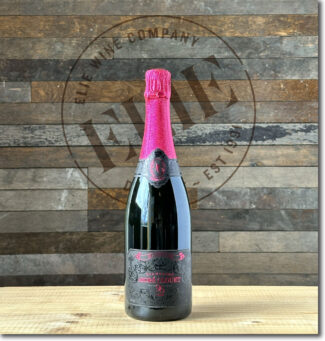 Champagne Andre Clouet ‘Spiritum 96’, Grand Cru Bouzy Rosé Brut ($81)
“Rosés are usually enjoyed while they are still young and fresh,” says Jean-François Clouet. “But I was looking for that complexity and fullness that exceptional wines acquire only after a very long maturation. I didn’t want to offer a rosé that had merely aged well; I wanted to combine the freshness and youth of a rosé wine with the essence of a great vintage. The key element in accomplishing this feat was going to be the liqueur!”
That goal led Clouet to use a concentration half that of a classic liqueur, giving the wine a final proportion of 88% Grand Cru Pinot Noir, 9% Rouge de Bouzy 2018 and around 3% Liqueur de Millésimé 1996.
*click photo for more info
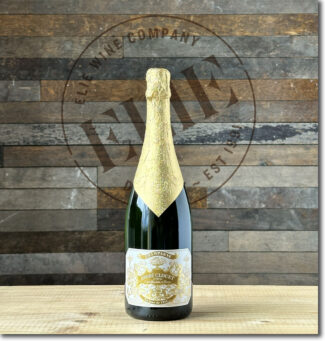 Champagne André Clouet ‘Cuvée 1911’, Grand Cru Bouzy Brut ($81)
At dosage of 0.5 grams per liter, 50% of the wine was fermented in stainless steel tanks and 50% in Sauternes barrels. 50% perpetual reserve with an assemblage that also includes four vintages: all of which are made from Grand Cru Bouzy estate-grown fruit. The wine is delicately perfumed with sweet rose petal and jasmine and framed in austere minerality and balanced autolytic notes. Despite the relatively recent disgorgement, the mousse presents itself as extraordinarily elegant.
*click photo for more info
Le Clos: Jewel In The Crown, Single Vineyard
A walled garden is of itself a place of mystery and promise; add Jean-François Clouet’s secret ‘Bouzy Black Powder’, a substance he claims is found within the enclosed vineyard that hosts “our most beautiful genetic combinations of Pinot Noir” and you have a real storyline. The northwest-facing Clos contains chalky subsoil in thick layer, with soil amendments that are entirely organic, but the magical properties of the black powder were known only to the Druids, and after much experimentation, himself.
What can be said without needling the fact-checkers is this: There are only four Grand Cru Clos in all of Champagne, and Clouet’s ‘Le Clos’ is among the best.
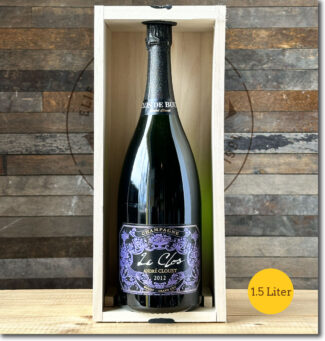 Champagne André Clouet ‘Le Clos’, 2012 Grand Cru Bouzy Brut ($320) 1.5 Liter
2012 is widely acknowledged as one of Champagne’s greatest vintages in decades, the result of a relatively warm winter moved into an extremely wet spring where both frost and a vicious hailstorm devastated yields. This cost growers, but benefitting drinkers as the reduced yields resulted in concentrated grapes that produced wines with great depth, complexity and aromatics along with balanced acidity.
This wine is only released in magnum format; the wine is aged in the Sauternes barriques of Château Doisy Daëne. The nose shows peach and almond evolving into a mineral finish quite reflective of the chalk terroir.
*click photo for more info
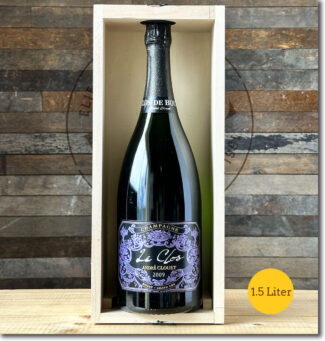 Champagne André Clouet ‘Le Clos’, 2009 Grand Cru Bouzy Brut ($380) 1.5 Liter
Vintage 2009: An exceptionally good vintage preceded by a dry winter that left the soils eagerly awaiting the spring rain, which came at an opportune time to ensure a successful budburst and flowering. After a stormy July, August delivered warm sunny days and cool, refreshing evenings as well as intense, dry heat that helped prevent rot and disease from taking hold. The resulting Champagnes tend to display rich, ripe orchard fruit reflecting the warm year and although acidity was far from searing, it was still very much present.
Bottled exclusively in magnums, the wine shows complex and dense scents of apple and cherry with a nice oxidative touch; chalk and discreet oak and mushroom aromas waft from the glass.
*click photo for more info
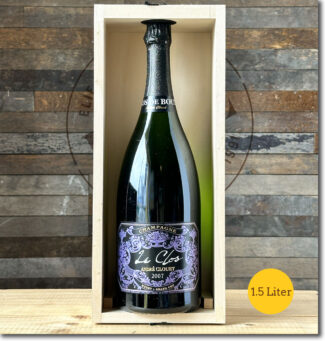 Champagne André Clouet ‘Le Clos’, 2007 Grand Cru Bouzy Brut ($320) 1.5 Liter
Vintage 2007: An unseasonably mild winter was followed by a sweltering April, prompting both early budburst and flowering. Then the rains began, signaling the beginning of an unusually cool and damp summer in which fighting rot and disease was an uphill battle. August finally brought warm weather and cleansing breezes which helped dry out the grapes, but harvest still came early, the result of the spring heatwave. Careful sorting was de rigeur, both in the field and in the cellar, and with due diligence the best producers were able to create wines of some merit.
‘Le Clos’, 2007 is one such wine. Post-harvest, the vin clair was fermented in stainless steel and selected barrels, with malolactic fermentations occurring there in these vessels respectively. En magnum.
*click photo for more info
The Magnum Effect
A magnum contains 1.5 liters of wine; a quantitative fact. Less understood is why Champagne producers consider this the ideal format for the vintage wines that connoisseurs intend to cellar for the long haul.
The reasons are several fold: First, since magnums hold twice as much as a standard 750 ml bottle but have the same ‘ullage’, or the space between the bottom of the cork and the wine’s surface, the wine’s exposure to oxygen is reduced in proportion. On a molecular level, this exchange of air and wine is key to the maturation process, generally leading to more complex flavors. The additional volume in a magnum also means that the wine is less sensitive to temperature fluctuations.
Autolysis is another chemical process in traditional sparkling wine production whereby yeast used for second fermentation in bottle breaks down and imparts flavor to the wine, especially the brioche/biscuit notes. In a magnum, the process is measurably slower since they have proportionally more glass surface than standard bottles, so there is more contact between lees on the inside of the bottle and the wine. This slows autolysis while greater contact with the yeast generates more roundness and greater complexity.
Millésimé Champagne: The Signature Of A Year
‘Millésimé’ refers to the process of harvesting, producing and bottling the grapes of a given year—a bit of information virtually always indicated on the label and the cork. Unlike terroir, which remains the same from year to year, Millésimé declarations are the result of exceptional weather in that site; a season in which the grapes achieve the perfect balance between two essential parameters, sugar and acidity.
It is a phenomenon that makes each Millésimé a special and rare Cuvée.
A vintage year is declared by the producer alone, and the well-known Comité Interprofessionnel du vin de Champagne cannot intervene. To reach this conclusion, the winemaker must recognize truly sublime characteristics in the vintage, meaning that the personality and aromatic intensity of the wines are such that they deserve special recognition. Additionally, since Millésimé Champagnes age for three to 10 years or more in the cellar before being marketed, it must be made from grapes with an ideal acid-sugar balance.
Interesting to note that Millésimé Champagnes may be declared in different years depending on the grape variety—an exceptional year for Chardonnay will not necessarily be so for Pinot Noir or Meunier, and vice versa.
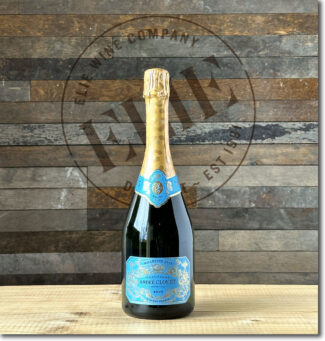 Champagne André Clouet ‘Léopard’, Millésimé 2015 Grand Cru Bouzy Brut ($63)
A leopard can’t change its spots, but a Chef de Cave can change his Assemblage. This blend is 80% Pinot Noir and 20% Chardonnay—the Champagne ages and then ferments in Sauternes barrels. The grapes are sourced from 100% Grand Cru vineyards in Bouzy, and from clay-calcareous parcels that face south and south-east to make the most of the sun and to ensure that the grape ripening is total and balanced. The Pinot Noir is intended to provide body and volume on the palate while the Chardonnay offers chalky length. At 5 grams per liter dosage, the wine promises a minimum of 20 years improvement in the bottle.
*click photo for more info
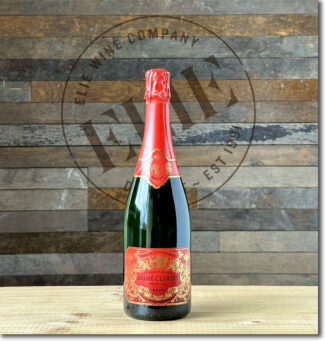 Champagne André Clouet ‘Dream’, Millésimé 2015 Grand Crus ‘Bouzy & Le Mesnil-sur-Oger’ Brut ($63)
Founded in 1937, so remarkable is the terroir of Le Mesnil that 100% of its vineyards are ranked Grand Cru. It is situated at the heart of the prestigious Côte des Blancs, so-called (in part) because of the omnipresence of superb Chardonnay. East-facing slopes dominate the village, but vary from steeper inclinations close to the forest on top of the Côte des Blancs hill to almost flat land below the village.
The Chardonnay grapes are sourced as a grower swap for Pinot Noir, and the union of Le Mesnil-sur-Oger and Bouzy Chardonnay works to delightful effect. The tension and minerality of Le Mesnil is bolstered by the body and richness of Bouzy. Layered with spice, grapefruit and white peach.
*click photo for more info
The Vintage 2015: Champagne Is Heating Up
The 2015 vintage in Champagne has been referred to as ‘glittering.’ It was, for starters, the hottest vintage ever recorded in the region, and the extreme heat prevented the development of disease and rot; a few producers commented that these unusual circumstances meant their wines ended up adhering to organic standards purely through circumstance rather than intent. The intense heat ran from June through to August, with the end of August seeing a touch of relieving rain along with cooler nights. Along with being the hottest growing season on record, it was also one of the shortest: Harvest began late August and continued into early September.
Coteaux-Champenois Bouzy Grand Cru: Still Champagne
Covering the same territory as Champagne, Coteaux Champenois may be the wine world’s most celebrated oxymoron: Flat Champagne. By ‘flat’, of course, we are not talking about the week-old Chandon’s Brut in the back of the fridge or the after-effects of shaking a bottle of Cristal after winning the Grand Prix, but the intentional act of releasing a still wine from the same terroir that would otherwise undergo the extraordinary process used to create Champagne.
Spread across 319 communes, Coteaux Champenois producers are entitled to use seven varieties, alone or in tandem, including the Champagne staples Chardonnay, Pinot Noir and Meunier along with Arbane, Petit Meslier and the Pinot derivatives, Pinot Blanc and Pinot Gris. In general, all these grapes thrive at region’s latitude (48 – 49° North) although like their sparkling counterparts, Coteaux Champenois wines tend to be dry and light-bodied with naturally high acidity. The reds are much better in the warmer vintages of recent years, as the predominant variety, Pinot Noir, is able to ripen more consistently.
 Domaine André Clouet ‘Versailles Diamant’, 2015 Coteaux-Champenois Grand Cru Bouzy Blanc ($108)
Tyson Stelzer (Wine Spectator, Decanter, Vinous) refers to Diamant as ‘the best Coteaux Champenois I have tasted to date.’ Sourced from the Grand Cru vineyards of Bouzy and Ambonnay, the 100% Chardonnay wine spends 20 months in Vicard barrels. Beautifully textured, the wine shows green apple, lemon, tropical fruit, pineapple, dried flowers with a persistent lemon and lime finish.
*click photo for more info
 Domaine André Clouet ‘Versailles Rubis’, 2015 Coteaux-Champenois Grand Cru Bouzy Rouge ($108)
Produced from pure Pinot Noir sourced from Grand Cru vineyards in the heart of the Montagne de Reims, the varieties undisputed home. Like the Blanc, the Rouge is aged for 20 months in Vicard barrels—one of the finest coopers in the region. The wine shows tart cherry behind silky tannins a clear and pronounced minerality on the palate.
*click photo for more info
Notebook …
Drawing The Boundaries of The Champagne Region
To be Champagne is to be an aristocrat. Your origins may be humble and your feet may be in the dirt; your hands are scarred from pruning and your back aches from moving barrels. But your head is always in the stars.
As such, the struggle to preserve its identity has been at the heart of Champagne’s self-confidence. Although the Champagne controlled designation of origin (AOC) wasn’t recognized until 1936, defense of the designation by its producers goes back much further. Since the first bubble burst in the first glass of sparkling wine in Hautvillers Abbey, producers in Champagne have maintained that their terroirs are unique to the region and any other wine that bears the name is a pretender to their effervescent throne.
Having been defined and delimited by laws passed in 1927, the geography of Champagne is easily explained in a paragraph, but it takes a lifetime to understand it.
Ninety-three miles east of Paris, Champagne’s production zone spreads across 319 villages and encompasses roughly 85,000 acres. 17 of those villages have a legal entitlement to Grand Cru ranking, while 42 may label their bottles ‘Premier Cru.’ Four main growing areas (Montagne de Reims, Vallée de la Marne, the Côte des Blancs and the Côte des Bar) encompass nearly 280,000 individual plots of vines, each measuring a little over one thousand square feet.
The lauded wine writer Peter Liem expands the number of sub-regions from four to seven, dividing the Vallée de la Marne into the Grand Vallée and the Vallée de la Marne; adding the Coteaux Sud d’Épernay and combining the disparate zones between the heart of Champagne and Côte de Bar into a single sub-zone.
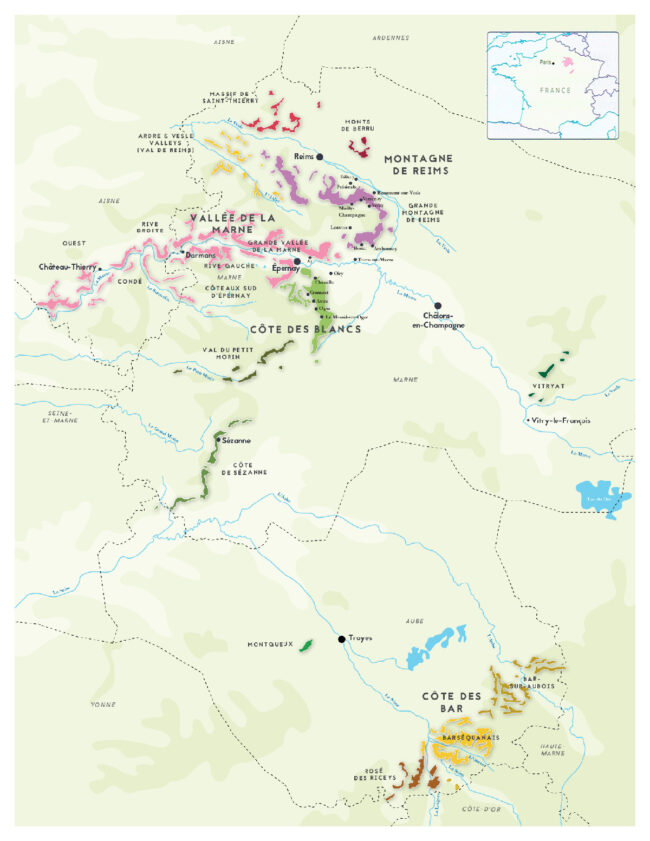
Courtesy of Wine Scholar Guild
Lying beyond even Liem’s overview is a permutation of particulars; there are nearly as many micro-terroirs in Champagne as there are vineyard plots. Climate, subsoil and elevation are immutable; the talent, philosophies and techniques of the growers and producers are not. Ideally, every plot is worked according to its individual profile to establish a stamp of origin, creating unique wines that compliment or contrast when final cuvées are created.
Champagne is predominantly made up of relatively flat countryside where cereal grain is the agricultural mainstay. Gently undulating hills are higher and more pronounced in the north, near the Ardennes, and in the south, an area known as the Plateau de Langres, and the most renowned vineyards lie on the chalky hills to the southwest of Reims and around the town of Épernay. Moderately steep terrain creates ideal vineyard sites by combining the superb drainage characteristic of chalky soils with excellent sun exposure, especially on south and east facing slopes.
… Yet another reason why this tiny slice of northern France, a mere 132 square miles, remains both elite and precious.
- - -
Posted on in France, Champagne, Wine-Aid Packages | Read more...
Second Thoughts: Fabled Château Ausone Re-releases Aged Second Wine ‘Chapelle d’Ausone’ In Three Vintages: 2011, 2012 And 2016 + Current Releases: 2019 And 2020
In Bordeaux, a Château has the right to sell all of its production under the name of its domain, yet they rarely do. Based on vine age vs. current yield, producers occasionally replant vineyard plots and it generally takes a few years before the fruit reaches the level of quality required to justify either the Château’s name or the price it seeks for top releases. Parcels that are nearly—but not quite—ready to rock are generally downgraded to a second wine which, the consumer has every right to expect, are nearly—but not quite—at a quality level of the first.
This week’s featured offering represents one such second wine, ‘Chapelle d’Ausone’ from Saint-Émilion’s legendary Château Ausone. These wines, although ready to drink, are re-releases, meaning that they come directly from the estate itself, so the provenance is guaranteed. They are individually packaged in the original wooden box, stamped with name and vintage, ideal as a gift idea.
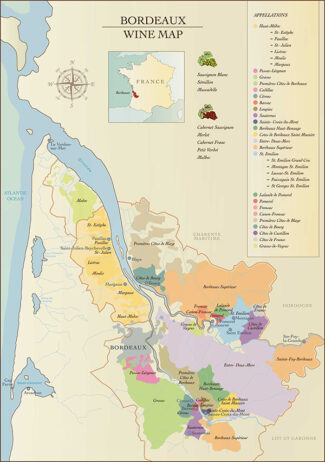
The town of Saint-Émilion lies just north of the Dordogne river in the final stages of its journey from the hills of the Massif Central to the Gironde estuary. It is a land from the pages of a storybook, renowned as much for its architecture and scenery as for its wine.
Unlike the wines of the Médoc, which focus heavily on Cabernet Sauvignon, Saint-Émilion is predominantly made from Merlot and Cabernet Franc. This is a matter of terroir; the clay and chalk rich soils around Saint-Émilion are generally cooler than those on the Médoc peninsula, and are less capable of reliably ripening Cabernet Sauvignon. Merlot makes up around two thirds of vines planted around Saint-Émilion, and continues to increase in popularity because of the softer, more approachable wine styles it produces. Both Cheval Blanc and Ausone may be seen as exceptions, since they are built predominantly around Cabernet Franc.
Château Ausone
The Most Confidential of Wines
‘Find a niche and fill it’ is one of the oldest, most revered bits of advice offered to entrepreneurs, but at Château Ausone, the mission statement is closer to ‘Find a niche and hide inside it.’
And that is because, despite being one of the only four Premier Grand Cru Classé A wines in Saint-Émilion (Ausone, Angélus, Cheval Blanc and Pavie), Château Ausone retains a relatively low profile, due in no small measure to its size. Encompassing a mere 17 acres in a region where 70% of the estates are larger than 50 acres, the output of Ausone is similarly restrained; even in spectacular vintages, fewer than 2,000 cases are produced. Château Haut-Brion, in contrast, releases ten times as many.
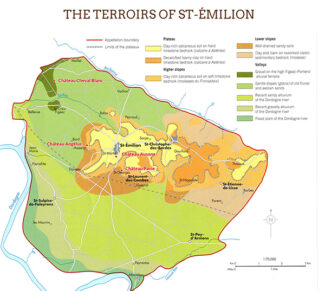
But that wine! Ask almost any French vigneron to name the best terroir in Bordeaux and the majority will say, without missing a beat, that it belongs to Château Ausone. Grown on Asteria limestone along terraces splashed in sunlight, protected from wind by geography and then nurtured in the cellar by Alain Vauthier (whose family has been making wine at Ausone since 1690), the typical profile of an Ausone Grand Vin is reticent and reserved in its youth, with a persistent elegance supplemented (especially in recent vintages) by a polished texture and aromatic complexity. With maturation, these elements combine to make Château Ausone a sublime secret.

Alain Vauthier stands in the caves of Ausone. (Photo Courtesy of Farr Vintners)
Alain Vauthier is proud to be beholden to his land. He is pragmatic about the challenges that will keep it producing at the top of its game: “To improve wine quality, we change details according to the vintage, but the terroir remains the same. The climate may change—but very slowly—and Ausone will remain Ausone in style. I don’t see how the hand of humans can do much to alter terroir. Terroir is the conjunction of wind currents, sunshine and stability of soils linked to hydrology. I don’t see how we could change it.”
A Theater of Stone: Subterranean Tales
To delve further beneath the surface of Vauthier’s remarks, The Ausone estate is anchored to the side of the hill in a place called Roc Blancan; literally the ‘white rock.’ Besides providing the vines with an ideal foundation, Ausone limestone, has been worked by masons for seven hundred years. As a memento to their labors, there are Gallo-Roman galleries under the château and a maze of tunnels that double as wine cellars. Over the years, local families have taken up residence inside the abandoned local quarries and many are buried there: The thick limestone bank that lies above the property contains a small Romanesque chapel which stands, surrounded by vines, in one of Ausone’s parcels. Beneath it sits another treasure of Christian art—an underground rotunda with a fresco of the Last Judgement.

The Fortunate Hill: The Terroir’s Favors
The alignment of conditions at Ausone may sometimes seem like alchemy; surrounded by stone, the terraced vine parcels are in a natural amphitheater, sheltered from the wind while enjoying a perfect east south-east exposure. Sunshine is generous and working in concert with the Dordogne and Isle rivers that meet nearby, creates an ideal microclimate for winemaking. Some of the vines grow on a plateau of asteriated limestone, where their roots are anchored in crevices. On the hill, the vines delve deeply into earth supplemented with a layer of clay that provides welcome moisture when drought conditions prevail. Both growth environments are equally hospitable. Nowhere has this truth been more obvious (and more welcome) than during the horrendous frosts of 1892 and 1956. As a result, the estate boasts Cabernet Franc vines that are more than 100 years old, the oldest planted in 1906.
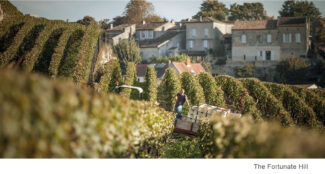
And at Château Ausone, Cabernet Franc is the name of the game: The vineyard is planted to 55% Cabernet Franc, 40% Merlot with the scant 5% Cabernet Sauvignon used primarily for Chapelle d’Ausone, the estate’s second label.
The Spirit and Practices: The Winegrower’s Task
Pauline Vauthier, Alain’s eldest daughter, is the eleventh wine growing generation at Ausone. Having started during 2005 vintage, she arrived well-prepared, having entered agricultural school at 15 and earning a degree in viticulture and enology, then working in South Africa at the Morgenster estate. “But I’ve always wanted to work at Ausone,” she admits, and today oversees all technical aspects at the famed château as well as at the family’s other properties in Moulin St-Georges, Château Fonbel and Château Simard.
She shares her father’s sensibilities, driving the estate towards organic viticultural practices in what she calls ‘educated agriculture: “Beyond the vines themselves, the wider ecosystem is also taken into account. Hedges, fruit trees and aromatic plants are grown as companions for the vines, stimulating a fertile exchange between species, backed up with natural applications of nettle, willow and valerian. A variety of wildlife is also preserved, including insects, birds and even bats, which all contribute in their own way to releasing the vital energy in the soil.”
Château Ausone rarely sticks to a singular regimen. Methods inspired by both organic and biodynamic procedures are implemented based on weather conditions, which the family agrees is the gentlest ways to craft wines. Says Alain, “The best tactic that man can adopt is discretion. From the vineyard through to the cellars, all the deliberate, measured practices employed pursue a single ambition, that of enabling the terroir to express itself as genuinely as possible.”
Ausone’s Second Wine: An Overture
Second wines are rarely an afterthought; in fact, they are better regarded as an overture—a wine that is often produced from younger vines or declassified lots, perhaps a slightly different cépage, but generally crafted by the same vigneron, using the same equipment and expertise, as the Grand Vin.
In short, a second label may be seen as an introductory course to the winemaker’s vision and can generally be identified by the absence of the word ‘Château’ on the label.
Chapelle d’Ausone is a prime example of this two-tiered, dual-philosophy excellence: Crafted under the same conditions as its elder sibling (the Merlot stands out more distinctly in Chapelle and mingles with subtle hints of Cabernet Sauvignon), it is a wine meant to be enjoyed younger than the Grand Vin, which may take fifteen or twenty years to unfurl. Chapelle is a great way to saturate the palate during the wait.
The re-release of several vintages of Chapelle d’Ausone from the estate itself is perhaps the best guarantee of its provenance and showcases the splendor of Ausone at a more rationale price point.
(Individually) Boxed Bottles, Re-releases
These wines are contained within their original wooden boxes, stamped with the estate’s name and vintage; they are perfect for those eager to get at least one significant other off the Father’s Day list early.
These wines have been recently re-released by Château Ausone itself, so there is no doubt about the integrity of storage conditions during the intervening years.

2020 was an excellent vintage in Saint-Émilion (along with the rest of the Right Bank), proving to be even more consistent than the Left. An unusually mild winter moved into a balmy spring, prompting both an early budburst and flowering; isolated heavy rains forced producers to be vigilant against the spread of both rot and mildew, but the rains proved useful in saturating the soils before the hot and exceedingly dry summer months arrived. Additionally, as the rain brought humidity, much of the region was able to dodge the worst of spring frosts. A hot, dry summer eventually arrived and although there were still intermittent rains in the run-up to August; after that, the vineyards dried out and the water reserves trapped deep in the soils became all-important. The good weather continued through to the harvest and the perfect conditions were a blessing in the ‘Year of Covid’, where social distancing protocol brought new and unexpected challenges.
 2020 Château Ausone ‘Chapelle d’Ausone’ Saint-Émilion Grand Cru ($199)
60% Cabernet Franc, 35% Merlot and 5% Cabernet Franc; the wine is fleshy and fruity up front, with herbs, mint, mocha also alive in the aromatic profile. The palate displays an array of crushed mineral salinity the red and black berries length, lift, precision, purity and silken textures.
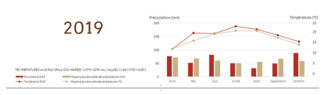
In Saint-Émilion, the 2019 vintage was exceptionally good. A benign winter moderated into a balmy spring and benevolent weather reigned supreme until April, which brought a significant cold snap. Like neighboring Pomerol, threats of frost hung in the air, but as it has in the past, Château Ausone weathered the storm without damage. A hot, dry summer emerged with cool nights that preserved essential acidity and aromatics. A hot July saw two significant rainstorms, which helped break up the heat while rehydrating the vines. September then marked the start of a golden autumn, interrupted only towards the end of the month by heavy, but welcome rainstorms. The harvest ran from mid-September to the beginning of October with Merlot first in line to be picked.
 2019 Château Ausone ‘Chapelle d’Ausone’ Saint-Émilion Grand Cru ($249)
45% Merlot, 45% Cabernet Franc, 10% Cabernet Sauvignon, with 85% new oak; a blend of wine from young vines with a few barriques of declassified Ausone. Brilliant flashes of juicy blackberry, warm plum compote and redcurrant jelly in the forefront with suggestions of sassafras, cedar chest, menthol and aniseed throughout. Fewer than one thousand cases made.
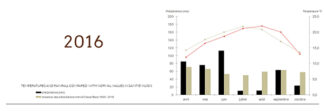
Like the rest of Bordeaux, Saint-Émilion experienced an unusually warm and wet winter with humid conditions continuing throughout the spring. Sporadic rains fell, serving to bolster water tables in the soil, although the lack of sun during the spring months meant budburst was slow to arrive. Eventually, the clouds cleared, and early June saw bright summer sunshine, which prompted a successful flowering. The early rains proved vital to the drought conditions that developed over a hot, dry summer.
Overall, the 2016 vintage for Saint-Émilion was excellent and a wide range of brilliant wines were made from easy-drinking second wines to sophisticated Grand Vins that will reward long-term cellaring.
2016 Château Ausone ‘Chapelle d’Ausone’ Saint-Émilion Grand Cru ($249)
A blend of 56% Cabernet Franc, 22% Merlot and 22% Cabernet Sauvignon. The high percentage of Cab Franc in this assemblage is the result of replanted plots that are not q
uite ready for the Grand Vin. The wine is exceptionally floral, with rose-petal and violet aromas floating above fleshed-out raspberry and loganberry notes and plenty of firm tannins and delicious acidity.
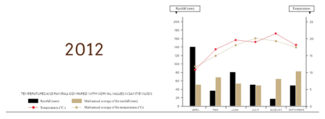
Overall, the 2012 vintage in Bordeaux was a challenge, and almost without exception the best wines came from older vines and long-established vignerons. Château Ausone was among them.
An extraordinarily wet April delayed both budburst and flowering; the latter did not occur until June. However, the flowering itself was beset with issues, from millerandage to mildew. The summer brought better weather, but a hot, dry August led to oppressive heat and drought. These harsh conditions caused some vines to temporarily shut down and the dry spell continued into September. Harvest was late, but those who delayed were rewarded, with Right Bank wines tending to fare better than the Left.
2012 Château Ausone ‘Chapelle d’Ausone’ Saint-Émilion Grand Cru ($199)
60% Cabernet Franc, 25% Merlot and 15% Cabernet Sauvignon. Rich, broad and expansive, with raspberry jam and smoky licorice above notes of plum, blueberry and black raspberry. Finishes with the powdered-chalk minerality one excepts from an Ausone. 500 cases made.
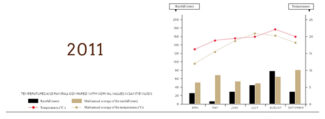
After two excellent vintages, 2011 handed Bordeaux a return to reality. A sweltering spring meant quick bud break and flowering, a full two weeks earlier than 2010. From April through June, drought conditions were noted. By July, however, summer nearly disappeared, with low levels of sunshine and cool temperatures followed by a rainy August.
Yet, in general, these conditions had a far more devastating effect on the Left Bank, with Cabernet Sauvignon on gravel soils suffering the worst. Generally speaking, Cabernet Franc did much better, and estates planted to this variety in both Pomerol and Saint Émilion (like Château Ausone) produced nice, early-drinking wines with fresh fruit and some gentle tannins.
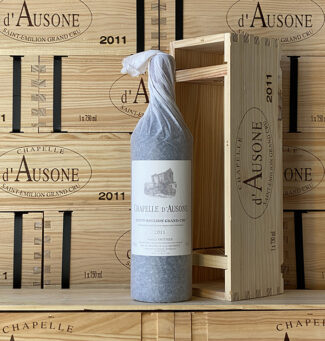 2011 Château Ausone ‘Chapelle d’Ausone’ Saint-Émilion Grand Cru ($199)
56% Cabernet Franc, 22% Merlot, 22% Cabernet Sauvignon. The wine has matured with earthy aromas of leather and forest floor above a core of fruit dominated by ripe cherry. The palate is supple and the tannins nicely integrated, finishing with dried fruit, black pepper and oak-driven butterscotch.
- - -
Posted on 2024.02.22 in Saint-Emilion, France, Bordeaux, Wine-Aid Packages | Read more...
Côte des Bar For The Course: Champagne Fleury, An Ecological Pioneer Is In Pursuit Of “Understanding And Enhancing Terroir’s Character” Eleven New Releases
Although it sounds a bit contradictory, ‘doing what comes naturally’ is often an exacting science and a dedicated quest, and nowhere in Champagne is this more evident than in the fields and cellars of Domaine Fleury, the Côte des Bar foremost champion of ‘The Art of Nature.’
Founded in 1895 in the heart of the Côte des Bar and driven by the terroir of the clay-limestone hillsides formed by the first tributaries of the Seine, Fleury has a storied history in the region, managing to weather both the phylloxera crisis and the market crash of 1929. But according to Jean-Pierre Fleury, it was biodynamics over all else that gave new meaning to Champagne production: “To be respectful of the natural and living heritage of this terroir, where custodians of the land forever learn, in all humility, to perceive the balance and to unearth its mysteries.”
Gone entirely biodynamic by 1992—a time when the concept was foreign to nearly every winemaker in France—Jean-Pierre has passed the spirit of purity and innovation to his children: Morgane Fleury, an actress and sommelier, who has developed a new concept of an ecological wine and champagne bar in central Paris; Jean-Sébastien, also at the heart of innovation at the domain, who is experimenting with grafting techniques in the vines as well as reintroducing horses to work on certain plots; Benoît, who is currently working with massale selection and agro-forestry as new ways of cultivating the vines in symbiosis with an adapting environment.
Biodynamic practices remain the focus of virtually every decision made at Fleury: According to Jean-Pierre Fleury, who passed away in 2023, “This idea of nature’s unity and the interdependence between the earth’s life forces has become central to everything we do. It simultaneously encompasses humility by questioning certain convictions or conventions, observation skills and a new way to care for plants and soils, the latter being the source of a plant’s balance. Biodynamic agriculture involves coordinating the element’s relation, exchange, affinity and also repulsion with cosmic rhythms.”
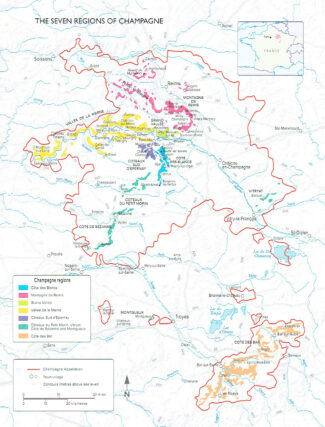
South Rising: Aube’s Côte des Bar
There is a certain ignominy in being Aube. Ninety miles south of Épernay, there have been times when its very inclusion in the Champagne appellation has been cast into doubt: In 1908, for example, Champagne Viticole was defined as 37,000 acres in the Marne and the Aisne, with the Aube département excluded. The effervescent French do not take such face-slaps lightly, and after a series of riots, a new legal delimitation of Champagne was drawn in 1927, delineating its modern boundaries—85,000 acres that this time included the Aube and its most heralded subzone, the Côte des Bar.
Even so, the échelles des crus ranking offered none of Aube’s villages the prestige of Grand Cru or Premier Cru ranking. This didn’t help in removing the stigma of being Champagne’s Pluto, and it has only been fairly recently that progressive—even iconoclastic winemakers— have thrust the region into the spotlight. Today, the Côte des Bar makes up 23% of Champagne’s output, and the past 20 years have seen its vineyard surface grow by more than three thousand acres.
Champagne Fleury
“Let Nature and Its Rhythms Express Themselves.”
If any estate is anchored to the Côte des Bar it is Champagne Fleury, whose Courteron vineyards span 38 acres on a clay-limestone hillside along a tributary of the Seine. But, as the first Champagne house to convert to biodynamics (1989), Jean-Pierre Fleury proved that a producer can have roots in the earth while raising the mainsail to innovation.
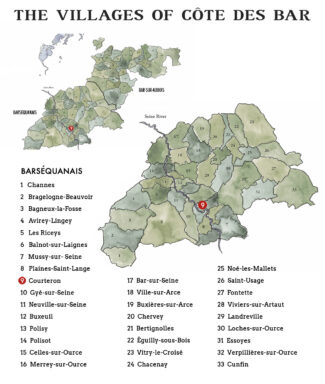
Today, his son Jean-Sébastien Fleury has taken the winemaking rudder, and is tacking toward the future with respect for the unique situation of the Côte des Bar, which is closer to Chablis than to Reims. “The key is soil health,” he says. “We must keep the earth healthy. The structure of the soil gives back the essence of the terroir.”
In this endeavor, he is joined by his younger brother Benoît, who came on board in 2010 to manage the vineyards, intent not only on maintaining biodynamics, but also researching soil biology, biodiversity and experimenting with agro-forestry. A third sibling, Morgane, initially studied to be an actress and a sommelier in Suze-la-Rousse, runs ‘My Cave Fleury’ in Les Halles (made famous by Émile Zola’s famous novel of the same name) where she specializes in biodynamic wines.
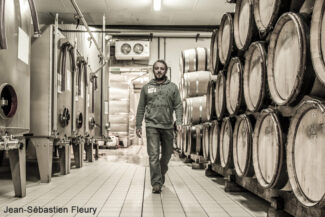
The estate encompasses ten plots planted primarily to Pinot Noir, the oldest planted in 1970, and new cuttings are established every year to maintain the vitality that younger vines bring to Champagne. The ultimate goal, according to Jean-Sébastien is a wish “to let the nature and its rhythms express themselves.”
Appreciate the Balance and Share the Mysteries of Nature
The Japanese have long espoused a mystical connection between the earth and sky; a spectacle of nature and the subtle balance that prevails between tradition and modernity. That is a philosophy that winemaker Jean-Sébastien Fleury grew up with. His father, Jean-Pierre, who originally wanted to be an astronomer, embraced the concept that every human on earth has a small but essential role in maintaining the harmony of the universe, and fell in love with cultures founded on principles of equity, between people and with the land, and decided early to raise his family in physical and spiritual health.
Champagne is especially suited to this thought process; at its core, it is an attempt to find a nearly magical equilibrium between nature and man’s ability to enhance it. An understanding of the microcosm and the macrocosm is essential to a biodynamic vision, and as an homage to the interdependence of earth and sky, Fleury vineyard practices seemed—in the last century—as almost druidic, although they are now being embraced throughout France.
Enhancing and Understanding Terroir’s Character
Reims lies at Latitude 49°5, and Épernay at 49°; in the northern hemisphere, it is generally considered difficult to obtain quality grapes at the 50th parallel and above. The ninety mile cushion enjoyed by Côte des Bar has a pronounced effect on the grower’s ability to ripen Pinot Noir; as a result, 86% of the vineyards are planted to this varietal. Despite this, the soils of the Côte des Bar is closer to that of Chablis—Kimmeridgian marl topped by Portlandian limestone, whereas the vines near Épernay and Reims tend to be planted in Cretaceous chalk. Chablis, of course, is ground zero for Chardonnay, and it is humidity coming from the Atlantic in the west as well as continental influences with higher temperatures that make the Côte des Bar Pinot Noir country through and through. That said, local climate conditions, slope and orientation are extremely varied throughout region, and produces many individual micro-climates, so each vigneron needs to be fully attentive to his own terroir in order to make the most of it. Côte des Bar features a host of small producers whose output varies almost as much as the local landscape.
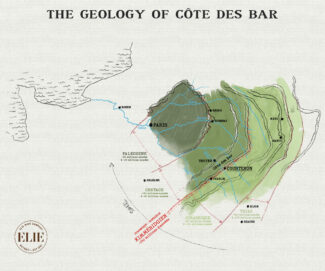
The Biodynamic Principles: Respecting Earth’s Life Forces
The Fleury family looks at the estate as a living organism and pampers it as one might a beloved family pet. “We have been cultivating our land in line with its habitat for more than thirty years, acknowledging nature’s rhythms and the influence of terrestrial and cosmic forces. At first, this agricultural principle may seem demanding and esoteric, but it is truly a virtuous circle. We envision wine as a support of nature’s creation that undeniably enhances the product we bottle. All wines are labeled ‘Organic Agriculture TM’ and ‘Biodynamic.’”
Fleury delves deeper: “A vineyard is a monoculture, so our work is directed toward increasing biodiversity. Our viticultural work is focused on both the soil and the plant. Cultivation is done by hand in addition to the application of biodynamic preparations. Vine work is synchronized with planetary and lunar cycles; this is based on the effects these heavenly bodies have on root, leaf, flower and fruit development. For example, vine suckering, de-leafing and de-budding is done on ‘leaf day’ in the lunar calendar. The grafts and harvest is done in accordance with the lunar spring, when the moon is rising, a time that favors heavy sap flow. The lunar fall, when the moon is descending, is the best time for pruning.”
Vinification at the Winery: Producing Earth’s Best
“Our slow aging process is a symbolic return to the earth,” says Jean-Sébastien Fleury, referencing the biodynamic methods that result in wines with an improved balance between sweetness and acidity compared to other wines. “In our Domain, these characteristics allow us to leave the bottles to age in our cellar for a longer time of 3 to 5 years for the Blanc de Noirs, Fleur de l’Europe and Rosé, and 6 to 10 years for the Millésimes. This slow aging process that is an essential step before revealing the wine during the tasting. Aging before beginning a new life symbolizes another cycle of nature and of the cosmos.”
Champagne’s Primary Grapes and Heirloom Varieties
The vast majority of Champagne is made from one or more of the Big Three, chosen in late 19th century as grape varieties that offer the best balance of sugar and acidity to complement the effervescence. First, Pinot Noir, which dominates the holdings in the Côte des Bar, where it is sometimes called Précoce due to its ability to ripen early. When allowed to thrive in cool, chalky soil, Pinot Noir endows Champagne with body, punch and structure. Chardonnay is also an early ripening variety, particularly well-suited to terroirs which lie on an outcrop of chalk, and yields delicately fragrant wines with floral, citrus and mineral notes and produces wines that age well. The trio is rounded out by Meunier, a hardy grape that is compatible with soils containing more clay, such as in the Marne Valley, where it is frequently considered an insurance grape against poor vintages since it buds later and is more accepting of cooler mesoclimates.
In terms of climate and attitude, no place in Champagne is more hospitable to heirloom grapes than the Côte des Bar; overall, more than 250 acres of vineyard is dedicated to Pinot Blanc (locally called Blanc Vrai), Pinot Gris (Fromenteau), Arbane and Petit Meslier.
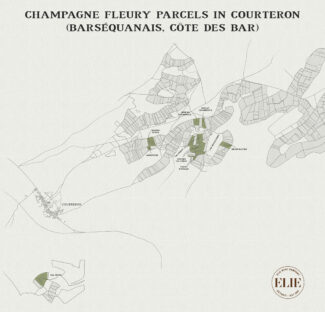
Chardonnay – ’White Rainbow’
Since virtually all Champagne not designated ‘rosé’ appear pale and straw-colored in the glass, it is sometimes assumed that white wine grapes are predominant in the region. In fact, Chardonnay is the least widely planted of the Big Three, and finds its most reliable stronghold in the north where the Côte des Blanc provides a home-base on an extension of the same chalk outcrop that runs through Chablis.
Despite being less represented in the southern part of Champagne, there still pockets of resistance where Chablisienne terroir prevails, especially those anchored off the slopes of Champraux.
 Champagne Fleury ‘Cépages Blancs’, 2011 Côte-des-Bar Extra-Brut ($105)
100% Chardonnay vinified 50% in oak; bottled 07/2012, disgorged 12/2022; dosage, 2 gram/liter.
The old-vine vineyards blended to make this wine are planted in Kimmeridgian limestone in the lieux-dits of Champraux and Valprune; the wine displays superb dried fruits aromas with licorice and praline, the wine is redolent of almonds, peach and white flowers.
*click photo for more info
Pinot Gris – ‘Return Of The Eclipse’
300 years ago, the early-maturing Pinot Gris (then called ‘Fromenteau’) made up 50% of the vineyards in Champagne and even today, the pink-skinned Pinot Noir mutation accounts for about 14% of the vineyard plantings. In Champagne, it can often be identified by the notes of honey and almond it lends to a cuvée.
 Champagne Fleury ‘Variation’, 2015 Côte-des-Bar Brut-Nature ($130)
100% Pinot Gris vinified in thermo-regulated vats. Bottled 10/2016; Disgorged 05/2021; dosage, 0 gram/liter.
Planted in 2010, harvested in 2015, this wine is made without sulfites and after five years aging, receives zero dosage. It is the second release of this unique biodynamic Pinot Gris; the mouth is rich and alive with a bright mousse, shows apple notes, bright stone fruit, soft spice and salinity.
*click photo for more info
Pinot Blanc – ‘Memory Of A Star’
Originating in Alsace, Pinot Blanc can be a problem child easily corrupted by disease and mutation, the result of its large berries and unstable relationship with parent Pinot Noir. Yet its value remains in its low sugar/acid ratio and it’s floral, green apple flavor profile.
 Champagne Fleury ‘Notes Blanches’, 2015 Côte-des-Bar Brut-Nature ($99)
100% Pinot Blanc with 50% oak élevage. Bottled,10/2016; disgorged,12/2022; dosage, 0 gram/liter.
Emile Fleury, who founded the domain, was a champion of Pinot Blanc—a well-known varietal in Alsace and a hidden gem in Champagne. Morgane Fleury’s vision of creating a monovarietal cuvée using 100% Pinot Blanc from lieux-dits Charme de Fin and Valverot is a rare and expressive experience.
Made from 25-year-old vines, ‘Notes Blanches’ is from the 2015 vintage; it shows creamy lemon and toasted bread on the nose. The palate is filled with tension and elegance, with a fine mousse and mineral finish.
*click photo for more info
Pinot Noir Country: Côte-des-Bar Takes Cues From Burgundy
So obsessed was the Aube on becoming part of Champagne that they fought back; 40,000 French soldiers were required to quell the violence. Still, like a child who denies his roots, the flavors of Burgundy can be tasted in most aspect of the region—traditions, architecture, cuisine and winemaking.
Most growers in Aube’s vineyard acres trained in Burgundy, and the luxurious Champagnes the region is capable of carry both the precision and minerality of Kimmeridgian limestone—often so close to the surface that no soil is evident and the vines appear to be planted in lunar bedrock—which is the identical foundation for the Grand and Premier Crus of Chablis. Puligny-Montrachet barrels are often used in cellars and biodynamics—much more prevalent in Burgundy than in Champagne—are becoming increasing indispensable to young winemakers in the Côte des Bar. It is, in part, this tension—the tug of war between Champagne and Burgundy—that creates the marvelous electricity of Côte des Bar wines.
‘Planet Pinot Noir’
 Champagne Fleury ‘Blanc de Noirs’, Côte-des-Bar Brut ($56)
100% Pinot Noir with 62% harvested in 2018, perpetual reserve for the balance. Bottled 10/2019; disgorged 01/2023; dosage, 4.7 gram/liter.
Created in 1955 by Robert Fleury, this traditional cuvée was re-labeled ‘Blanc de Noirs’ in 2010. Delicate aromas of white peach and iris appear on the nose, while the body shows black cherry and a hint of tart cranberry behind an elegant, zesty and bright bead.
*click photo for more info
‘Notes Of Twilight’
 Champagne Fleury ‘Boléro’, 2008 Côte-des-Bar Extra-Brut ($130)
100% Pinot Noir with 30% élevage in oak. Bottled 12/2009; disgorged 12/2022; dosage 0 gram/liter.
Formerly called ‘Millésimé’ (when it contained a small amount of Chardonnay), the cuvée became pure Pinot Noir in 2004. Aged nine years on lees, it is the brainchild of Benoît Fleury, and drawn from four plots—Charme de Fin, Champreaux, Meam Bauché and Montégné. It exhibits complex scents of toasted almond, apricot and freshly-baked bread followed by a lengthy, mineral-driven finish. shows interwoven aromas of dried fruits, toasted almonds, apricots and freshly-baked bread followed by juicy stone fruits wrapped in crystalline effervescence.
*click photo for more info
‘When Mars Meets Venus’
 Champagne Fleury ‘Rosé de Saignée’, Côte-des-Bar Brut ($76)
100% Pinot Noir vinified in thermo-regulated vats. From the 2018 harvest; bottled 07/2019; disgorged 10/2022; dosage 3.4 gram/liter.
The grapes see a short period of maceration before pressing—the production method called saignée. It produces a light, lyrical sparkling wine whose dosage has been gradually reduced over the years; the wine is redolent of strawberry compote and vanilla, with a rich palate that maintains both elegance and delicacy.
*click photo for more info
Coteaux-Champenois: Still Champagne
Coteaux-Champenois is a unique AOP dedicated entirely to non-effervescent Champagne. It may be red, white or rosé, although the lion’s share is red—Bouzy rouge being the most celebrated. With a warming climate ripening grapes more consistently, Coteaux-Champenois is becoming positively trendy and producers across the 319 communes entitled to make wines under the Coteaux Champenois appellation are becoming better known.
Like their fizzy sisters, still wines from the region tend to be dry and light-bodied with naturally high acidity. The reds are better in warmer vintages, which is why the predominant red variety, Pinot Noir, is currently basking in the newfound heat waves of northern France. The reason that 90% of the Coteaux Champenois output is red is not necessarily because the terroir has traditionally favored Pinot Noir, but because locally grown Chardonnay has commanded a higher price when sold to Champagne houses.
 Domaine Fleury, Coteaux-Champenois Rosé ‘Côte-des-Bar’ ($68)
Comprised of vintages 2017, 2018 and 2019 hand-harvested 35 to 40 years old Pinot Noir vines, fermented spontaneously with low-intervention, bottled unfined and unfiltered. The wine offers a nose of Maraschino cherry, strawberry and lemon zest while the fruit-driven palate had notes of cherry and raspberry behind bright acidity.
Predominantly Pinot Noir: Blended for ‘Subtle Alchemy’
Champagne should illustrate the word ‘synergy’ above all, where the sum of the total is greater than the individual parts. The ideal blend should be the aggregation of positive components; every thread should add to the tapestry’s whole. The blend should always drive toward harmony; Chardonnay is often up front, while Pinot Noir supplies the middle and finish. Other allowable varietals should only appear if they contribute to the primary blend.
This is not a universal outcome, of course, and according to Jean-Marc Lallier of Champagne Deutz, “Some winemakers do not blend; they mix.”
When cellar masters do it right, it is a painstaking undertaking; every tank, barrel and vat is tasted countless times to assess which batch would enhance which. This is the true art of Champagne making—the intimate familiarity with each component in order to align them perfectly.
View Champagne Fleury cuvée blends over the years here.
‘Where The Sun Meets The Moon’
 Champagne Fleury ‘Fleur de l’Europe’, Côte-des-Bar Brut-Nature ($61)
85% Pinot Noir, 15% Chardonnay, 54% from the 2017 harvest; 40% received élevage in oak. Bottled 07/2018; disgorged 01/2023; dosage 0 gram/liter.
The first biodynamic cuvée in Champagne, the name references the generation that witnessed the fall of the Berlin Wall and results from a special pressing of the grapes that reserves the optimum juice. The wine displays silken notes of green apple and peach with warm brioche on the nose and persistent pinpoint bubbles throughout the palate.
*click photo for more info
‘Cosmic Symphony’
 Champagne Fleury, 2010 Côte-des-Bar Millésime Brut ($110)
80% Pinot Noir, 20% Chardonnay with 60% in bottle with corks during second fermentation. Bottled 12/2013; disgorged 09/2022; dosage 3 gram/liter.
The grapes come from 20-year-old vines, the first declared vintage for Fleury since 2004. The old vines give intensity and toasty character to the palate, which is full of honey-nut spiciness with hints of smoke behind citrus/apple flavors.
*click photo for more info
‘Little Music For Time And Space’
 Champagne Fleury ‘Sonate’, 2013 Côte-des-Bar Extra-Brut ($105)
92% Pinot Noir, 8% Pinot Blanc bottled 07/2014, disgorged 10/2022 and dosed at 0 gram/liter.
Sonate is the fourth edition of sulfite-free wine. From plots in Champraux, Valprune and Charme de Fin, the vines average 35 years of age. The wine is loaded with aromatic richness, opening with aromas of acacia, daffodil and citrus peel behind ripe peach and a characteristic note of quince jelly.
*click photo for more info
 Champagne Fleury ‘4 Cépages’, 2014 Côte-des-Bar Brut-Nature ($130)
58% Pinot Noir, 25% Chard, 12% Pinot Blanc, 5% Pinot Gris (the four ‘cépages’, or grapes), harvested in 2014, bottled 07/2015 and disgorged 01/2022 with 0 gram/liter dosage.
The wine has a notably complex nose of toasted nuts, fresh pastry and apricot marmalade with a sensationally rich palate dominated by citrus, honeycomb, saffron, apricot and candied cashews.
*click photo for more info
Notebook …
Single Harvest vs. Vintage
In France, under Appellation d’Origine Portégée (AOP) rules, vintage Champagnes must be aged for three years—more than twice the required aging time for NV Champagne. The additional years on the yeast is said to add complexity and texture to the finished wine, and the price commanded by Vintage Champagne may in part be accounted for by the cellar space the wine takes up while aging.
On the other hand, a Champagne maker might prefer to release wine from a single vintage without the aging requirement; the freshness inherent in non-vintage Champagnes is one of its effervescent highlights. In this case, the wine label may announce the year, but the Champagne itself is referred to as ‘Single Harvest’ rather than ‘Vintage’.
Vintage Journal
2018
An outstanding vintage for Champagne, producing both quality and quantity. A few isolated hailstorms led to some crop loss, notably in the Côte des Bar, but fortunately, early summer brought hot, sunny and dry days. Occasional showers were welcome relief to parched vines and kept hydric stress at bay, allowing for optimal ripening at a gradual pace in ideal conditions that resulted in an early harvest.
2017
2017 was a vintage that managed (in some areas) to seize defeat from the jaws of victory. A promising start was compromised by August rains which prompted an outbreak of botrytis. This meant the harvest had to be carried out fast and for some producers, it was the shortest on record. Chardonnay tended to be uniformly good and there was also some extremely good Pinot Noir. It was Pinot Meunier that tended to suffer the most, with many grapes overripe.
2015
A wet winter and mild spring gave way to an exceptionally dry summer from mid-May onwards, and hot weather prevailed until mid-August, when heavy rains fell. Rains gave way to fine, cool, yet sunny weather for the first two weeks of harvest, which began on August 29th.
2013
2013 saw a cool spring followed by a cool summer, with delayed flowering and an onset of millerandage and coulure due to the cool temperatures, cutting yields. However, the reduced crops tended to ripen more easily during what would transpire to be a long growing season. Chardonnay was the strongest performer with some great examples coming from the Côtes des Blancs as well as from the Marne Valley. However, Pinot Noir from Aÿ was also very good.
2012
Like 2008, 2012 was a difficult growing season, with severe frosts in the winter. March brought warmth but early bud break made the vines vulnerable. Overall, the early growing season was wet, with mildew a serious issue, however, conditions improved dramatically in the summer months. An August heatwave resulted in a rapid accumulation of sugar, but the nights remained cool, which preserved acidity. Although yields were low due to the early frost, later hail and disease pressures, the 2012 harvest was exemplary in its maturity, acidity and grape health.
2011
Following a warm, early spring and a cool, damp summer season, 2011 was one of the earliest Champagne harvests in history. Patience and fierce selection at harvest time turned out to be the winning recipe.
2010
Dry conditions hindered grape development early in the season, and after a hot summer, torrential rain in mid-August caused widespread disease pressure. The ripeness of the grapes was good and the acidity remained high despite the warm season, but as a combined consequence of the challenges of the growing season, the global financial crisis and the cellars bursting with fine 2008 and 2009 vintage bottles, few houses declared 2010 a vintage. The ones who did, did so so for a reason.
2008
Initially a difficult, damp year with widespread mildew, expectations for 2008 were low. However, drier conditions in August and a fine, warm September with cool nighttime temperatures proved to be the saving grace. Harvest began on September 15th and it quickly became known as an outstanding year, due to the finesse brought about by the fine, saline freshness and purity of fruit. A dream-come true vintage in many aspects, 2008.
Drawing The Boundaries of The Champagne Region
To be Champagne is to be an aristocrat. Your origins may be humble and your feet may be in the dirt; your hands are scarred from pruning and your back aches from moving barrels. But your head is always in the stars.
As such, the struggle to preserve its identity has been at the heart of Champagne’s self-confidence. Although the Champagne controlled designation of origin (AOC) wasn’t recognized until 1936, defense of the designation by its producers goes back much further. Since the first bubble burst in the first glass of sparkling wine in Hautvillers Abbey, producers in Champagne have maintained that their terroirs are unique to the region and any other wine that bears the name is a pretender to their effervescent throne.
Having been defined and delimited by laws passed in 1927, the geography of Champagne is easily explained in a paragraph, but it takes a lifetime to understand it.
Ninety-three miles east of Paris, Champagne’s production zone spreads across 319 villages and encompasses roughly 85,000 acres. 17 of those villages have a legal entitlement to Grand Cru ranking, while 42 may label their bottles ‘Premier Cru.’ Four main growing areas (Montagne de Reims, Vallée de la Marne, the Côte des Blancs and the Côte des Bar) encompass nearly 280,000 individual plots of vines, each measuring a little over one thousand square feet.
The lauded wine writer Peter Liem expands the number of sub-regions from four to seven, dividing the Vallée de la Marne into the Grand Vallée and the Vallée de la Marne; adding the Coteaux Sud d’Épernay and combining the disparate zones between the heart of Champagne and Côte de Bar into a single sub-zone.
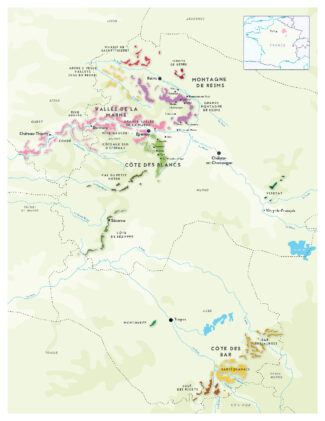
Courtesy of Wine Scholar Guild
Lying beyond even Liem’s overview is a permutation of particulars; there are nearly as many micro-terroirs in Champagne as there are vineyard plots. Climate, subsoil and elevation are immutable; the talent, philosophies and techniques of the growers and producers are not. Ideally, every plot is worked according to its individual profile to establish a stamp of origin, creating unique wines that compliment or contrast when final cuvées are created.
Champagne is predominantly made up of relatively flat countryside where cereal grain is the agricultural mainstay. Gently undulating hills are higher and more pronounced in the north, near the Ardennes, and in the south, an area known as the Plateau de Langres, and the most renowned vineyards lie on the chalky hills to the southwest of Reims and around the town of Épernay. Moderately steep terrain creates ideal vineyard sites by combining the superb drainage characteristic of chalky soils with excellent sun exposure, especially on south and east facing slopes.
… Yet another reason why this tiny slice of northern France, a mere 132 square miles, remains both elite and precious.
- - -
Posted on 2024.02.21 in France, Champagne, Wine-Aid Packages | Read more...
Featured Wines
- Notebook: A’Boudt Town
- Saturday Sips Wines
- Saturday Sips Review Club
- The Champagne Society
- Wine-Aid Packages
Wine Regions
Grape Varieties
Aglianico, Albillo, Aleatico, Alicante Bouschet, Aligote, Altesse, Arcos, Aubun, Auxerrois, Barbarossa, Beaune, Biancu Gentile, Bonarda, bourboulenc, Cabernet Franc, Cabernet Sauvignon, Caino, Caladoc, Carignan, Chablis, Chardonnay, Chenin Blanc, Cinsault, Clairette, Cortese, Corvina, Corvinone, Cot, Counoise, Dolcetto, Fiano, folle Blanche, Frappato, Friulano, Fumin, Gamay, Garganega, Garnacha Tintorera, Godello, Graciano, Grenache, Grenache Blanc, Grolleau, Groppello, Jacquère, Lladoner Pelut, Maconnais, Malbec, Malvasia, Malvasia Nera, manseng, Marcelan, Melon de Bourgogne, Mencía, Merlot, Mondeuse, Montepulciano, Montònega, Morescola, Mourv, Mourvèdre, Muscadelle, Muscat, Nebbiolo, Nero d'Avola, Niellucciu, Palomino, Pecorino, Pedro Ximénez, Persan, Petit Verdot, Pinot Auxerrois, Pouilly Fuisse, Pouilly Loche, Poulsard, Prieto Picudo, Riesling, Rondinella, Rose, Rousanne, Roussanne, Sagrantino, Sangiovese, Sauvignon, Savignin, Sciacarellu, Serine, Souson, Sylvaner, Syrah, Tannat, Tempranillo, Teroldego, Timorasso, Treixadura, trepat, Trousseau, vaccarèse, Viognier, ViuraWines & Events by Date
- September 2025
- August 2025
- July 2025
- June 2025
- May 2025
- April 2025
- March 2025
- February 2025
- January 2025
- December 2024
- November 2024
- October 2024
- September 2024
- August 2024
- July 2024
- June 2024
- May 2024
- April 2024
- March 2024
- February 2024
- January 2024
- December 2023
- November 2023
- October 2023
- September 2023
- August 2023
- July 2023
- June 2023
- May 2023
- April 2023
- March 2023
- February 2023
- January 2023
- December 2022
- November 2022
- October 2022
- September 2022
- August 2022
- July 2022
- June 2022
- May 2022
- April 2022
- March 2022
- February 2022
- January 2022
- December 2021
- November 2021
- October 2021
- September 2021
- August 2021
- July 2021
- June 2021
- May 2021
- April 2021
- March 2021
- February 2021
- January 2021
- December 2020
- November 2020
- October 2020
- September 2020
- August 2020
- July 2020
- June 2020
- May 2020
- April 2020
- March 2020
- February 2020
- January 2020
- December 2019
- November 2019
- October 2019
- September 2019
- August 2019
- July 2019
- June 2019
- May 2019
- April 2019
- March 2019
- February 2019
- January 2019
- December 2018
- November 2018
- October 2018
- September 2018
- August 2018
- July 2018
- June 2018
- May 2018
- April 2018
- March 2018
- February 2018
- January 2018
- December 2017
- November 2017
- October 2017
- September 2017
- August 2017
- July 2017
- June 2017
- May 2017
- April 2017
- March 2017
- February 2017
- January 2017
- December 2016
- November 2016
- October 2016
- September 2016
- August 2016
- July 2016
- June 2016
- May 2016
- April 2016
- March 2016
- February 2016
- January 2016
- December 2015
- November 2015
- October 2015
- September 2015
- August 2015
- July 2015
- June 2015
- May 2015
- April 2015
- March 2015
- February 2015
- January 2015
- December 2014
- November 2014
- October 2014
- September 2014
- August 2014
- July 2014
- June 2014
- April 2014
- March 2014
- February 2014
- January 2014
- December 2013
- November 2013
- October 2013
- September 2013
- August 2013
- July 2013
- June 2013
- May 2013
- April 2013
- March 2013
- February 2013
- January 2013
- December 2012
- November 2012
- October 2012