Beaujolais’s Pleasure of Now: Cru Moulin-à-Vent Wine Finds a Balance Between the Cerebral and the Carnal. Eight Producers in a Dozen Wines.
Saturday Sips: A Taste of Moulin-à-Vent
Come as you are; come any time that’s convenient for you during our business hours to sample selection from this week’s selections. Our staff will be on hand to discuss nuances of the wines, the terroirs reflected, and the producers.
Elie
The word ‘truism’ is rarely used with wine, a wondrous world where there as many exceptions as there are rules. One such example is price points: Whereas a ten dollar bottle of well-made wine is a better bargain than a hundred dollar bottle of flawed wine, in general, less expensive wines tend to be linear, intended to showcase a vineyard’s fruit and are meant to be consumed young. Pricier wines are constructed for the long haul and will improve markedly if allowed to mature under ideal conditions—for a year, two years, ten years and so on, depending on the label. They are complex wines that I have always considered to be ‘liquid memories.’ Intended to be consumed on special occasions—or in some case, being so special of themselves that consuming them becomes the occasion.
And now, the exception: Cru Beaujolais villages, which has in recent years striven to provide both modes of expression with equal intensity—wines that can be enjoyed in their heady, sensuous youth and will also mature with marked dignity.
Gamay, when grown in granitic soils and handled with expertise in the cellar, is the rare grape that can fulfill either destiny. Syrah-like in warm seasons and more like Pinot Noir when the vintage is cooler, Beaujolais’s workhorse monarch displays a chameleon-like versatility that shines in this region brighter than anywhere else in the world.
This week, we’ll focus a lens on Moulin-à-Vent, one of ten Cru-level appellations. Iconic both in terms of image and durability, the ‘windmill’ appellation is known for terroirs containing streaks of manganese winding through the granitic soils, and this mineral is said to augment the tannins naturally produced by Gamay.
Beaujolais’s Gamay: Wines of Contemplation and Complexity, Yet Provide Immediate Gratification.
‘The pleasure of now’ seems to be a 21st century operative, and when lighting delivery is the mandatory expectation, Gamay’s ability to deliver the goods within a year or so of bottling have it well-positioned to fill this need. Long appreciated for its hedonistic burst of fresh, grapey quaffability, Gamay’s more brooding face was kept as a guarded secret by the Cru cult, who often turned their noses up at plebian versions and relished in the meatier versions grown in hallowed vineyards.
But these noses should have been placed in the glass. Much of Beaujolais’ signature aromatics come from carbonic maceration, a method embraced (at least in part) by most Beaujolaisien winemakers in all appellations. In this style, intact grape bunches ferment inside their own skins with carbon dioxide used as a catalyst, either introduced or occurring naturally as a byproduct of fermentation. Once the alcohol reaches 2%, the grapes burst and release their juice naturally, whereupon a normal yeast fermentation finishes the job.
Even wines only partially fermented via carbonic maceration show bright fruit with aromas that bounce from the glass. A hybridization of these two faces of Gamay, which some call ‘street carbo,’ has as many varieties as there are experimentative winemakers. The complexity in the top-shelf Beaujolais are the result of superior fruit and—especially among practitioners of ‘Burgundy-style’ Beaujolais—from the oak-aging that is becoming more common.
Either way, the 21st century movement in Beaujolais is a step away from wines that could, even in the most cynical interpretation, be called ‘standardized.’
The Beaujolais Underground: A Veritable Mosaic of Soil
The biggest error a Beaujolais neophyte makes is an expectation one-dimensional predictability. To be fair, the mistake easy to make based on the region’s reliance on Gamay, a grape that elsewhere may produce simple and often mediocre wine.
In Beaujolais’ wondrous terroir, however, it thrives.
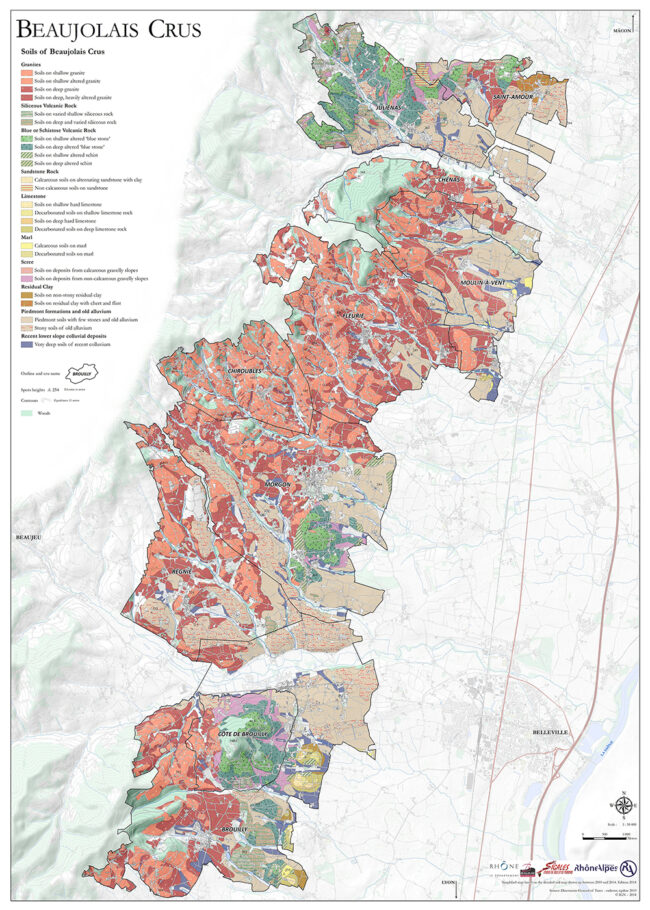
In fact, this terroir is so complex that it nearly defies description. But Inter-Beaujolais certainly tried: Between 2009 and 2018, they commissioned a colossal field study to establish a detailed cartography of the vineyards and to create a geological snapshot of the exceptional richness found throughout Beaujolais’ 12 appellations.
Beaujolais may not be geographically extensive, but geologically, it’s a different story. The region bears witness to 500 million years of complex interaction between the eastern edge of the Massif Central and the Alpine phenomenon of the Tertiary period, leaving one of the richest and most complex geologies in France. Over 300 distinct soil types have been identified. Fortunately, Gamay—the mainstay grape, accounting for 97% of plantings—flourishes throughout these myriad terroirs. In the south, the soil may be laden with clay, and sometimes chalk; the landscape is characterized by rolling hills. The north hosts sandy soils that are often granitic in origin. This is the starting point wherein each appellation, and indeed, each lieu-dit draws its individual character.
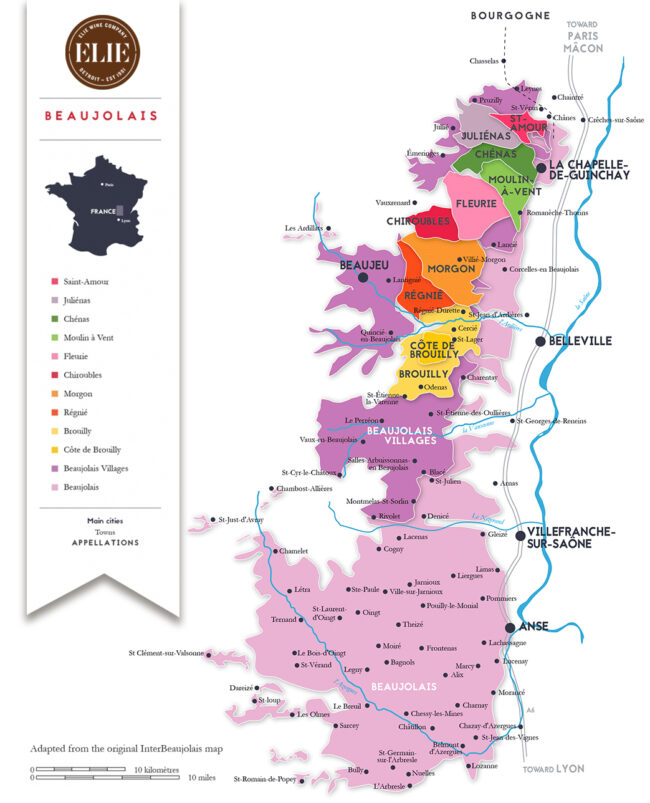
There are ten Crus, the top red wine regions of Beaujolais, all of them located in the hillier areas to the north, which offer freer-draining soils and better exposure, thereby helping the grapes to mature more fully.
Courtesy of Wine Scholar Guild
A Palette of Ten Crus
Beaujolais is a painter’s dream, a patchwork of undulating hills and bucolic villages. It is also unique in that relatively inexpensive land has allowed a number of dynamic new wine producers to enter the business. In the flatter south, easy-drinking wines are generally made using technique known as carbonic maceration, an anaerobic form of closed-tank fermentation that imparts specific, recognizable flavors (notably, bubblegum and Concord grape). Often sold under the Beaujolais and Beaujolais-Villages appellations, such wines tend to be simple, high in acid and low in tannin, and are ideal for the local bistro fare. Beaujolais’ suppler wines generally come from the north, where the granite hills are filled with rich clay and limestone. These wines are age-worthy, and show much more complexity and depth. The top of Beaujolais’ classification pyramid is found in the north, especially in the appellations known as ‘Cru Beaujolais’: Brouilly, Chénas, Chiroubles, Côte de Brouilly, Fleurie, Juliénas, Morgon, Moulin-à-Vent, Régnié and Saint-Amour.
Each are distinct wines with definable characteristics and individual histories; what they have in common beyond Beaujolais real estate is that they are the pinnacle of Gamay’s glory in the world of wine.
Cru Moulin-à-Vent: Syrah-like in warm vintages, Pinot Noir-like in Cooler vintages
To the ten crus of Beaujolais, Moulin-à-Vent is what Moulin Rouge is to Parisian cabarets: First among equals. Of course, that equality is a matter of taste—some consumers prefer floral Fleurie and charming Chiroubles to the full-bodied, tannic-structured Moulin-à-Vent and it’s no secret that Georges Duboeuf manages to sell a hundred thousand cases of Beaujolais Nouveau a year.
Forgetting the forgettable and concentrating on the myriad styles of Cru Beaujolais, nowhere is the evidence of terroir—the site-specific contributions of geology, sun-exposure and rainfall—more obvious than in Moulin-à-Vent. Although each appellation works with a single grape variety, Gamay, the results range from light, glorified rosé to densely layered, richly concentrated reds that rival Burgundian Pinot Noir cousins from the most storied estates.
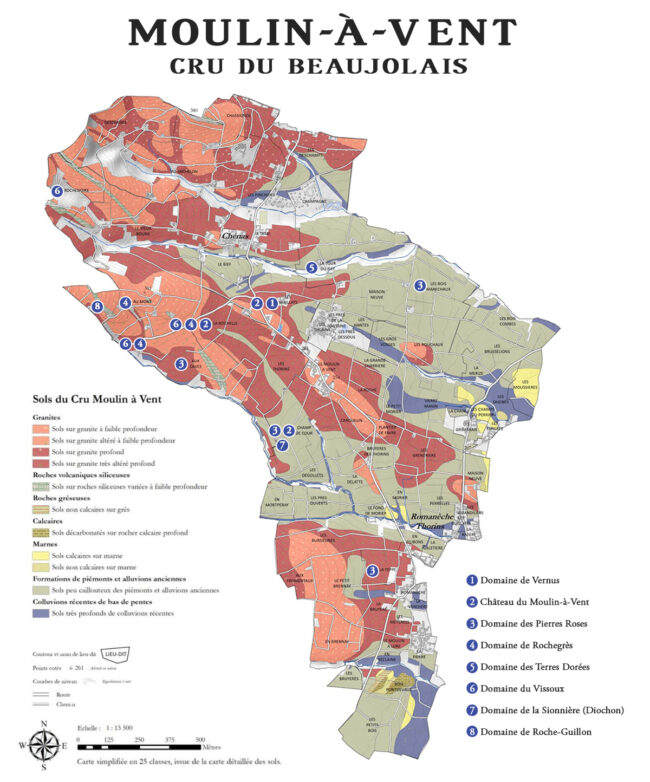
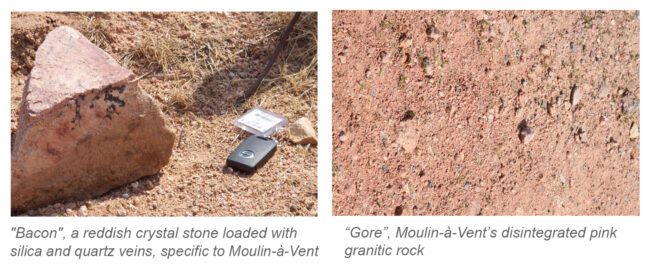
Moulin-à-Vent is unusual for a number of reasons, and among them is the fact that there is no commune or village from which it takes its name. Like the Moulin Rouge, the appellation is named for the ‘moulin’—windmill—that sits atop the hill that overlooks the south- and southeast-facing vineyards. The most outrageous reality of the Cru, however, is that the wine owes its structure and quality to poison: Manganese, which runs in veins throughout the pink granite subsoil, is toxic to grapevines and results in sickly vines that struggle to leaf out and produce small clusters of tiny grapes. It is the concentration of the juice in these grapes that gives Moulin-à-Vent a characteristic intensity unknown in the other crus of Beaujolais, where manganese is not present. It also gives the wine the foundation of phenolic compounds required for age-worthiness; Moulin-à-Ventis among a very select few of Beaujolais wines that can improve for ten, and even twenty years in the bottle.
Domaine de Vernus
After thirty years in the prosaic world of insurance brokerage, Frédéric Jametton decided to do a rakehell turn on his career trajectory. Having been born in Dijon and lived in Burgundy for most of his life, he had become an enlightened wine lover. Not only that, but his former profession brought him in contact with numerous members of the wine community. At the end of 2017, he realized that the time had come to invest in a winery.
Initially looking in the south, he became convinced that the heat spikes brought on by climate change made it unsuitable for the long haul, and after discussions with his friend Guillaume Rouget of Flagey-Echézeaux (who agreed to come on board as a consultant) Jametton settled on Beaujolais, piecing together 30 acres of vineyards acquired from 12 different proprietors, and is gradually restructuring parcels with a view to more sustainable farming.
Among his more valuable pieces of real estate is Les Vérillats in Moulin-à-Vent, where the sandy granitic soils are rich in iron oxide, copper and manganese.
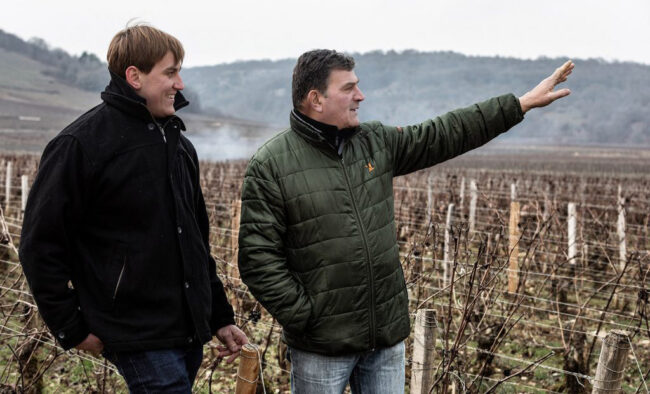
Winemaker Guillaume Rouget, left, with Frédéric Jametton, Domaine de Vernus
Thanks in part to Rouget’s influence, vinification is conducted along Burgundian lines, with around 70% of the grapes destemmed and fermented in stainless steel with élevage in recently-used, high-quality Burgundy barrels for some 10–11 months. Jametton’s ultimate goal, echoed by Rouget, is to offer a range of wines that brings out the best of the different terroirs while respecting the character and personality of each Cru and each plot. With Rouget in charge of the vineyards and winemaking process, Frédéric remains at the management helm and spearheads marketing.
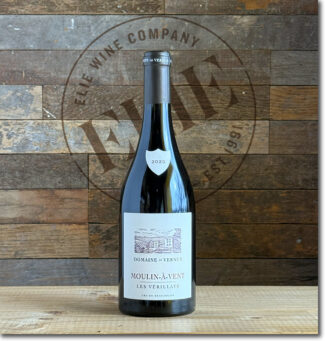 Domaine de Vernus, 2020 Moulin-à-Vent ‘Les Vérillats’ ($64)
Les Vérillats lieu-dit is considered one of the top terroirs in Moulin and is known for producing small, concentrated grapes, even from vines of the relatively young age of 27. The harvest is by hand; destemming is 100% and cold maceration is followed by three weeks of natural fermentation and then, aging in oak barrels, of which 11% new. The wine shows translucent purples with a fine balance of bright red fruit and lightly glinting acidity.
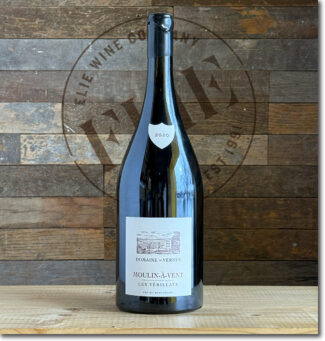 Domaine de Vernus, 2020 Moulin-à-Vent ‘Les Vérillats’ ($162) en magnum
The above wine in magnum, which will allow a fuller and more carefully controlled maturation process.
Château du Moulin-à-Vent
Château du Moulin-à-Vent has a history as unique and fascinating as the wine. In the late 1700s, Philiberte Pommier discovered that certain plots on her estate yielded better wines than others, and set out to understand the geology that underscored a self-evident truth. She began to tailor her winemaking to individual lieux-dits in her property (then called Château des Thorins), and in 1862, Pommier’s wines were deemed the best in the Mâcon region at the Universal Exhibition of London. At the time, Philiberte Pommier was 99 years old.
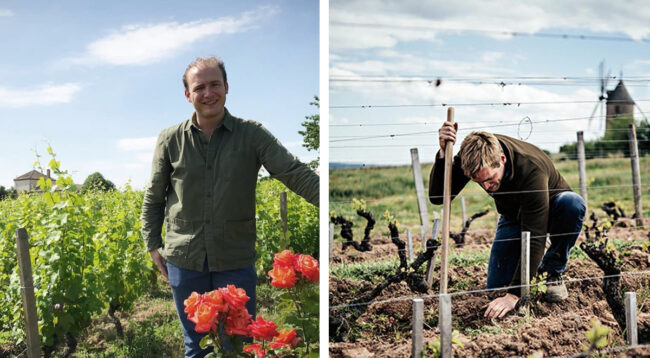
Édouard Parinet & Brice Laffond
Today, the estate encompasses nearly a hundred acres and covers some of the appellation’s finest climats—Les Vérillats, Le Champ de Cour, La Rochelle—with an average vine age of over forty years. The pink granite soil is rich in iron oxide, copper and manganese, and since 2009, under the new ownership of the Parinet family, investment in the winemaking facilities and the vineyards has resulted in plot-specific signature wines.
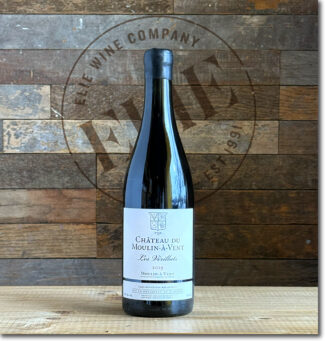 Château du Moulin-à-Vent, 2019 Moulin-à-Vent ‘Les Vérillats’ ($57)
Lieu-dit Vérillats is a high-altitude, east-facing site with only a thin layer of granite sands at the top of a granite mount—poor and porous soil that yields around 25 hectoliter/hectare. These conditions lend themselves to a serious, nearly tense wine with iron notes and graphite. These harsher notes are leavened by bright savory fruit and finely-textured tannins with some dark chocolate on the finish.
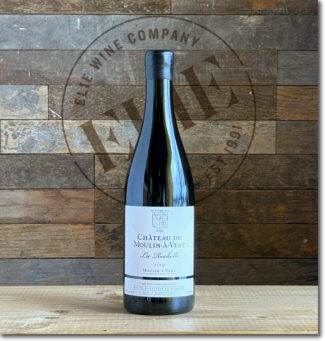 Château du Moulin-à-Vent, 2019 Moulin-à-Vent ‘La Rochelle’ ($72)
Lieu-dit La Rochelle sits on a côte, and hosts a thin layer of granite sands over very fine clays. Average yield here are 15hl/ha. with southerly exposures and an altitude of 920 ft. The wine is perfumed with summer strawberries and lifted notes of white pepper with fine and supple tannins. The finish excels; it is sharp and focused and showcases the site’s minerality.
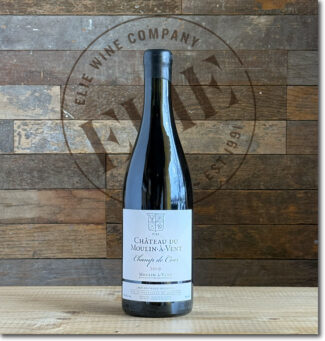 Château du Moulin-à-Vent, 2019 Moulin-à-Vent ‘Champ de Cour’ ($58)
Lieu-dit Champ de Cour sit at the bottom of the hill overlooked by the iconic windmill; its soils are varied forms of eroded granite and white alluvial clays. The lower elevation tends to mean deeper soil, so water retention is better. The wine is spicy and opulent with Moulin-à-Vent’s muscular typicity.
Thibault Liger-Belair
Domaine des Pierres Roses
Winemaking has been the legacy of Liger-Belair family for a quarter of a millennium. Prior to establishing his own domain, Thibault Liger-Belair studied oenology, worked for a communications firm in Paris and started an internet company to discover and sell high quality wines. Still, the vines beckoned, and in 2001, at the age of 26, he returned to them. The following year saw his first harvest of Nuits-Saint-Georges, and in 2003, he expanded into Richebourg Grand Cru, Clos Vougeot Grand Cru and Vosne-Romanée Premier Cru Petits Monts. In 2009, he ranged farther afield, into Beaujolais, and now produces Beaujolais-Villages and several Moulin-à-Vent wines.
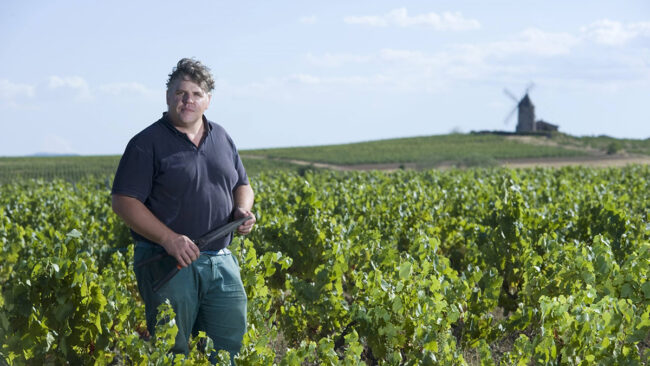
Thibault Liger-Belair
Although his Moulin wines are labeled as Liger-Belair, he speaks of his journey to Beaujolais under the name ‘Domaine des Pierres Rose’:
“Having completed a part of my studies in Beaujolais region, I have always been very attracted by the beauty of this region, its landscapes but also the quality and diversity of its soils. I then asked myself the question: why not create a Burgundian model by isolating each terroir within the same appellation in order to try to understand it and then make the most of its identity? My ever-growing curiosity has always made me want to understand other soils and other grape varieties, so that I can start again what I had built in Nuits-Saint-Georges in 2001, in Moulin-à-Vent in 2009.
To create the estate and buy the vines I have already tried to understand the different types of soil by asking the winemakers, by tasting the wines, but above all by walking through the vineyard. What surprised me first of all was to see so many differences in such a small area, it reminded me of the Burgundian terroirs. However, almost none of the producers were making differences between each of their vintages. Indeed, if they have vines in Moulin à Vent, they make a Moulin à Vent cuvée without isolating the different types of soil by different vintages. It’s hard to understand when you have a Burgundian approach that is based on the principle of isolating each of the plots.
So, I had the idea to acquire the best plots of land in the area, all located on the historical hillside of the appellation overhung by the Moulin à Vent, with the objective: to understand and to produce wines that stick to their climat as well as their grape variety: Gamay. The first plots were bought in 2008, in order to produce the first vintage in 2009. We have reproduced the same working methods as the ones as in Nuits-Saint-Georges by reintroducing ploughing while removing all weedkillers. We converted all the plots of land from the first year to organic and Biodynamic cultivation.”
The soil in his Moulin-à-Vent property is shallow (less than 20 inches deep) and composed primarily of granitic sand and quartz, and about half the vines of the 35 acres were planted between 1910 and 1955. His signature wine, for this reason, is ‘Les Vieilles Vignes’—the ‘old vines.’
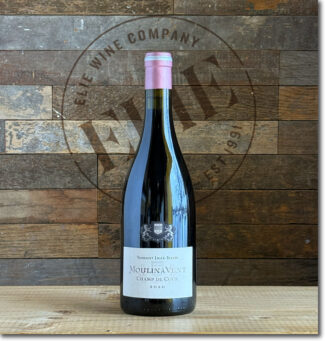 Thibault Liger-Belair, 2020 Moulin-à-Vent ‘Champs de Cour’ ($54)Champs de Cour is a tiny, south-facing parcel of 80 year old vines and produces a wine that typically shows its quality even when young. Harvesting is done by hand with between 40-50% left in whole bunches, following which the must is left to ferment in open vats for three weeks. Extraction is gentle and ageing is carried out in oak barrels that have seen between one and three wines for 18 months or more. The wine shows a well-balanced palate with black cherries, tar and blueberry through a chewy finish.
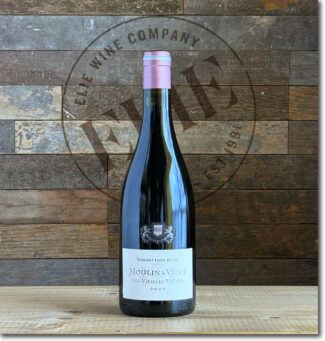 Thibault Liger-Belair ‘Vieilles Vignes’, 2020 Moulin-à-Vent ($48)
A cuvée blending nine old vine parcels of old vines located in a belt around the Moulin à Vent hill. The wine offers exotic aromas of spiced candied cherries with a rustic undertow of damp earth; bright, acidic with a firm tannic structure and long, sweet finish.
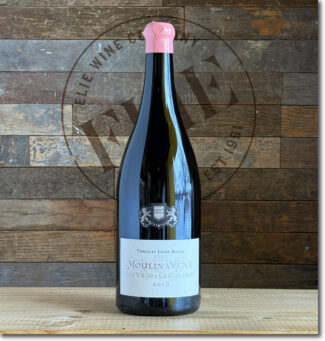 Thibault Liger-Belair ‘Centenaire’, 2015 Moulin-à-Vent ($250) en magnum
This wine originates in three distinct terroirs planted to Gamay between 1872 and 1880, pre-dating the scourge of phylloxera. One plot is the south of La Teppe, one in Les Bois Maréchaux in the north and one in Caves, to the west of the hill. Bottled only in magnums, it shows a distinctly mineral-driven nose and opens in the glass to reveal brooding dark fruit evolving into tertiary notes of forest floor and leather.
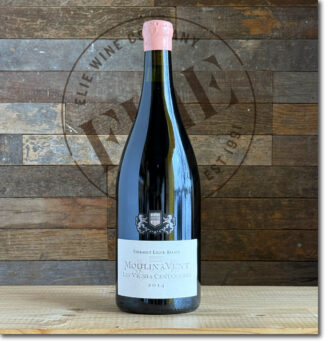 Thibault Liger-Belair ‘Centenaire’, 2014 Moulin-à-Vent ($160) en magnum
As rare as it is precise in focus, this ‘unicorn’ wine is made from vines that predate phylloxera; three distinct terroirs planted to Gamay between 1872 and 1880. One plot is the south of La Teppe, one in Les Bois Maréchaux in the north and one in Caves, to the west of the hill. 2014, as the practice, is bottled only in magnums.
Domaine de Rochegrès
Albert Bichot owns six domains in the heart of five great vinicultural regions; each estate cultivates its own land using with sustainable practices and employs a dedicated winemaking team devoted to that domain alone.
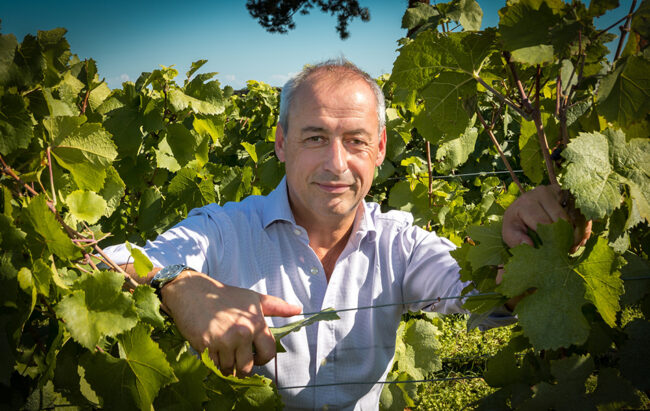
Albert Bichot, Domaine de Rochegrès
Bichot’s 13 acres within the 1631 acre Moulin-à-Vent appellation are located at the heart of one of the 18 recognized single vineyards, Rochegrès, meaning ‘grey rock’ As the name suggests, the granitic parent rock is visible at the surface of the soil in the vineyards. These vines benefit from mainly south-eastern exposure and thrive in very pure, lean pink granitic soil, forcing them to plunge their roots deep in search of the nutrients they need.
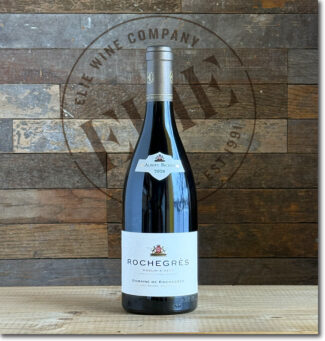 Domaine de Rochegrès, 2020 Moulin-à-Vent ‘Rochegrès’ ($48)
The wine, taken from the oldest vines in the Rochegrès lieu-dit, is 50% fermented in 350-liter barrels (20% new) and 50% in stainless steel vats; then 100% aged in stainless steel vats. It displays upfront notes of ripe cherry evolving toward forest bracken and dried flowers.
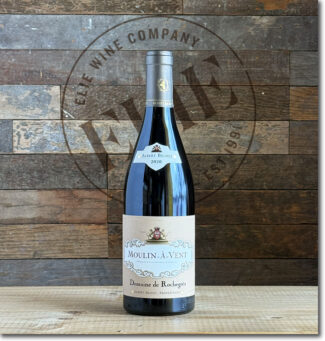 Domaine de Rochegrès, 2020 Moulin-à-Vent ($23)
The wine shows a classic bouquet of smoky black cherry and blackberry followed by clove, floral notes and earth. Some weight on the palate with a pleasant, but still firm, tannic structure and fresh acidity and a long, spicy finish.
Domaine des Terres Dorées
Jean-Paul Brun
With a name from a fairy tale (‘House in the Land of the Golden Stones’), Domaine des Terres Dorées is a 150-acre vineyard located in Charnay, just north of Lyon. Owner/winemaker Jean Paul Brun is a champion of ‘old-style Beaujolais’, and by ‘old’, he means an era before pesticides and herbicides, and especially, a time when native yeasts alone were used to ferment.
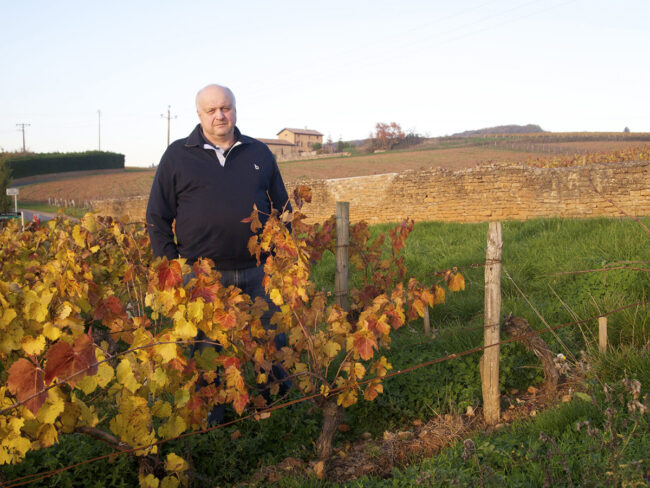
Jean-Paul Brun, Domaine des Terres Dorées
He says: “Virtually all Beaujolais is now made by adding a particular strain of industrial yeast known as 71B. It’s a laboratory product made in Holland from a tomato base, and when you taste Beaujolais with banana and candy aromas, 71B is the culprit. 71B produces a beverage, but without authenticity or charm.”
Brun also insists that Beaujolais drinks best at a lower degree of alcohol and that there is no need to systematically add sugar to the must (chaptalize) to reach alcohol levels of 12 to 13%.
“My Beaujolais is made to be pleasurable,” he maintains. “Light, fruity and delicious, not an artificially inflated wine that is only meant to shine at tasting competitions.”
“The emphasis is not on weight, but on fruit,” he adds. “Beaujolais as it once was and as it should be.”
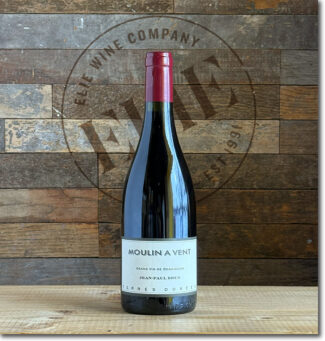 Domaine des Terres Dorées, 2020 Moulin-à-Vent ($27)
This wine is exemplary of ‘old school’ Moulin; allowed the longest maceration of any Jean Paul Brun cuvées, it ages in oak for ten months. It comes from Brun’s younger vines, which are still on the order of forty years old. The wine opens with scents of berry compote, licorice, sweet soil tones and spices while offering layered and compact mid-palate with fine depth and plenty of sweet, powdery tannin.
Famille Chermette
Domaine du Vissoux
When a winemaker tries to bottle something for everyone, he/she is not always successful. The father, daughter and son team of Martine, Pierre-Marie and Jean-Etienne Chermette of Domaine du Vissoux are the exception to prove the rule, producing high quality white, red and Beaujolais rosé from crus such as Brouilly, Fleurie, Moulin-à-Vent, Saint-Amour, Crémants de Bourgogne as well as hand crafted fruit liqueurs, cassis and vine peach with ginger.
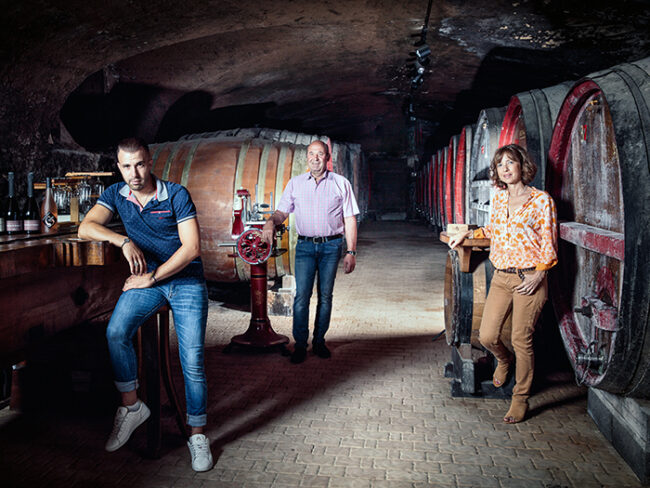
Jean-Étienne, Pierre-Marie and Martine Chermette
In 2002, Martine and Pierre-Marie Chermette acquired the La Rochelle plot in Moulin-à-Vent, a high-altitude lieu-dit with pink granitic soils and ideal south/southeast exposure. From this beautifully situated vineyard, the family wrests wines that live up to their reputation as a beacon of Beaujolais excellence, able to broadcast the region’s terroirs with authority: Old vines, diligent but traditional vinification and élevage in foudre are the rudiments of their approach.
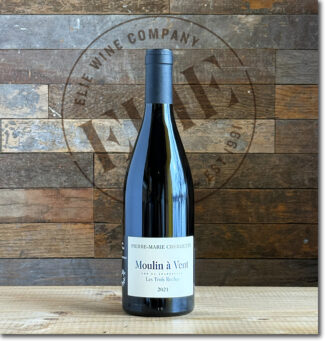 Pierre-Marie Chermette Vissoux ‘Les Trois Roches’, 2021 Moulin-à-Vent ($33)
Famille Chermette considers ‘The Three Rocks’ to be the ideal alliance between finesse and power. “The three different plots of vines we use for this cuvée give a wine that is full and balanced: Rochegrès give finesse, Roche Noire liveliness and fruit while La Rochelle contributes power.” The wine’s aromatic palate ranges from ripe red currants through soft pie spice and finishes with a nice mineral snap.
Domaine de la Sionnière
Estelle & Thomas Patenôtre
* Diochon is a branded Moulin-à-Vent cuvée from Domaine de la Sionnière; these wines were previously released under the Domaine Diochon label.
Along with his wife Estele, Thomas Patenôtre created the Domaine de la Sionnière in 1996, beginning with 15 vineyard acres in Romanèche-Thorins. Today, it covers more than thirty acres, with plots in some of the top Beaujolais lieux-dits, including Champ de Cour, Le Petits Morier, Les Greneriers and Les Perelles.
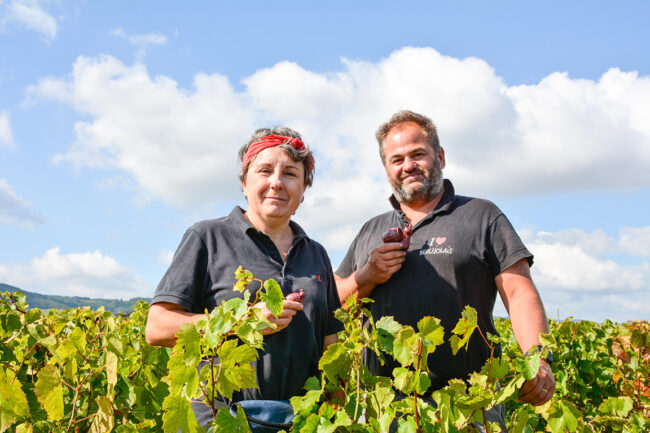
Estelle & Thomas Patenôtre
Moulin-à-Vent holds a place close to the Patenôtres’ heart. Says Thomas “Moulin-à-Vent stands out from other Beaujolais appellations, and the reason that some refer to it the ‘Lord of Beaujolais’ are to be sought in a glass. These are fine, complex and powerful wines with has superb aging potential, owing its intensity of exposure on the best hillsides, where the granite subsoil is rich in trace elements. Our role is to ensure that we create a harmonious balance between flavors, aromatics and tannic composition in order to obtain an authentic product. To achieve this end we pick at maximum, between the end of August and the end of September depending on the year. The grapes are then placed in vats without prior destemming in order to undergo the initial phase of carbonic maceration, characteristic of Beaujolais wines. Following this first stage, which lasts around ten days, the grapes are pressed and vatted to undergo alcoholic fermentation and malolactic fermentation. We’ll hold the wine in air-tight tanks for six to eight months before bottling.”
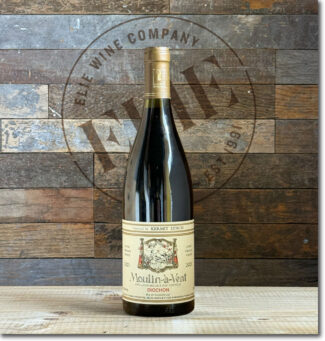 Domaine de la Sionnière ‘Diochon – Cuvée Vieilles Vignes’, 2021 Moulin-à-Vent ($31)
Crafted from vines planted in 1920, 1950 and the 1960s, it remains a benchmark of the old Diochon style, defined by well-integrated tannins without heaviness and lifted by fragrant fruit and floral aromas. The 2021 is true to this mission statement, over-performing for the vintage, filled with lush aromatics of sweet berries and plums mingled with peonies and potpourri.
Domaine de Roche-Guillon
Bruno and Valérie Copéret
With five generations working the same hillside, a certain metaphysical pas de deux takes place between terroir and wine grower. Add a third party (Bruno Copéret’s wife Valérie) and Domaine de Roche-Guillon is ready for the challenges of marketing and climate change that lie ahead. The Copéret vineyards spread over 22 rolling acres of granite-based soil; they enjoy a south facing exposure, which—combined with altitude of over 1100 feet—ensure the vines yield grapes with considerable ripeness.
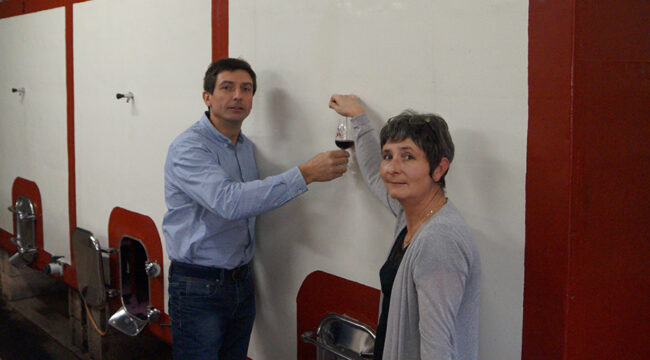
Bruno and Valérie Copéret, Domaine de Roche-Guillon
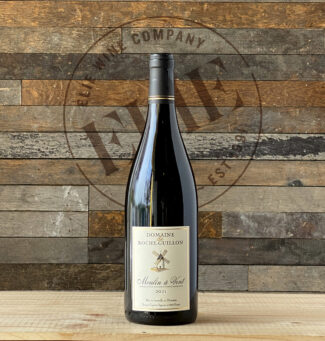 Domaine de Roche-Guillon, 2021 Moulin-à-Vent ($23)
The plots to elaborate this wine are located between the Vauxrenard commune and Émeringes, expressing the granitic soils of Vauxrenard and the sandy-clay of Émeringes. Half the selected grapes were fermented in whole bunches and half were destemmed before spending twelve days macerating at 84° F. With a floral potpourri on the nose and maraschino cherry and wild blackberry on the palate, the wine demonstrates typical muscularity of Moulin-à-Vent with gripping tannins, concentration and energy.
Beaujolais Vintage Journal
The 2021 Vintage: Chaotic Weather Allow for a Sugar/Acidity/Tannin Balance Different from Previous Sunny Years
A warm, humid winter prompted an early budbreak in Beaujolais—and that always puts growers at risk. In fact, April produced a vicious bout of frost followed by a snow-dump that affected new growth. A slight reprieve ensued in June, which allowed for a successful flowering, but heavy rain settled back in throughout July and August. The grapes did not dry out until late August, and the alert against rot and disease was a feature of the entire season.
Harvest came later than usual but was a success; the fruit remained fresh and aromatic with good acidity, although overall, 2021 wines are lighter in both body and alcohol compared to other years.
The 2020 Vintage: ‘Solar’ Vintages Continue, Round and Concentrated Wines
If you can invent a way to leave Covid out of the equation, 2020 was a wonderful vintage throughout Beaujolais. The growing season was warm, beginning with a mild and frost-free spring, which developed into a hot and sunny summer without hail or disease. Drought—a persistent worry in the region—was not as severe as it might have been, and by harvest-time the majority of grapes were in fine health with rich, ripe, almost Rhône-like flavors—raspberries, sour cherry and even garrigue; the local scrub comprised of bay, lavender, rosemary and juniper.
2020 yields were low due to the dry conditions, leading to concentrated juice and wines able to benefit from time in the cellar.
But, of course, you can’t leave Covid out of the equation: Normally the release of Beaujolais Nouveau occurs on the third Thursday of every November, but in pandemic-dominated 2020, the normal celebrations could not take place and producers instead chose to release the wines a week earlier than usual in order to allow for international shipping times.
The 2019 Vintage: The Hotter Rhône Weather Drifts North
As 2021, unexpectedly sharp April frosts cut yields throughout the region. The summer then heated up, with reports of temperature highs exceeding 104F. The ensuing drought further cut into yields, and adding insult to injury, hailstorms struck in mid-August. These storm clouds had a silver lining, however—they concentrated the juice within the fruit that remained on the vines. Although a heartbreaking loss to farmers who rely on quantity, the resulting wine is very intense with nicely balanced acids. The top estates produced cellar-worthy gems—a marvelous representation of what the appellation can offer.
Notebook …
Spoiled For Choice: More Than One Way To Make Beaujolais
The truism about the Germans and Riesling holds equal validity in Beaujolais with Gamay: They each have but a single grape, but build better wines from it than anyone else on earth. This is not to suggest that Beaujolais and its ten fascinating Grand Crus are homogenous—the opposite is true. Each region, each climat and each winemaker provides slight variations in terroir and technique.
Nowhere does the dual nature of Beaujolais appear more profoundly than in the choice faced by winemakers to vinify in the traditional ‘Burgundian’ way, or to rely on the semi-carbonic macerations that produce the fruity, ridiculously early-drinking Nouveau-style wines. Both techniques have their place in Beaujolais, and both produce strikingly different flavor profiles.
Traditional Burgundian-style production relies on destalking and crushing the grapes prior to fermentation, a mean of opening up the fruit up and bringing out the tannins. Only then does fermentation start, either through natural yeasts on the grape skins or from a commercial additive. In most cases, wines made this way in Beaujolais will also have wood aging. Alternately, semi-carbonic maceration involves fermentation that starts in closed containers. The wine is then transferred to traditional fermentation vats and yeast is added to continue the process. While some of the wines will go into wood, many will continue to age in tanks, which highlight the fruit and lower the tannins.
Moulin-à-Vent is Capable of Long-Aging, Pleasurable While Young
‘Decanter Magazine’ recently staged a vertical tasting of Château du Moulin-à-Vent, vintages 2010-2019 (and published in the July 2022 issue), believing that the revitalization of the estate by the father-and-son team of Jean-Jacques and Édouard Parinet (and their brilliant winemaker Brice Laffond) has been so successful that they were willing to give Master of Wine Andy Howard a crack at determining if all the hype around the ageability of Moulin-à-Vent is warranted. Wines from 1996 and 1976 were also tasted.
No cliffhangers here: Howard MW’s opinion was a resounding ‘yes’.
As most Beaujolais fans know, the wines of the ten Crus of Beaujolais can be among the world’s most terroir-expressive. Subtle shifts in sun exposure and soil structure from commune to commune can be detected in the glass, even among those with untrained palates. The wines from Château du Moulin-à-Vent are traditional standouts for their robust texture, deep flavor and age-worthiness made possible by Jacques and Édouard Parinet’s adherence to Burgundian winemaking methods and their steadfast refusal to employ semi-carbonic maceration. Because of that, their wines reveal the best of Beaujolais’ most powerful Cru, the wind-funnel slopes of Moulin-à-Vent.
According to Howard MW: “The tasting certainly demonstrated a distinct shift in style with the change in oak management. Whereas the older vintages (although with undoubted aging potential) demonstrated a firmer tannic structure, the more recent vintages were much more expressive, floral, delicate and refined. However, there is every reason to suspect that these wines will deliver the same ageing capacity as the more ‘traditional’ style.”
- - -
Posted on 2025.02.01 in France, Wine-Aid Packages | Read more...
The Champagne Society February 2025 Selection: Pascal Lejeune
Champagne Pascal Lejeune’s Terroir Fundamentals
Preserving a Place’s Details and a Vine’s Finger Print in a Single Premier Cru Village

The Coteaux Sud d’Épernay
Premier Cru Pierry In Two Bottles ($103)
Champagne Pascal Lejeune ‘N°4 – OXYMORE’ Blanc de Noirs (100% Meunier) Brut
and
Champagne Pascal Lejeune ‘N°2 – ANAPHORE’ Premier Cru Pierry Blanc de Blancs (100% Chardonnay) Extra-Brut
 Dear Member,
The soul of Champagne has always been finesse, and a Cellar Master’s decision to balance blends (in a search for complementary aromas and personalities) or to bottle a single variety is intended to be a statement. Listening to the winemaker’s voice in different incarnations of the same art form is to enjoy an ever-changing dialogue between man and grape.
It’s our normal practice to send out a single bottle as a bimonthly presentation, but this month, it will be two—one Blanc de Blancs and one Blanc de Noirs—from Champagne Pascal Lejeune. Taste them individually or side-by-side; each is a unique reflection of Pascal and Sandrine Lejeune’s commitment to terroir expression through organic cultivation.
Listen to the conversation with your nose and palate and decide which one resonates best with your personality.
Elie
The permutations of Champagne are as varied as its terroir, but in the exploration, facts keep popping up in triads: In the favored grapes (Pinot Noir, Chardonnay, Meunier), in styles (Blanc de Noirs, Blanc de Blancs, Rosé) and in varying level, in dosage (Brut, Sec and Doux). There are strata in each of these categories, of course, but you get the picture.
Now the trio of Pascal, Sandrine and Thibaut Lejeune (a dad, mom and son team) from the Coteaux Sud d’Épernay, are excelling in the production wines from three categories: Village level, lieu-dit (monoparcellaire) level and a cépage made of grapes from the three villages where they grow fruit, Épernay, Moussy and Vinay.
A new addition to our Champagne portfolio, Champagne Pascal Lejeune is a small grower/bottler whose reputation is as solid as the output is small. These wines represent both a spirit of renewability in an age-old product and some of the most terroir-reflective Champagnes we’ve tasted.
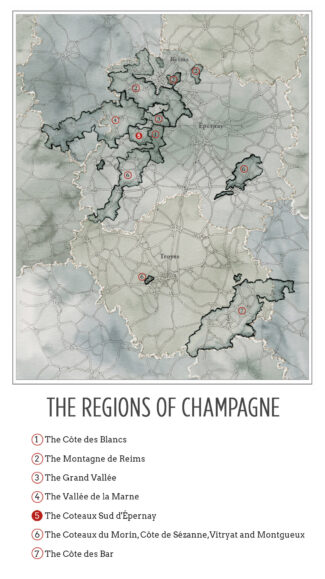
The Coteaux Sud d’Épernay: Middle Grounds
The Reims-based Union de Maisons de Champagne names 17 ‘terroirs’ in Champagne; among them, on the left bank of the Marne river, is Côteaux Sud d’Épernay. As the name suggests, it occupies the slopes (côteaux) south of Épernay. These slopes are formed by three streams (another triad), Le Cubry, Le Darcy, and Le Mancy. Le Cubry empties into the Marne at Épernay, and forms the valley that runs to the southwest and further west to Saint-Martin-d’Ablois. Le Darcy is a tributary of Le Cubry that empties into the latter at Pierry and Le Mancy is a tributary of Le Darcy that empties into it in the northern part of the Mancy commune.
Enough geography? On to grapes! The Coteaux Sud d’Épernay is fairly evenly balanced between Meunier at 46.7% and Chardonnay at 40.9%, with Pinot Noir making up the remainder. Somewhat simplified, it can be said that Chardonnay is most common in Épernay and in the valleys of Le Mancy and Le Darcy in the north and east, while Meunier prevails in the valley of Le Cubry (excluding Épernay) in the center and west.
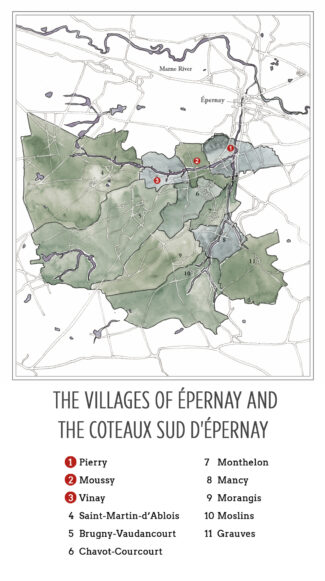
Sandwiched between two powerhouse wine regions (Côte des Blancs and Vallée de la Marne), the Coteaux has an identity removed from either one. Its terroir is different from the clay-heavy soils of the Marne and it lacks the pure chalk that puts the ‘blanc’ in the Côte des Blancs.
In short, these Champagnes are uniquely situated to offer the best of both worlds. As a result, the Coteaux Sud d’Épernay has long fought for recognition as entity unto itself, not necessarily a sub-region of its big brothers on either side.
The current vineyard surface in the Coteaux Sud d’Épernay is a little over 3000 acres distributed among 878 vineyard owners in 11 communes.
Champagne Pascal Lejeune
Beating swords into ploughshares is a Biblical injection that Pascal Lejeune takes literally—he left his career in the military and gave himself to the vine. It didn’t hurt that he fell in love with a Champagne grower’s daughter: Pascal’s wife Sandrine hails from a family that has been growing grapevines in Moussy (where more than half of the vineyard’s grapevines are located) on the south-facing slopes of Épernay since 1910. Originally a side operation, not an essential part of the family’s activities, Sandrine’s great grandfather Edmond played an active part in creating the Moussy cooperative.
In 1995, when Pascal and Sandrine took the reins, their aim was to usher in a new era by enlarging the vineyard area into nearby terroirs, and by enriching the range of offerings via new cuvées: As a brand, Champagne Pascal Lejeune was born.
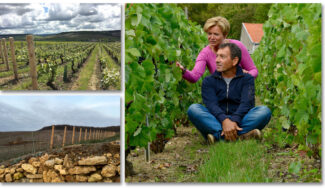
Pascal and Sandrine Lejeune, Champagne Pascal Lejeune
Says Pascal, “I believe I have a responsibility and commit myself collectively to our business and our terroir in order to perpetuate and monitor developments for our children and future generations. This requires a sincere respect for people, nature, our vines, our soils, and careful work in order to obtain quality grapes. To offer you the best that nature offers us, our vintages are very different, there is something for every occasion and taste… Nature does things well!”
This commitment to nature has been proven out over the past 17 years; Lejeune was one of the first producers in Champagne to plant specially-selected grass species between vine rows. Manual techniques are used for pruning, trellising and debudding. “The benefits of this special care can be observed,” says Sandrine. “Biodiversity is maintained, the soils are protected, the erosion is limited, and as the grapevine roots develop, the phytosanitary products have been significantly reduced.
Pascal adds: “Our aim is to give our soils the utmost respect in order to express the organoleptic qualities with authenticity and reveal the subtlety of our champagne. The culmination of these special treatments is, strictly speaking, the grape harvest, which is carried out entirely by hand, reflecting an entire year’s labor of love.”
Pascal and Sandrine are happy with the latest addition to their team, their son Thibaut, now a fifth-generation wine-grower, who joined the family business in 2015. Having completed his oenology and BAC qualification, he shares his father’s passion for grapevines and brings a fresh perspective to the family adventure, and offers a perspective on what he has taken on:
“Our three grape varieties spread out across a mosaic of 42 plots, 64% of our vines are Meunier. Otherwise, Chardonnay and Pinot Noir represent respectively 25% and 11% of the whole vineyard.”
Single-Village Expression: The Stony Soils of Premier Cru ‘Pierry’
The Premier Cru village of Pierry is located immediately to the south of Épernay at the foot of southeast-facing slopes where the vineyards are located. The stream Le Cubry, which forms the valley runs just below the village and continues to the west, emptying into the Marne River at Épernay. Within Pierry, single vineyard sites include Cantuel, Les Chevernets, Les Gayères, Les Gouttes d’Or, Les Noues, Les Porgeons, Les Rouges Fosses, and Les Tartières.
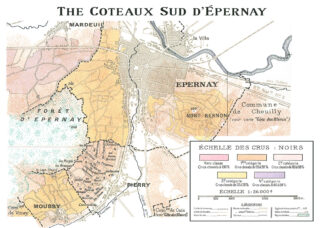
In the now-defunct ‘échelles des crus’ system, Pierry’s former rating of 90% makes it a Premier Cru village, the only commune in the Coteaux Sud d’Épernay to be so classified. (Its three neighbouring communes in the same area were rated 88%.) The terroir explains it, and a local saying is, “Pierry est Pierreux…” Pierry is stony, dominated by flint and chalk, and this minerality carries through to the wine.
Pierry’s current vineyard surface is 270 acres; half Meunier, 32% Chardonnay and 18% Pinot Noir. There are 125 vineyard owners in the commune.
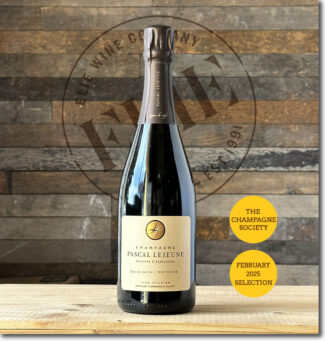 nv Champagne Pascal Lejeune ‘Figure de Style N°4 – OXYMORE’ Brut ($49)
100% Meunier, 40% from the 2019 harvest, 60% reserve wine from 2018; the wine undergoes partial malolactic and 30% barrel aging with regular lees stirring. Dosage is to Extra-Brut level; 6 gram/liter. The wine is plump and bold with rich notes of raspberry and stone fruit underlined by cassia and clove, all characteristics of the Meunier grape. 1255 bottles made. Disgorged July 2023.
Chardonnay in Pierry
Less than 30% of Champagne’s 84,000 low, densely-planted acres are Chardonnay, the grape that lords of Burgundian white wine. In cool climates north of Burgundy, however, Chardonnay demands well-favored sites and thrives best on the south- and east-facing chalky slopes of the Côte des Blancs south of Épernay.
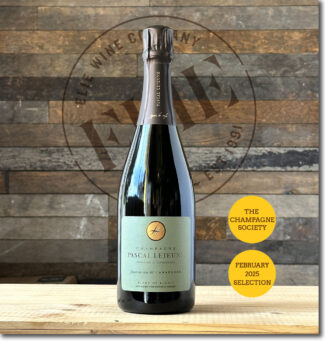 nv Champagne Pascal Lejeune ‘Figure de Style N°2 – ANAPHORE’ Blanc de Blancs Extra-Brut ($54)
100% Chardonnay, all from the 2020 harvest; the wine ages in 30% oak barrels for ten months with regular stirring of lees. Dosage is to the level of Extra-Brut, 4 gram/liter, using homemade liquor distilled from the three grape varieties used in Champagne. The wine displays complex aromas of lime, sweet Meyer lemon and golden apple. 1235 bottles made. Disgorged February 2024. 2900 bottles produced.
Site-Specific ‘Parcellaire’: Village Vinay’s Lieu-dit ‘Les Longs Martins’
The vineyards of Vinay in the Vallée de la Marne, are located both on the slope southwest of Épernay formed by the valley of the stream Le Cubry, and also, in part, below the slope. The vineyards face south-south east, and Meunier is the most common grape variety found. The vineyards are continuous with those in Moussy and Saint-Martin-d’Ablois. The 365 acres are owned by 102 individual ‘exploitants.’
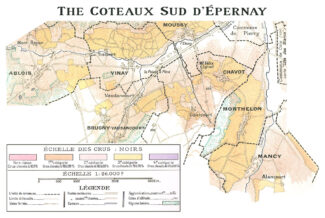
A ‘parcel’ is site-specific, synonymous with ‘lieu-dit’ as used in Burgundy—a named group of exceptionally emblematic vine. It is estimated that there are 84,000 of these named parcels throughout Champagne. ‘Les Longs Martins’ is one.
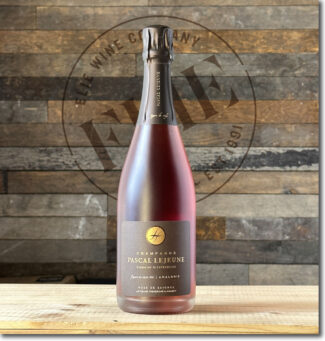 nv Champagne Pascal Lejeune ‘Figure de Style N°6 – ANALOGIE’ Rosé de Saignée Zéro Dosage ($74)
From the organic lieu-dit ‘Les Longs Martins’, this saignée is 100% Pinot Noir (2019 harvest) from vines that average 25 years old grown in clay, silt, sand and marne limestone. Maceration lasted ten hours, and no malolactic fermentation occurred, leaving the crisp acids intact along with notes of brioche, sweet pastry, vanilla, ripe forest berries and raspberry coulis. Only 638 bottles made. Disgorged December 2022.
The Bigger Picture: Villages Vinay, Moussy and Épernay
Of the 18 communes in the canton ‘Épernay-2’, the triad that produces grapes for Style N°1 each brings its own special spice to the party.
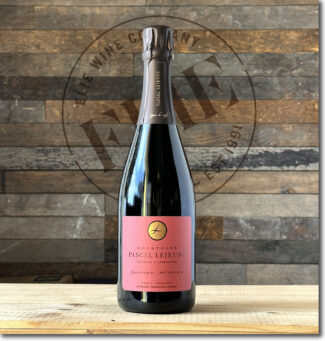 nv Champagne Pascal Lejeune ‘Figure de Style N°1 – METONYMIE’ Extra-Brut ($42)
59% Meunier, 32% Chardonnay, 9% Pinot noir from vines that average thirty years old and grown on a south-southeast exposure. 40% of the harvest in this wine came from 2019, the rest from 2018; malolactic only touches the 2019. These grapes originate in the three communes of Vinay, Moussy and Épernay and provide beautifully focused aromas of apple, caramel, stones and minerals. 13,875 bottles made. Disgorged July 2023 and dosed at 4 gram/liter.
Notebook ….
Single Harvest vs. Vintage
In France, under Appellation d’Origine Contrôlée (AOC) rules, vintage Champagnes must be aged for three years—more than twice the required aging time for NV Champagne. The additional years on the yeast is said to add complexity and texture to the finished wine, and the price commanded by Vintage Champagne may in part be accounted for by the cellar space the wine takes up while aging.
On the other hand, a Champagne maker might prefer to release wine from a single vintage without the aging requirement; the freshness inherent in non-vintage Champagnes is one of its effervescent highlights. In this case, the wine label may announce the year, but the Champagne itself is referred to as ‘Single Harvest’ rather than ‘Vintage’.
Drawing the Boundaries of the Champagne Region
To be Champagne is to be an aristocrat. Your origins may be humble and your feet may be in the dirt; your hands are scarred from pruning and your back aches from moving barrels. But your head is always in the stars.
As such, the struggle to preserve its identity has been at the heart of Champagne’s self-confidence. Although the Champagne controlled designation of origin (AOC) wasn’t recognized until 1936, defense of the designation by its producers goes back much further. Since the first bubble burst in the first glass of sparkling wine in Hautvillers Abbey, producers in Champagne have maintained that their terroirs are unique to the region and any other wine that bears the name is a pretender to their effervescent throne.
Having been defined and delimited by laws passed in 1927, the geography of Champagne is easily explained in a paragraph, but it takes a lifetime to understand it.
Ninety-three miles east of Paris, Champagne’s production zone spreads across 319 villages and encompasses roughly 85,000 acres. 17 of those villages have a legal entitlement to Grand Cru ranking, while 42 may label their bottles ‘Premier Cru.’ Four main growing areas (Montagne de Reims, Vallée de la Marne, the Côte des Blancs and the Côte des Bar) encompass nearly 280,000 individual plots of vines, each measuring a little over one thousand square feet.
The lauded wine writer Peter Liem expands the number of sub-regions from four to seven, dividing the Vallée de la Marne into the Grand Vallée and the Vallée de la Marne; adding the Coteaux Sud d’Épernay and combining the disparate zones between the heart of Champagne and Côte de Bar into a single sub-zone.

Courtesy of Wine Scholar Guild
Lying beyond even Liem’s overview is a permutation of particulars; there are nearly as many micro-terroirs in Champagne as there are vineyard plots. Climate, subsoil and elevation are immutable; the talent, philosophies and techniques of the growers and producers are not. Ideally, every plot is worked according to its individual profile to establish a stamp of origin, creating unique wines that compliment or contrast when final cuvées are created.
Champagne is predominantly made up of relatively flat countryside where cereal grain is the agricultural mainstay. Gently undulating hills are higher and more pronounced in the north, near the Ardennes, and in the south, an area known as the Plateau de Langres, and the most renowned vineyards lie on the chalky hills to the southwest of Reims and around the town of Épernay. Moderately steep terrain creates ideal vineyard sites by combining the superb drainage characteristic of chalky soils with excellent sun exposure, especially on south and east facing slopes.
… Yet another reason why this tiny slice of northern France, a mere 132 square miles, remains both elite and precious.
- - -
Posted on in France, Saturday Sips Review Club, The Champagne Society, Champagne | Read more...
Châteauneuf-du-Pape Finds Its Balance: Neo-traditionalist Isabel Ferrando Makes the Case for Blending (or not Blending) Terroir & Varieties. Pack $499
In-Store Tasting with Guillemette Ferrando, Famille Isabel Ferrando
Saturday Sips, January 18 from 1 pm to 3 pm
This Saturday, January 18, from 1pm to 3pm, we are excited to welcome Guillemette Ferrando, daughter of iconic, iconoclastic winemaker Isabel Ferrando for an in-house tasting of the wines of Famille Isabel Ferrando. Guillemette will walk us through technique and philosophy, illustrating the evolution of Châteauneuf-du-Pape and her mother’s journey from a high-powered banker to a dynamic vigneron in beautiful Southern Rhône. Isabel’s expressions of Châteauneuf-du-Pape are as unique as they are profound, and Guillemette has inherited a pioneering spirit and adaptability in and out of the vineyard.
Elie

Isabel Ferrando and daughter Guillemette
Isabel Ferrando comes from a small town about a half an hour south of Châteauneuf-du-Pape. To the hidebound traditionalists in Southern Rhône’s most heralded appellation, that means she is an outsider. Perhaps if you want to bring something new to the party, it helps if you weren’t invited to the party in the first place.
In any case, since launching Domaine Saint-Préfert in the early years of this century, drawing from a 33 acre parcel she purchased from the Serre family, her wines have earned some of the highest praise in France. Critics have trumpeted her wines as being not only among the most profound in Châteauneuf-du-Pape, but in the world.
And to her everlasting credit, Ferrando has managed to wrest many of these gems from a parcel that is considered among the most heat-prone in the region.
Her reputation has grown in each year of the two decades since her first release in 2003, but this has not stopped her from constant innovation, introspection and improvement. She was certified biodynamic in 2022, the same year she opened a new winery (built from local Luberon stones) with an assortment of cement vats for primary fermentations and blending. In the cellar, Ferrando works primarily with neutral demi-muids, but she has also introduced glass demi-johns, Stockinger foudres, and amphora. Aging in the correct vessel for the style and variety has become a cornerstone of her technique.
She says, “Under the benevolent and demanding eye of Henri Bonneau, the maestro, I learned that work in a vineyard must be progressive, from the slow taming of the vines to the translation of the grapes into wine. Inspired by the tradition of Burgundy’s climats, I first produced three cuvées from the Saint Préfert terroirs from 2003 to 2019: Classique, Réserve Auguste Favier and Collection Charles Giraud. Then, the Grand vin du terroir de Saint Préfert was created in 2020, the ultimate result of 20 years of work.”
The Terroir of Châteauneuf-du-Pape: A Mosaic of Soils
Châteauneuf-du-Pape in France’s Rhône valley has traditionally been viewed as a rustic cousin to the elegant and long-lived persistence of great wines from Bordeaux and Burgundy. Châteauneuf is age-worthy, certainly, but there is exuberance in the fresh fruit flavors that dominate the style that makes it decadently drinkable virtually from the day it is released. It was said to make up for in pleasure what it lacked in sophistication.
With more than 8,000 acres under vine, Châteauneuf-du-Pape is the largest appellation in the Rhône, producing only two wines, red Châteauneuf-du-Pape, representing 94% of the appellation’s output, and white Châteauneuf-du-Pape. Of the eight red varietals planted, Grenache is the most dominant variety by far, taking up 80% of vineyard space, followed by Syrah, Mourvèdre and tiny quantities of Cinsault, Muscardin, Counoise, Vaccarèse and Terret Noir.

Terroir varies and can only be viewed as a generalization; limestone soil predominates in the western part of Châteauneuf-du-Pape; sand and clay soil covered with large stones on the plateaus. Mixed sand, red and grey clay, and limestone can be found in the northern part of the appellation, less stony soil alternating with marl in the east and shallow sand and clay soil on a well-drained layer of gravel in the south. The large pebbles contribute to the quality of the vines and grapes by storing heat during the day and holding water.
Like the soils, there is an enormous diversity of winemaking styles among CdP producers, creating both appealing, easy-to-understand fruit-filled wines as well as wines of greater intensity and sophistication.

Untrained Old Vines Grenache Bush in Galets Roulés

Grès Rouge, Sand and Safre
Châteauneuf-du-Pape’s New Old-Style
Throughout much of its history, CdP provided a leathery foil to the potent and somewhat austere elegance of Bordeaux and the heady sensuousness of Burgundy. CdP is ‘southern wine’, filled with rustic complexity—brawny, earthy and beautiful. But as a business, all wine finds itself beholden to trends, since moving product is necessary to remain afloat. During the Dark Ages (roughly1990 through 2010—in part influenced by the preferences of powerful critic Robert Parker Jr.) much of Châteauneuf-du-Pape’s output became bandwagon wines, jammy and alcoholic, lacking structure and tannin, in the process becoming more polished than rustic and more lush than nuanced. For some, this was delightful; for others, it was a betrayal of heritage and terroir.
These days, a new generation of winemakers seem to have identified the problem and corrected it. Recent vintages have seen the re-emergence of the classic, balanced style Châteauneuf-du-Pape, albeit at slightly higher prices. A changing climate has also altered traditional blends, so that more Mourvèdre may be found in cuvées that were once nearly all Grenache. Mourvèdre tends to have less sugar and so, produces wine that is less alcoholic and jammy, adding back some of the herbal qualities once so highly prized in the appellation. But a return to old school technique has also helped; however, many of the wines in this offer were destemmed prior to crushing and were fermented on native yeast rather than cultured yeast.

The Primacy of Place: Blending Terroirs Changes its Role
Terroir has always been lauded as a reflection of place while blending is a means for a winemaker to reflect an interpretation of places. When a wine is released as a monovarietal from a labeled lieu-dit, the expectation is that its character will express primacy—all the specific complexities of a specific soil structure and exposure-driven weather conditions over a single season.
When a wine is released as a blend, both of grape varieties and vineyards, the paradigm shifts and the goal—born of practicality, tradition or artistic license—is to showcase a final product built from various ingredients, as a chef might conceive a course. Likewise, a choral group does not seek to drown out potential soloists, but to use each voice to its strength. An ensemble of terroirs is a search for harmony. It does not try to overpower individual terroirs, but the opposite: It attempts weave them together to create a tapestry that illustrates the totality of a concept.
Rare is the winemaker who not only appreciates, but excels under both philosophies. So it is fitting that Isabel Ferrando has situated herself in Châteauneuf-du-Pape, where blending wines is the foundation of tradition. In 2020, Ferrando—having studied her parcels for many years—decided to explore the idea of blends. She says, “18 years of experience and knowledge of the terroirs and grape varieties now allow me to return to the great tradition of Châteauneuf-du-Pape, so I have released single blended wine in Châteauneuf-du-Pape red and white. …because the history of this appellation is written in this great art.”
Famille Isabel Ferrando
The ‘Grand Vin du Terroir de Saint Préfert’
If a ‘Grenachiste’ is a loyalist who fights for Grenache, it would be hard to find a High Priestess more qualified than Isabel Ferrando. A former banker who learned winemaking at Domaine Raspail-Ay in Gigondas, she purchased the seventy-year old Domaine Saint-Préfert from the Serre family (one of the region’s first domains to estate bottle) in 2002. That year, the property stood at a little over thirty acres, all in the Les Serres lieu-dit south of the village of Châteauneuf.
Les Serres has a much longer history: In the 1920’s, a pharmacist from Avignon named Fernand Serre purchased a vineyard parcel south of Chateauneuf du Pape, drawn to the spot by coincidence of the name: Les Serres. When Ferrando purchased the lieu-dit, she found vines more than a hundred years old. Alas, many were unsalvageable, and some places needed to be replanted entirely.

Isabel Ferrando
Once a successful first vintage was in the cellar, Ferrando began to purchase more land in the appellation, expanding her holdings to its current 55 acres. Among her acquisitions was a small parcel of old-vine Grenache vines that became Domaine Ferrando ‘Colombis’. Meanwhile, in 2013, Domaine Saint Préfert earned its certification for using 100% biodynamic farming, an agricultural technique that is somewhat easier pull off in Châteauneuf thanks to the sporadic but predictable Mistral winds that naturally protect vines from pests and mildew.
Still, it is Ferrando’s ever-growing expertise and hands-on winemaking that produces her outstanding portfolio. Says ‘The Grenachiste’: “There is no secret formula to making great wines in Châteauneuf. I work with a young team who is always open to new ideas. We rely on tradition without being trapped by it, working with whole-cluster fermentations without added yeasts because we discovered that it increased freshness in the wines and lowered alcohol, giving the wines vibrancy. Aging occurs in a mix of concrete and used foudres for up to 18 months.”
Isabel maintains that her responsibility is to strive for constant innovation to propel the estate forward. She believes that ‘innovation today is the innovation of yesterday.’ It is what led her to embrace biodynamic farming and it is what led her to build her new winery with only materials from within or surrounding her vineyards: It is what led Isabel to re-embrace the DNA of Chateauneuf-du-Pape and focus on the singular blended wine to showcase the best of the vintage.
* It is noted that with the arrival of Isabel Ferrando’s daughter Guillemette to the winemaking team in 2020, Isabel Ferrando has bottled her wines under the name ‘Famille Isabel Ferrando’ and totally changed the range previously labelled as Domaine Saint-Préfert.
Instead of an extensive portfolio of single-vineyard bottlings, she has combined most of her fruit (formerly bottled as ‘Classique,’ ‘Reserve Auguste Favier’ and ‘Collection Charles Giraud’) into a new flagship cuvée.
Latest Release: Special Pre-Arrival 6-Bottle Sampler Pack $499
We are proud to offer our family of customers a specially priced Famille Isabel Ferrando pre-arrival pack that includes one bottle each of Ferrando’s Châteauneuf-du-Pape (red) 2022 and white (2023) with one bottle of the special ‘Colombis’ cuvée in addition to three bottles of Famille Isabel Ferrando’s Côtes du Rhône ‘Beatus Ille’ 2023.
Côtes du Rhône ‘Beatus Ille’: The Gateway to Châteauneuf-du-Pape
The storied River Rhône runs through southern France from its bed in the south of the Drôme, flowing between vineyards and ancient edifices all the way to the sea. Only a small portion of it wends through the vineyards that have become its most renowned, those of Châteauneuf-du-Pape—a village you can drive through faster than you can pronounce its name. Surrounding it are the other, less flashy, less famous and less pricy vines of the Côtes du Rhône.
‘Beatus Ille’ is a quote from an ancient poem by Horace in the second Epode; it translates to ‘happy is the man,’ and may well be the mood of those who first smell the sea and wild herbs of the Provence. Ferrando chose this name to reflect the spirit of the wine, which she refers to as, “A wine of great freedom, expressing the pleasure of living in the country surrounded by good food and true friends. Beatus Ille is a cup of fresh fruit that is greedy, complex and uninhibited.”
 2020 Domaine Saint Préfert ‘Clos Beatus Ille’, Côtes du Rhône ($31)
90% grenache, 5% Syrah, 5% Cinsault from a parcel named ‘La Lionne’ in the Sorgues district just at the southern border of Chateauneuf-du-Pape where the soil is a blend of red clay and pebbles. It’s 100% destemmed and fermented and aged in cement tanks. It shows loads of fresh summer fruit with a touch of Provençal herbs and a hint of peppery spice behind nicely integrated tannins.
 2023 Famille Isabel Ferrando ‘Beatus Ille’, Côtes du Rhône (PRE-ARRIVAL $33) Package $499
Ferrando’s 2023 release of ‘Beatus Ille’ takes advantage of the vintage’s aggressive warmth to produce a bottling full of explosive and opulent fruit peppered with the region’s classic garrigue.
.
Châteauneuf-du-Pape ‘Classic’: Post Parcellar Exploration
Wine evolves and so do winemakers. When the two are in tandem, the results can be unparalleled. That is certainly the case with Isabel Ferrando’s re-interpretation of her mission in CdP.
Of course, the concept of evolution may apply to an entire appellation, and nowhere is the relatively rapid rise, fall, and rebirth of a style more evident than in Châteauneuf-du-Pape. Throughout much of its history, CdP proved to be a leathery foil to the potent and somewhat austere elegance of Bordeaux and the heady sensuousness of Burgundy. They were considered ‘southern wines’ of rustic complexity—brawny, earthy and beautiful.
But as a business, wine finds itself beholden to trends, since moving product is necessary to remain afloat. Suring the Dark Ages (roughly1990 through 2010—in part influenced by the preferences of powerful critic Robert Parker Jr.) much of Châteauneuf-du-Pape’s output became bandwagon wines, jammy and alcoholic, lacking structure and tannin, in the process becoming more polished than rustic, more lush than nuanced. For some, this was delightful; for others, it was a betrayal of heritage and terroir.
Isabel Ferrando seems to have identified the problem and corrected it. Her take on the classic, balanced style Châteauneuf-du-Pape is aided by a changing climate has also altered traditional blends, so that more Mourvèdre may be found in cuvées that were once nearly all Grenache. Mourvèdre tends to have less sugar, and so produces wine less alcoholic and jammy, adding back some of the herbal qualities once so highly prized in the appellation. But a return to old school technique has also helped.
If you survived the Fruit-Bomb era begrudgingly, you will no doubt welcome the return to the future that has begun to again take hold in Châteauneuf-du-Pape, in many ways, completing a cycle.
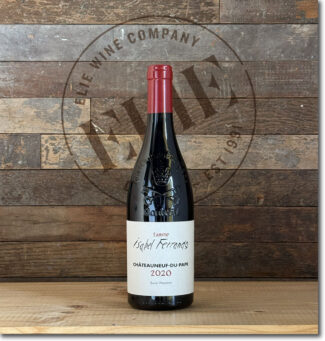 2020 Famille Isabel Ferrando ‘Saint Préfert’, Châteauneuf-du-Pape ($114)
2020 was the year that Isabel Ferrando put her poetry in motion, creating a cuvée of 75% old-vine Grenache, 12% Cinsault, 11% Mourvèdre, and 2% Syrah drawn entirely from the Les Serres parcel, the oldest vines she owns. This was the fruit previously used to make up her Favier and Giraud wines. 100% whole cluster made in demi-muids; the wine shows polished oak spice and toasty cedar encasing warm blackberry compote, fig and red currant. The wine is incredibly concentrated with suave tannins on a long, mocha-dusted finish.
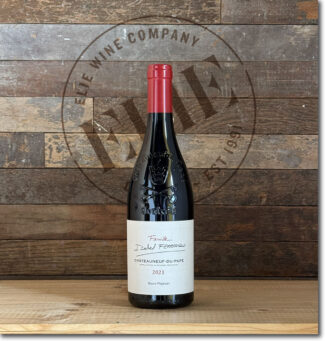 2021 Famille Isabel Ferrando ‘Saint Préfert’, Châteauneuf-du-Pape ($114)
The 2021 vintage offered more problems than 2020, with late and devastating frosts. Old vines such as Ferrando farms did far better than younger vines.
* A more detailed analysis of Vintage 2021 is offered below.
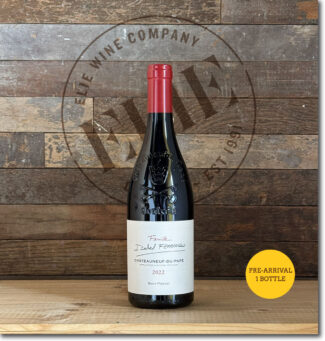 2022 Famille Isabel Ferrando ‘Saint Préfert’, Châteauneuf-du-Pape (PRE-ARRIVAL $107) Package $499
“The 2022 vintage is an exceptional one for Châteauneuf-du-Pape in general and for us in particular. For me, it also marks a significant milestone in my work. I have rarely felt as accomplished and proud of a vintage in my career.” – Isabel Ferrando
* A more detailed analysis of Vintage 2022 is offered below
White Châteauneuf-du-Pape: Two Parcels, Two Varieties.
Châteauneuf-du-Pape Blanc is one of the most consistently under-rated and under-celebrated wines in an occasionally over-rated pantheon of red CdPs. Always a sensuous mouthful, the warm weather tends to ripen white varietals (generally a measured blend of Grenache Blanc, Roussanne, Clairette and/or Bourboulenc) to a tropical cornucopia. It’s this juicy explosion of exotic flavors that make the style delightful in its youth and increasingly complex with age, picking up meaty notes of leather and white truffles.
Isabel Ferrando focuses on old-vine Clairette and Roussanne from two plots in her Serres lieu-dit, using Clairette to bring minerality and the region’s characteristic salinity while the Roussanne provides honeysuckle, acacia flower and peach notes to a tannic backbone.
She began making this wine in 2009 after sharing a bottle of after 1947 Bonneau at a meal with her mentor, Henri Bonneau, the last of that vintage of old vine Clairette—grapes that still grew on her property.
 2021 Famille Isabel Ferrando ‘Saint Préfert’, Châteauneuf-du-Pape Blanc ($114)
“This wine is vinified in glass globes and in foudres,” says Isabel Ferrando. “The purity and freshness conferred by fermentation in glass and the tension offered by the 12 HL oak foudres ensure a great capacity for ageing. The organic and biodynamic management allows us to achieve the right level of maturity without excessive alcohol and with remarkable natural acidity.”
60% Clairette and 40% Roussanne the wine shows acacia and lime blossom on the nose with jasmine, rosehip and pulpy mango and pineapple leading to a needle-sharp and focused finish.
 2022 Famille Isabel Ferrando ‘Saint Préfert’, Châteauneuf-du-Pape Blanc ($114)
* From Ferrando’s favorite vintage—more details are given below.
.
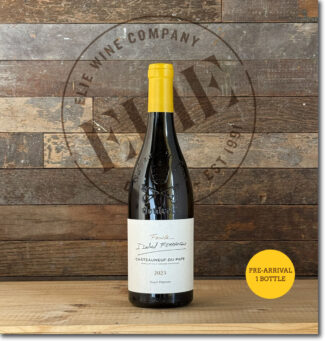 2023 Famille Isabel Ferrando ‘Saint Préfert’, Châteauneuf-du-Pape Blanc (PRE-ARRIVAL $107) Package $499
* Specifics of the 2023 vintage are offered below.
White Châteauneuf-du-Pape en Magnum: Rich, Rare and Age-Worthy Monovarietal
Why the magnum? Surface area plays a tremendous role in the changes that a wine undergoes during élevage and later, ‘en bouteille’, and these changes happen at a rate that is in proportion to the size of the container. In a magnum—roughly twice the size of a conventional wine bottle—the aging process is slowed down and the wine will keep fresher longer; a plus if the wine is white.
Back in 2009, Henri Bonneau assured Ferrando that she had the ability and grapes to make a wine to rival his own from the rare, old-vine, pink Clairette that is co-planted in her vineyards. The first year, Bonneau helped to do the vinification. It was Bonneau who told her, “You are who you are; embrace the wines that naturally come from your style. Go with what nature give you. Less is more.”
The wine is very gently pressed and aged for 18 months in one new large barrel. Bonneau recommended bottling it in magnum-size because there is not enough for everyone, so when it’s opened, it’s for a special occasion.
To this day, Ferrando’s tradition is to always give the first bottle each vintage to the Bonneau family. Normally, only one 600-liter barrel is made per year.
 2021 Famille Isabel Ferrando ‘Vieilles Clairettes, Saint Préfert’, Châteauneuf-du-Pape ($399) (1.5 Liter)
Only produced ‘en magnum’, this is a heavily allocated gem with less than a thousand bottles made and even fewer exported. 100% Clairette from 100-year-old vines in the dry-farmed lieu-dit ‘Quartier des Serre’ renowned for being one of the most sun-drenched plots in the appellation as well as nurturing vines in well-drained, river-rolled pebble soil. An exquisite, unctuous expression of an under-appreciated varietal, the wine reflects both sun and sand with warm notes of honey, quince jam, creamy lemon curd and pink grapefruit acidity as a backbone.
Châteauneuf-du-Pape ‘Colombis’: Grenache, Reconsidered.
Despite its potential for splendor in the glass, Grenache has never made the leap into the rarified atmosphere of the ‘noble’ grapes. But in the right hands, grown in the proper lieu-dit and farmed correctly, it can be as expressive of terroir as Pinot Noir and as complex and age-worthy as Cabernet Sauvignon. In Châteauneuf-du-Pape, it produces most favorably on sandy soils that provide delicacy and finesse, but where there is also limestone for structure, red clay for the development of rich (but not harsh) tannins and the small stones known as ‘galets’ for power.
For a grape that produces such bold and muscular wines, Grenache is thin-skinned and not overly acidic, so it must be picked at an optimum period of phenolic ripeness to avoid becoming flabby and aggressively alcoholic. Vine age is of extreme importance for Grenache, with younger cultivars making pale-colored and often mediocre wines—60-100 years appears to be an ideal age for producing wine of consistently good quality.
 2016 Domaine Isabel Ferrando ‘Colombis’, Châteauneuf-du-Pape ($172)
‘Colombis’ is 100% Grenache, but a blend from three parcels in the western part of the appellation: Colombis, featuring sandy soils, Les Roues, where clay lies just beneath the surface, and Le Cristia, where sand again predominates.
 2017 Domaine Isabel Ferrando ‘Colombis’, Châteauneuf-du-Pape ($172)
100% old-vine Grenache from Ferrando’s prized vineyards.
* An overview of the 2017 vintage is found below.
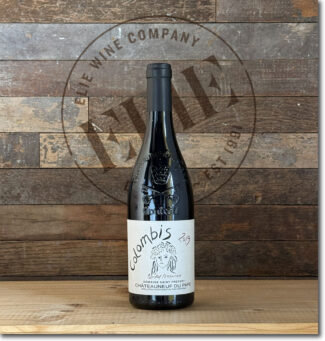 2019 Domaine Isabel Ferrando ‘Colombis’, Châteauneuf-du-Pape ($155)
The vines average 60 years and the concentrated juice from the small clusters produce a wine that critic Jeb Dunnuck referred to as “One of my favorite wines in the world.” Expansive in bouquet and again on the palate, the wine shows spice-accented currant preserves with incense and cola, crisp mineral undertones and an intensely long finish framed by velvety, well-integrated tannins.
2021 Famille Isabel Ferrando ‘Colombis’, Châteauneuf-du-Pape ($199)
* An overview of the 2021 vintage is found below.
 2022 Famille Isabel Ferrando ‘Colombis’, Châteauneuf-du-Pape (PRE-ARRIVAL $186) Package $499
Isabel Ferrando affixed her own name to the mono-varietal wines she produced at Domaine Préfert before the change to ‘Famille Isabel Ferrando.’.
* An overview of the 2022 vintage is found below.
Châteauneuf-du-Pape ‘F601’: Pure Cinsault, Pure Audacity
The roughly 51,000 acres of Cinsault in France make it the ninth-most-planted grape there, but that is just a fraction of the more than 120,000 acres that covered wine country during its peak years in the 1970s. Now, while much of the production is still used in red blends, an increasingly large share of this acreage goes into the region’s many rosés.
In Châteauneuf, it doesn’t even come in third, landing behind Grenache, Syrah and Mourvèdre in acres planted. Still, it produces copious yields and thrives in drought conditions, ripening roughly one-third of the way through the harvest cycle. For Isabel Ferrando, who inherited supremely old Cinsault vines, it is a variety worth romancing, and she pushes it front and center in her unique and luscious ‘F601.’
 2018 Domaine Isabel Ferrando ‘F601’, Châteauneuf-du-Pape ($786)
‘F601’ may sound like an unpoetic name for a lieu-dit, and in fact, it is an arid block in the southern part of the estate. It is also atypical of the terroirs of Châteauneuf-du-Pape; fifteen feet below the surface, sand made of degraded quartz can be found and a bit higher up, extra moisture is lodged in a fine layer of blue clay fed by the mica gravel and rolled pebbles already visible at ground level. Of this remarkable habitat for Cinsault, Isabel Ferrando writes, “I needed 16 years of observation and apprenticeship to find the audacity to throw away the rule book and forge a personal relationship with this terroir, guided by instinct and sensuality. With the 2018 vintage, I am launching ‘F601, and for the first time, the pure and absolute expression of the fusion between this block of land and the venerable Cinsault vines planted on it in 1928. At this defining moment in my life, I am happy to share with you my sense of wonder in this iconic Châteauneuf-du-Pape. Welcome to F601!”
 2020 Domaine Isabel Ferrando ‘F601’, Châteauneuf-du-Pape ($786)
* Details of the 2020 vintage are offered below.
Notebook …
Châteauneuf-du-Pape Vintages
The 2023 Vintage
2023 followed many of the climate-change patterns that have come to dominate in European viticulture. Winter and spring were relatively mild with sporadic rainfall to help replenish dry soils. February, however, saw temperatures drastically plummet as a cold snap took hold. March did not entirely shake off the winter blues, although temperatures rose enough to allow for a successful budburst and May saw the beginning of flowering. Rain continued throughout both May and June and temperatures began to climb. By July, thermometers in the southern Rhône were registering the nineties. The region had to grapple with the threat of drought, and when rain fell, it was violent and occasionally accompanied by crop-destroying hail. Fortunately, September brough cooler nights preserving both aromatics and acidity, and yields ran high. In CdP, Syrah showed well, but Grenache stole the show.
The 2022 Vintage
The year began with a dry winter that produced little precipitation. Spring rapidly warmed up, although April did bring a fleeting cold snap. Temperatures proceeded to rise, although both budburst and flowering were a success. May was abnormally hot but June brought some relieving rain in time for what wound up being an extremely torrid summer. Most of Châteauneuf-du-Pape baked under a Mediterranean sun, but older vines took this in stride while rot and disease were kept at bay. August brought some humidity, which helped revive some of the stressed grapes. Even so, conditions were perhaps more conducive to reds like Syrah and Grenache than whites, although whites with lower acid character like Marsanne, Roussanne and Viognier performed well. Overall, the crop was of very high quality with the promise of sophisticated, age-worthy wines.
The 2021 Vintage
After six blessed harvests in a row, 2021 brought earth back to earth: Temperatures were unpredictable throughout the growing season, without heat spikes, and random thunderstorms later in July served to test vignerons, including a torrential downpour in mid-September right at harvest-time. Early-budders like Syrah, having been jeopardized by spring frost, and the late-ripening grapes also found themselves under threat. Despite this, Mourvèdre, Cinsault, and Carignan fared well, while the quality of Grenache was mixed, some of it (almost unaccountably) particularly good. The best of 2021 wines focus on red rather than black fruit, on lean but elegant tannins rather than any attempts to overcompensate with an ambitious extraction regime or indulgent use of oak.
The 2020 Vintage
Following the extreme heat of 2019, growers were hoping for plenty of rainfall over the winter to replenish aquafers, and they got it. An astonishing 15-20 inches of rain fell between October and December, and a mild early spring saw vine buds break nearly two weeks earlier than in 2019. The summer was hot, but not unreasonably so; rains were moderate and frequent enough to prevent heat stress. Harvest for white grapes began in the third week of August, and the 2020 vintage is extremely strong in this category, however small (only 5% of Châteauneuf-du-Pape’s total). It is characterized by elegance and beauty, with a nose marked by citrus and stone fruit and a palate that combines balanced acidity with a prolonged finish
The 2019 Vintage
Grenache enjoyed a marvelous renaissance in 2019, and for this sun, heat and wind-loving varietal, the vintage was ideal. An abundant fruit set was followed by three heat waves interspersed with rain and more moderate temperatures, and as a result, there was no stress for the vines and ripening never shut down. Growers were able to pick at optimum ripeness and nothing much had to be done in the vineyard. The fruit’s health carried through to the cellar, with many growers reporting that their vinification were fast and efficient.
The 2018 Vintage
The quintessence of a year that the old winemaker’s cliché refers to ‘a vintage made in the vineyard’—based on the difficulty that growers had bringing in the harvest. Rains in May and June created a poor fruit set for Grenache, and the threat of mildew was redoubled by the failure of the mistral; a rare occurrence in Châteauneuf-du-Pape. Humidity skyrocketed, making 2018 the dampest year since 1973, and organic farmers grew frustrated that natural treatments were washed away by un-forecasted rain. The result was a harvest that in particular showed a 40%-60% reduction in Grenache. Syrah and Mourvèdre fared better, and these varieties tend to be more pronounced in the blends.
The 2017 Vintage
The 2017 harvest in Châteauneuf-du-Pape was small, but of very high quality, leading to limited releases and perhaps higher prices. A mild winter was followed by an idyllic spring, until a cold snap in May brought extreme rainfall; this sudden shift in conditions led many vines to suffer from mildew, which cut yields dramatically—in some instances by half. As a result, the impact on Grenache had massive consequences for blends. Fortunately, even-keel weather continued through to the September harvest.
The 2016 Vintage
The 2016 vintage in CdP was dominated by warm days and cool nights; ideal conditions for growing top-shelf Cinsault, Mourvèdre, Grenache and Syrah. Preceded by a relatively mild winter, the spring was dry and cool and summer exploded with plenty of sunshine and heat. September rains replenished the reservoirs enough to allow each variety to reach full phenolic ripeness. Harvest began in mid-September and, depending on vine age and terroir, some growers continued grape picking until early October. Châteauneuf red wines from this vintage are creamy and concentrated with silken texture and brilliant fruity richness, while the whites, full-bodied richness, remarkable complexity and sensational freshness.
Climate And Weather
Located within the Vaucluse department, Châteauneuf-du-Pape has a Mediterranean climate—the type found throughout much of France’s south—and characterized by hot, dry summers and cool, wet winters. It rarely snows at sea level (as opposed to the surrounding mountains, where snowfall may be considerable).

As the equal of elevation and rainfall, a third defining feature of the climate in Southern France is the wind. In a land dominated by hills and valleys, it is always windy—so much so that in Provence, there are names for 32 individual winds that blow at various times of year, and from a multitude of directions. The easterly levant brings humidity from the Mediterranean while the southerly marin is a wet and cloudy wind from the Gulf. The mistral winds are the fiercest of all and may bring wind speeds exceeding 60 mph. This phenomenon, blowing in from the northeast, dries the air and disperses the clouds, eliminating viruses and excessive water after a rainfall, which prevents fungal diseases.

- - -
Posted on 2025.01.17 in Châteauneuf-du-Pape, Côtes-du-Rhône, France, Wine-Aid Packages | Read more...
A Wine Full of Contradictions: Beaujolais’ Morgon Expresses Its Unwelcome Terroir in All Its Intensity. In-Store Saturday Sips: A Taste of Morgon.
Join Us for Saturday Sips: A Taste of Morgon
Come as you are; come any time that’s convenient for you during our business hours to sample selection from this week’s selections. Our staff will be on hand to discuss nuances of the wines, the terroirs reflected, and the producers.
Elie
Morgon has always represented a Beaujolais of a different color. Not merely the richer, denser dark-red hue (as opposed to the grapey purples of other appellations) but the metaphorical color of ambition. Not willing to produce Gamay-based wines that are simply fun and enjoyable (‘peasant wines’ in the parlance of the French, or side-show wines like Beaujolais Nouveau), Morgon—aided by its unique terroir—has always set the goal of producing wines that are complex, meaningful and on a par with great wines found anywhere else in the world.
The frontal assault on the world’s perception of Beaujolais began in the last century. Led by négociant Jules Chauvet (a staunch opponent of the industrial farming that had become the norm in the region) the movement embraced older, earth-friendly agriculture that disdained the use of chemical fertilizers, synthetic pesticides and a factory mentality among producers. At the time, this was a rather unheard of proposition in the region, but the goal was hand-crafted, often painstaking artisan winemaking.
Chauvet’s disciples were dubbed the Club de Cinq—the ‘Gang of Five,’ they included (besides Chauvet) Guy Breton, Joseph Chamonard, Jean Foillard, Marcel Lapierre and Jean-Paul Thévenet, and sometimes Yvon Métras. The revolution came to a head in the 1980s and forever altered the reputation of once-lowly Gamay in the rhetoric of cognizant wine lovers, who have delighted in seeing these wines approach the earthy majesty once thought exclusive to Pinot-Noir-based Burgundy.
In modern times, a new generation of winemakers (influenced by the Club de Cinq’s work) are determined to display Morgon in her full glory. They have returned to the quintessential and traditional Beaujolais practices of viticulture and vinification: Old vines, late harvests (never chaptalizing), rigorously sorting grapes and using minimal doses of sulfur dioxide or none at all. Over the decades, those principles have expanded to include biodynamic and organic farming and vineyard management.
For an audience who has embraced natural wines, Morgon has long been the natural choice, but for hardcore fans of terroir, who realize that the more transparent is the work done in the field and the cellar the more identifiable is the location, modern Morgon is a mirror of its remarkable foundations, especially the schistous, manganese-veined ‘roche pourrie’ that provides many Morgons with their underlying structure.
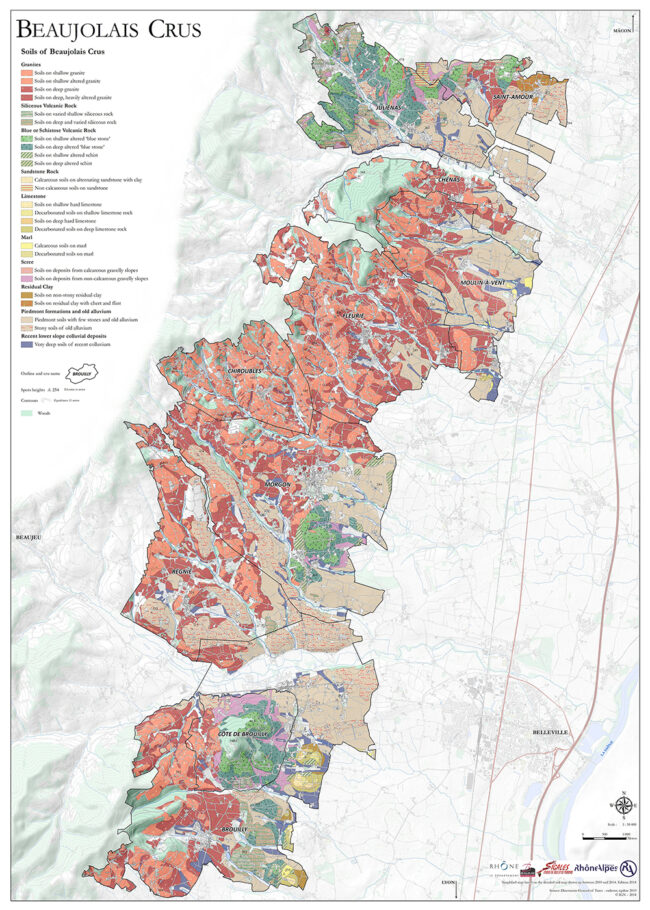
The Beaujolais Underground: A Veritable Mosaic of Soil
The biggest error a Beaujolais neophyte makes is an expectation one-dimensional predictability. To be fair, the mistake easy to make based on the region’s reliance on Gamay, a grape that elsewhere may produce simple and often mediocre wine.
In Beaujolais’ wondrous terroir, however, it thrives.
In fact, this terroir is so complex that it nearly defies description. But Inter-Beaujolais certainly tried: Between 2009 and 2018, they commissioned a colossal field study to establish a detailed cartography of the vineyards and to create a geological snapshot of the exceptional richness found throughout Beaujolais’ 12 appellations.
Beaujolais may not be geographically extensive, but geologically, it’s a different story. The region bears witness to 500 million years of complex interaction between the eastern edge of the Massif Central and the Alpine phenomenon of the Tertiary period, leaving one of the richest and most complex geologies in France. Over 300 distinct soil types have been identified. Fortunately, Gamay—the mainstay grape, accounting for 97% of plantings—flourishes throughout these myriad terroirs. In the south, the soil may be laden with clay, and sometimes chalk; the landscape is characterized by rolling hills. The north hosts sandy soils that are often granitic in origin. This is the starting point wherein each appellation, and indeed, each lieu-dit draws its individual character.
There are ten Crus, the top red wine regions of Beaujolais, all of them located in the hillier areas to the north, which offer freer-draining soils and better exposure, thereby helping the grapes to mature more fully.
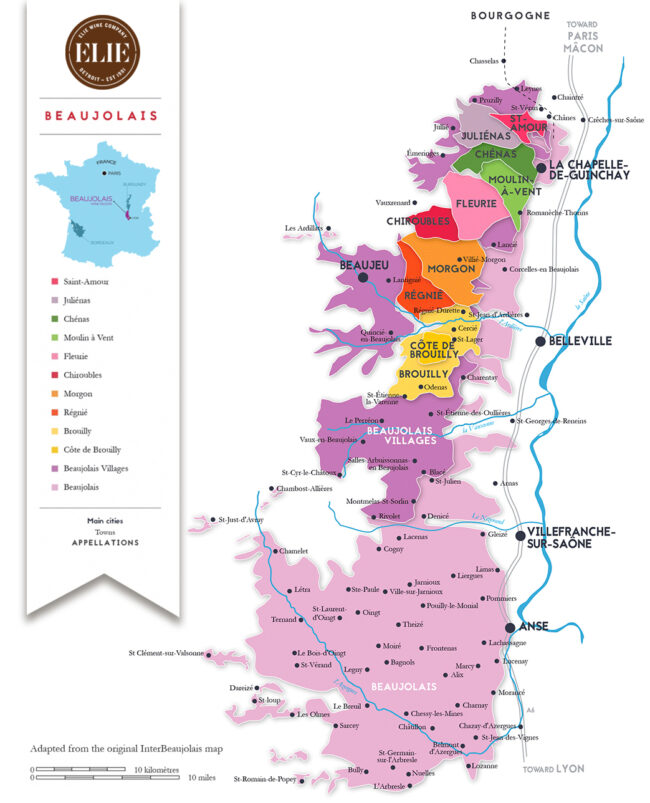
Courtesy of Wine Scholar Guild
A Palette of Ten Crus
Beaujolais is a painter’s dream, a patchwork of undulating hills and bucolic villages. It is also unique in that relatively inexpensive land has allowed a number of dynamic new wine producers to enter the business. In the flatter south, easy-drinking wines are generally made using technique known as carbonic maceration, an anaerobic form of closed-tank fermentation that imparts specific, recognizable flavors (notably, bubblegum and Concord grape). Often sold under the Beaujolais and Beaujolais-Villages appellations, such wines tend to be simple, high in acid and low in tannin, and are ideal for the local bistro fare. Beaujolais’ suppler wines generally come from the north, where the granite hills are filled with rich clay and limestone. These wines are age-worthy, and show much more complexity and depth. The top of Beaujolais’ classification pyramid is found in the north, especially in the appellations known as ‘Cru Beaujolais’: Brouilly, Chénas, Chiroubles, Côte de Brouilly, Fleurie, Juliénas, Morgon, Moulin-à-Vent, Régnié and Saint-Amour.
Each are distinct wines with definable characteristics and individual histories; what they have in common beyond Beaujolais real estate is that they are the pinnacle of Gamay’s glory in the world of wine.
Vins de Lieux: The Particulars of Terroir Plot by Plot
Although the individual qualities inherent in a specific plot of vines was always discussed privately among Beaujolais growers, the wines themselves—even those by the region’s patron saints, the Club de Cinq—were generally blends.
Says Louis-Clément David-Beaupère (Domaine David-Beaupère; Juliénas): “We forgot to tell people about our climats.”
‘Climat’ is the Burgundian term for ‘vins de lieux’— wines sourced entirely from a given parcel of land, and may be considered the ultimate expression of terroir. This is the essence of the Bourgogne viticulture model, since each of these parcels—which may be only a portion of an overall vineyard—has a specific geological, hydrometric and exposure characteristic. The production of each Climat is vinified separately, from a single grape variety.
Every one of Beaujolais Crus is subdivided into lieux-dits—the change is in trumpeting them. For example, the soils of the Côte du Py, the source of many of Morgon’s most cherished wines, is built around decayed schist, while the soils of nearby Douby—only around seven hundred feet away—are deeper and more granitic, producing markedly different wines.
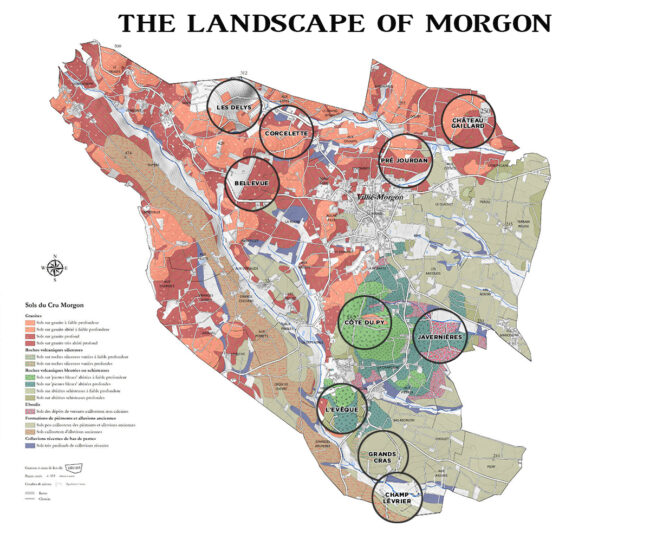
Cru Morgon: Durable, Long-Lived and Slightly Off-Message
Overlooked by Mont du Py, Morgon is the second largest of the Beaujolais crus after Brouilly, and in the heart of it lies the appellation’s most famous terroir, the Côte du Py. Sitting atop an extinct volcano at the highest point in the region, Py contains the oldest soils of Beaujolais, dating back hundreds of millennia.
Morgon’s neighborhood is upscale; surrounded by Fleurie, Chiroubles, Brouilly and Régnié, and slightly under five square miles in total, it is an epicenter for the terroir that Gamay loves best. While all ten Crus feature some granitic soil, Morgon is granite-land. Not that, but it is a unique type, the blue-tinged version known as andesite. And the only rock that Gamay loves more is iron-rich schist, which in Morgon also has in spades; decomposed and referred to by locals as ‘rotten rock.’
As in much of Beaujolais, Morgon vineyards are protected from cold northwesterly winds by the hills immediately to the west. Instead, warm, dry ‘foehn’ winds develop on the eastern slopes, drying the vineyards after rain and helping to prevent fungal diseases. Otherwise, the wide, shallow valley of the Saône River offers no topographical barriers to unfettered sunlight and vines bask in plentiful sunshine during the growing season. Heat is moderated by cooling influences from the Mediterranean, allowing for the retention of acidity while phenols and sugars evolve. As a result, Morgon wines are denser than those made in much of Beaujolais, displaying ripe cherry and dark fruit characters and a fleshy, juicy texture. Morgon wines age so well that the region’s name is often used as a verb to describe a cellar-worthy wine, saying ‘il morgonne’, or ‘it Morgons.”
Clos de Mez
Marie-Élodie Zighera has roots in the past; a metaphor that is not really a metaphor since her oldest vines were planted so long ago that when France entered the First World War, they were already producing.
“Vines have been in my maternal family for four generations,” she says. “The grapes they grew were delivered to the cooperative cellar by my grandmother and mother up until I arrived at the domain as a winegrower. However, this did not deter my grandmother or mother from taking great care of our 17-hectare (42-acre) vineyard. At that time, I was living in Paris with my family and we would come to Fleurie for the holidays. I used to love this time so much, being in close contact with nature.”
With a drive to turn this love into a vocation, Zighera studied viticulture; after graduation, she found work in a number of vineyards. Among them was Clos Vougeot, where she concluded that she could not hope to make such wines from her family holding.
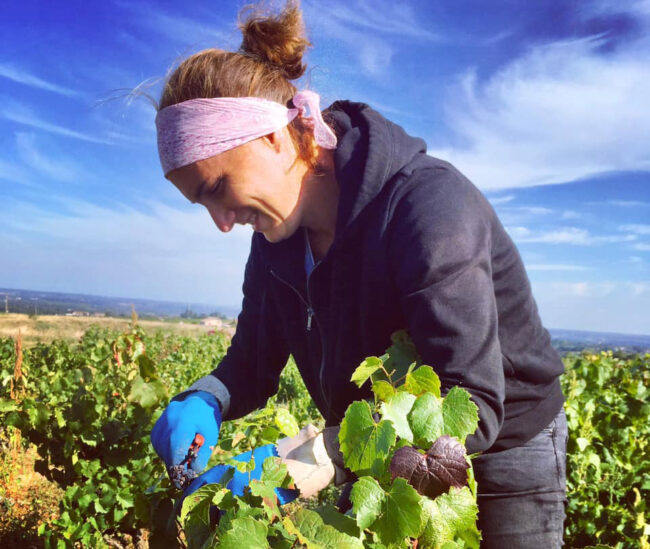
Marie-Élodie Zighera, Clos de Mez
Then came the eureka moment: “A professional tasting of old vintages was held and I was invited to attend during my work placement at Vougeot. With a Morgon 1911, the unanimous opinion was that it was magnificent wine; that it had aged as well as a Burgundy. I finally knew what type of wine I wanted to make and most importantly I realized it was possible. I had another strong advantage too: The freedom to imagine without guidelines being imposed. I set up my business in 2006 and named the domain Clos de Mez, a shortened version of my name.”
Zighera makes wine in Fleurie and Morgon, where the average age of vines in her plots is 45 years. Her Fleurie holding outlines a hilly landscape, where Gamay vines follow the contours of the slopes of Fût d’Avenas, the mountain passes of Durbize, Labourons and Raymont Peak. She says, “Legend recounts that a Roman legionary once passed through here, leaving his name to the site and to the village. Our vines in Fleurie are found in the southern part of the appellation, bordering Morgon. Facing South/South-East, they stand at an altitude of about 300 meters. The soils of Fleurie La Dot and Fleurie ‘Mademoiselle M,’ which originate from acid rock, are deep and provide good drainage. Rose colored granite is widely predominant here and is found in the form sand called saprolite.”
Vintage 2017
In Beaujolais, 2017 will be remembered as the little vintage who could. After enduring frost in the spring, hail and drought in the summer and rain during the harvest, this sequence of events actually helped produce some excellent wines. The period of drought concentrated the grapes and the harvest rain provided reinvigoration. Gamay excelled, gaining a rich, ripe, fruit character balanced by acidity.
The resulting wines ranged from the intensely concentrated, which should stand cellaring, to the equally excellent lighter examples, which displayed the classic florals that Beaujolais is known for.
Despite the unnerving weather, in 2017, Beaujolais delivered against the odds.
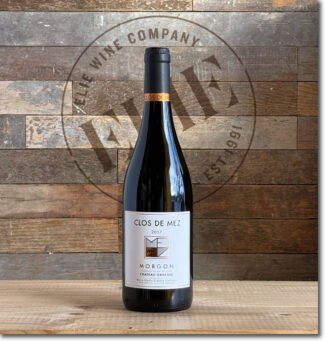 Clos de Mez, 2017 Morgon-Château Gaillard ($32)
Château Gaillard is a lieu-dit that passed to Marie-Élodie from her grandmother. Adjacent to the border of Morgon where it borders Fleurie, the plot of 70 year old vines with very low yields giving a wine of great depth and aging potential. Grapes are sorted as they are picked in each plot of the vineyard; the grapes are moved to the vats by a system of gravity where whole-bunch pre-fermentation maceration at cold temperature is carried out for few days, followed by alcoholic fermentation interspersed by cap-punching and pumping-over. The wine offers ripe, black-fruit character with lively acidity and an expansive finish.
Domaine de Vernus
After thirty years in the prosaic world of insurance brokerage, Frédéric Jametton decided to do a rakehell turn on his career trajectory. Having been born in Dijon and lived in Burgundy for most of his life, he had become an enlightened wine lover. Not only that, but his former profession brought him in contact with numerous members of the wine community. At the end of 2017, he realized that the time had come to invest in a winery.
Initially looking in the south, he became convinced that the heat spikes brought on by climate change made it unsuitable for the long haul, and after discussions with his friend Guillaume Rouget of Flagey-Echézeaux (who agreed to come on board as a consultant) Jametton settled on Beaujolais, piecing together 30 acres of vineyards acquired from 12 different proprietors, and is gradually restructuring parcels with a view to more sustainable farming.
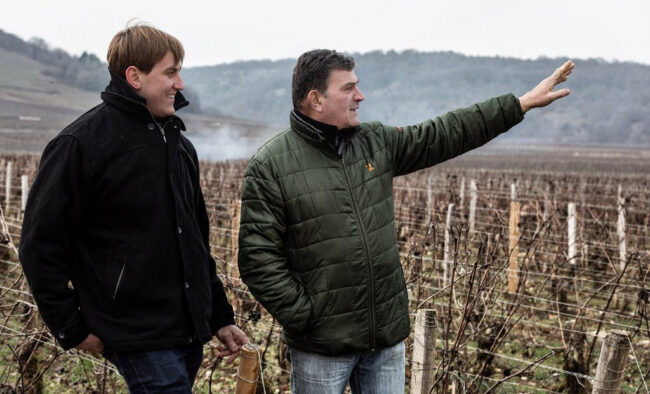
Winemaker Guillaume Rouget, left, with Frédéric Jametton, Domaine de Vernus
Thanks in part to Rouget’s influence, vinification is conducted along Burgundian lines, with around 70% of the grapes destemmed and fermented in stainless steel with élevage in recently-used, high-quality Burgundy barrels for some 10–11 months. Jametton’s ultimate goal, echoed by Rouget, is to offer a range of wines that brings out the best of the different terroirs while respecting the character and personality of each Cru and each plot.
With Rouget in charge of the vineyards and winemaking process, Frédéric remains at the management helm and spearheads marketing.
Vintage 2020
If you can invent a way to leave Covid out of the equation, 2020 was a wonderful vintage throughout Beaujolais. The growing season was warm, beginning with a mild and frost-free spring, which developed into a hot and sunny summer without hail or disease. Drought—a persistent worry in the region—was not as severe as it might have been, and by harvest-time the majority of grapes were in fine health with rich, ripe, almost Rhône-like flavors—raspberries, sour cherry and even garrigue; the local scrub comprised of bay, lavender, rosemary and juniper.
2020 yields were low due to the dry conditions, leading to concentrated juice and wines able to benefit from time in the cellar.
But, of course, you can’t leave Covid out of the equation: Normally the release of Beaujolais Nouveau occurs on the third Thursday of every November, but in pandemic-dominated 2020, the normal celebrations could not take place and producers instead chose to release the wines a week earlier than usual in order to allow for international shipping times.
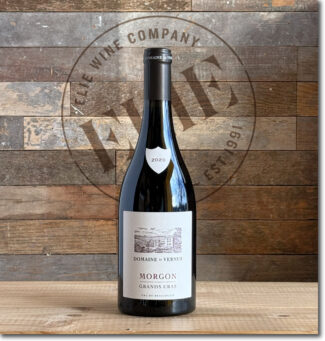
Domaine de Vernus, 2020 Morgon ‘Grands Cras’ ($47)
Grands Cras, ideally situated at the foot of the Côte du Py, ranks among the appellation’s most famous climats. The deep soil is made up of granitic alluvium that allows grapes to maintain Burgundy-level tannins while retaining the fruitiness typical of Beaujolais. With an average vine age of 71 years, the fruit is hand-harvested and 80% destemmed, following which the wine spends ten months in oak. A rich, cherry-driven profile with hints of kirsch, fresh tobacco and menthol.
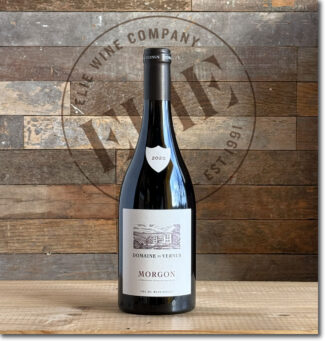 Domaine de Vernus, 2020 Morgon ($36)
Lieux-dits L’Évêque and Champ Lévrier from vines with an average age of 67 years. 80% destemmed with three weeks of fermentation on native yeasts followed by ten months maturation in 80% oak barrels and 20% in stainless steel tanks. This structured Morgon is a benchmark wine showing cherries and plums abound along with licorice, mineral and taut acidity.
Mélanie et Daniel Bouland
Daniel Bouland has been called reclusive and solitary—he has also been called the best artisanal vigneron in Beaujolais. When collectors compare him to more flamboyant regional names like Foillard and Lapierre, it is always favorably, at least in part because of his obsessive respect for micro-terroirs—in French, ‘pur’ terroir. Working with fewer than twenty acres of impeccably cultivated vines in the Morgon lieux-dits of Corcelette, Bellevue and Les Delys, plus small parcels in Chiroubles and Côte de Brouilly, Bouland’s wines are approachable upon release, but created with such a backbone that his terroir’s mineral nuances will continue to become more pronounced with five or more years in the cellar.
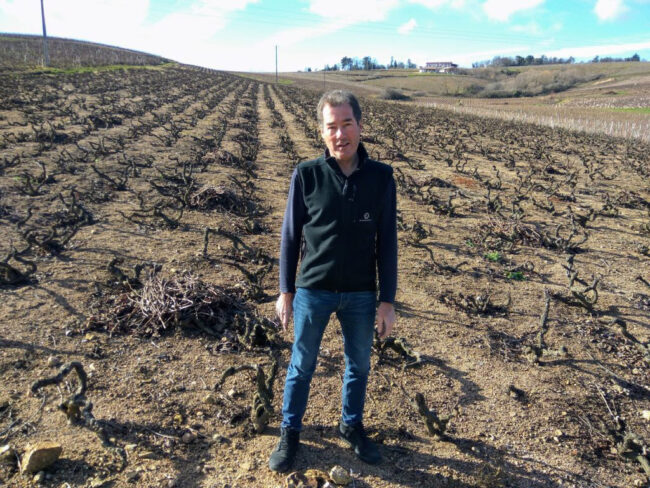
Daniel Bouland in Morgon’s lieu-dit ‘Les Delys’ with Gamay vines planted in 1926.
With the success of Cuvée Mélanie, named for Daniel Bouland’s daughter, Bouland has added her name to current bottlings beneath the name ‘Mélanie et Daniel Bouland’, possibly in advance of the younger Bouland ultimately taking charge.
Vintage 2022
Like 2017, 2020 was vintage with highs and lows throughout the season, temperature-wise especially. A cold and dry winter led to savage frosts in the spring and hail that damaged crops. And then, in July, the agricultural canvas dried out and remained rain-free and sweltering until harvest. Such arid conditions had a two-fold effect; both kept the berries clean from rot and disease as well as pushed them to phenolic ripeness – drought, however, did become an issue. As vines struggled, yields were inevitably reduced. For some producers this meant forgoing making Beaujolais Nouveau. The quality of the fruit, however, was fantastic as the intense heat concentrated juices, making for some very rich, flavorful wines.
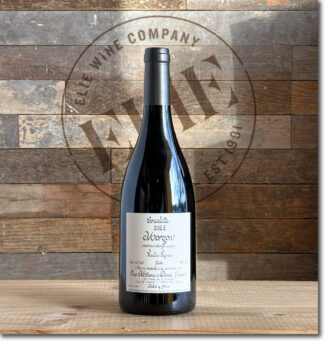 Mélanie et Daniel Bouland ‘Vieilles-Vignes Sable’, 2022 Morgon-Corcelette ($48)
Corcelette is a south-east facing climat where the soils are made of sandy pink granite and the vines are between 60 and 75 year old. Made famous by the iconic Jean Foillard, the roster of vintners who today bottle a Corcelette reads like a who’s who of Beaujolais masters. Brooding and filled with mineral piquancy, Bouland’s bursts with wild fruit including dried black cherry, blackberry, cranberry and pomegranate that digs in with powdery, penetrating tannins.
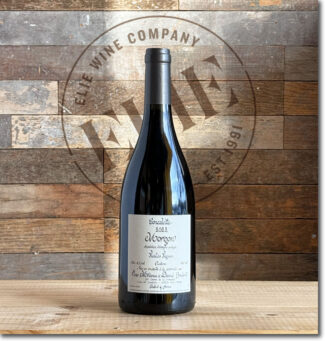 Mélanie et Daniel Bouland ‘Vieilles-Vignes Cailloux’, 2022 Morgon-Corcelette ($48)
Bouland’s Corcelette soils are split into two named cuvées—one for the sand (Sable) and one for the stones (Cailloux).
“These two parcels are only separated by a small track,” says Bouland. “but the soil is completely different. Not only does the weathered sandy granite differ from the Cailloux parcel, but the slope is steeper, and the 40-50 years old vines are on a specific low-yielding rootstock called Vialla—a stock well adapted to these soils.”
Opening in the glass with a sappy bouquet of black cherries, pomegranate and a hint of sweet cranberry, the wine shows Morgon’s depth along with Morgon’s firm backbone.
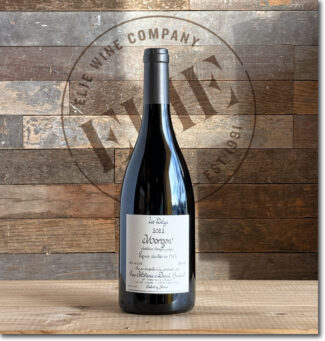 Mélanie et Daniel Bouland ‘Vignes Plantées en 1926’, 2022 Morgon-Les Delys ($48)
The lieu-dit Les Delys is part of the larger climat Corcelette, down the slope and located right where Domaine Chamonard sits. From a three-acre parcel featuring the domain’s oldest vines, the plot was planted in 1926.These ancient workhorses have dug deep into the subterranean water sources to keep maturity progressing in a dry growing season. This is Bouland’s most age-worthy and firmly-structured Morgon, showing deep and brooding wild berries, cherries, exotic spices, cracked black pepper and vine smoke. It is very young, though—it would be a shame not to leave a few bottles to develop secondary and tertiary notes through the years.
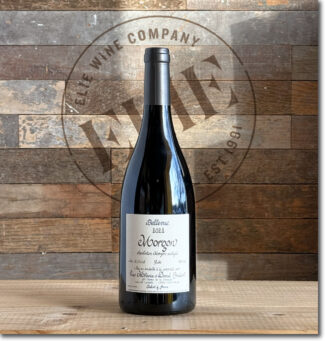 Mélanie et Daniel Bouland ‘Sable’, 2022 Morgon-Bellevue ($39)
Morgon’s renowned, high-altitude lieu-dit Bellevue is built on ancient, eroded pink granite soil on a 22% southeast-facing slope. As in Corcelette, Bouland releases wine from this plot under two names, ‘Sable’ and ‘Cailloux’ for the specifics of the soil beneath the 70-year-old vines.
‘Sable,’ grown on sandier soils, shows a nice balance between fresh acidity and well-structured tannins with blackberry and cherry on the nose and assertive minerality on the finish.
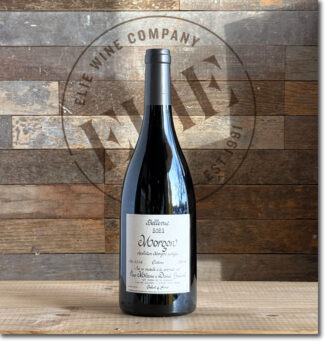 Mélanie et Daniel Bouland ‘Cailloux’, 2022 Morgon-Bellevue ($41)
‘Cailloux’ soils are rockier, and provide classic aromas of red cherries, kirsch, herbs and a pleasant hint of carbonic bubblegum.
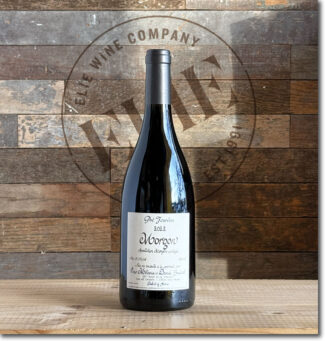 Mélanie et Daniel Bouland, 2022 Morgon-Pré Jourdan ($41)
Pré Jourdan is a lieu-dit that has only been producing for Bouland for a few years, but has been around a lot longer; near Fleurie, the vines are over 70 years old. One of the last cuvées to be bottled this year, it shows blackberries and spices mingled with notes of rose petals, violets and potpourri.
Domaine des Terres Dorée
With a name from a fairy tale (‘House in the Land of the Golden Stones’), Domaine des Terres Dorées is a 150-acre vineyard located in Charnay, just north of Lyon. Owner/winemaker Jean Paul Brun is a champion of ‘old-style Beaujolais.’ And by ‘old’, he means an era before pesticides and herbicides, and especially, a time when native yeasts alone were used to ferment.
He says: “Virtually all Beaujolais is now made by adding a particular strain of industrial yeast known as 71B. It’s a laboratory product made in Holland from a tomato base, and when you taste Beaujolais with banana and candy aromas, 71B is the culprit. 71B produces a beverage, but without authenticity or charm.”
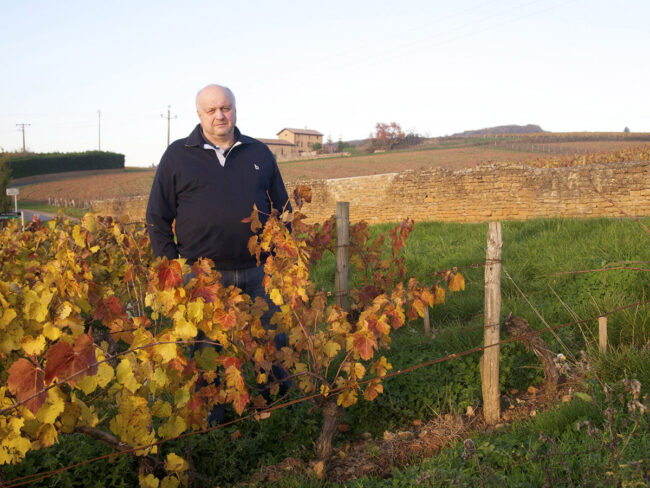
Jean-Paul Brun, Domaine des Terres Dorées
Brun also insists that Beaujolais drinks best at a lower degree of alcohol and that there is no need to systematically add sugar to the must (chaptalize) to reach alcohol levels of 12 to 13%.
“My Beaujolais is made to be pleasurable,” he maintains. “Light, fruity and delicious, not an artificially inflated wine that is only meant to shine at tasting competitions.”
“The emphasis is not on weight, but on fruit,” he adds. “Beaujolais as it once was and as it should be.”
Vintage 2021
A warm, humid winter prompted an early budbreak, but April produced a vicious bout of frost followed by a snow-dump that affected new growth. A slight reprieve ensued in June, which allowed for a successful flowering, but heavy rain settled back in throughout July and August. The grapes did not dry out until late August, but the alert against rot and disease was a feature of the entire season.
Harvest came later than usual but was a success; the fruit remained fresh and aromatic with good acidity, although overall, 2021 wines are lighter in both body and alcohol compared to other years.
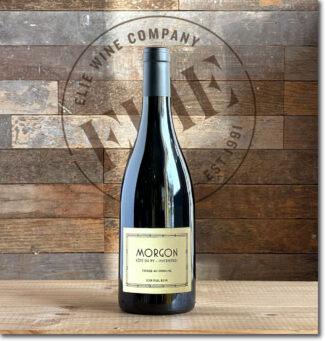 Domaine des Terres Dorées, 2021 Morgon Côte du Py-Javernières ($30)
The Javernières lieu-dit sits at the foot of the hallowed Côte du Py hill, noted for the iron-rich clay component of its sandy granite soils. The vines in this bottling range from 50 to 100 years old and are farmed sustainably and harvested by hand. he vinification is traditional Burgundian: The bunches are destemmed and fermented with native yeasts and without sulfur in concrete tank. The maceration lasts about four weeks. The wine is aged in concrete for 6-8 months and bottled with a light, non-sterile filtration and minimal sulfur.
Guy Breton
Guy Breton took over the family domain from his grandfather in 1986—up until then, the family had been selling their fruit to the large cooperative wineries which dominated the region. The rise of imported yeast cultures to impart flavor and aroma, the use of high-tech carbonic maceration and the widespread commercialization of Beaujolais Nouveau played hell with the region’s reputation, and to much of the wine world, Beaujolais came to be seen as one-dimensional, lacking any expression of the native terroir.
Guy Breton took over the family domain from his grandfather in 1986—up until then, the family had been selling their fruit to the large cooperative wineries which dominated the region. The rise of imported yeast cultures to impart flavor and aroma, the use of high-tech carbonic maceration and the widespread commercialization of Beaujolais Nouveau played hell with the region’s reputation, and to much of the wine world, Beaujolais came to be seen as one-dimensional, lacking any expression of the native terroir.
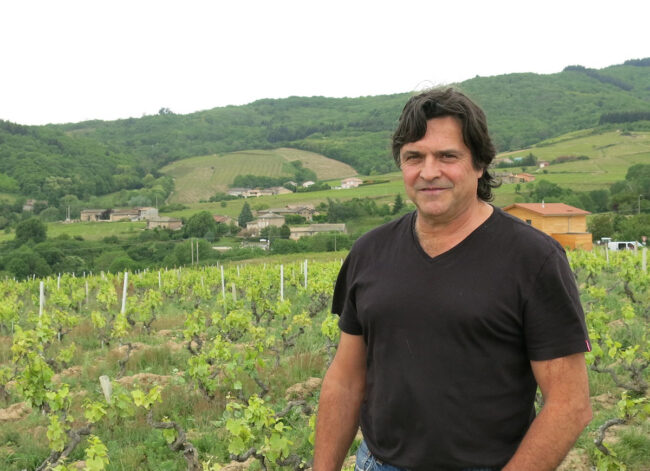
Guy Breton
Following the example of traditionalist Jules Chauvet, Guy and three other local vignerons initiated a ‘back-to-nature’ movement, calling for called for a return to the old practices of viticulture and vinification. This began with old vines and refusing to use synthetic herbicides or pesticides. They harvested late and sorted rigorously to remove all but the healthiest grapes, adding minimal doses of sulfur dioxide or none at all, and refusing both chaptalization and filtration.
“The end result allows my wine to express itself naturally,” he says, “without make-up or plastic surgery: rustic, spicy, loaded with schist minerals and at the same time, refreshing and deep-down delicious.”
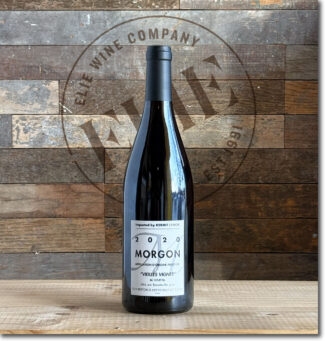 Guy Breton, 2020 Morgon ($45)
Although 2020 was one of the hottest growing seasons on record, Guy Breton draws juice from 80-year-old vines to produce this succulent, floral, breezy wine; a dose of relief from the sundogs of summer. Managing elegance and lightness behind a rich backbone of fruit, the wine shows wild strawberry tartness and crystalline, balancing floral notes and an appealing softness that is evidence of Breton’s reputation among the Club de Cinq who are ushering Beaujolais into a new era.
Notebook …
Is Beaujolais on a Path Towards Premier Cru Recognition?
Of all the ‘subdivisions’ in wine, lieux-dits (named places) are perhaps the most poetic. Having earned their reputation for quality, often over centuries, they are individual plots of exceptional terroir named with love and respect—after a family, a natural landscape feature or a historical event. Among more than six hundred recognized lieux-dits in Beaujolais is La Chapelle des Bois (The Chapel of the Woods), La Tour du Bief (The Tower of the Reach) and La Martingale—whose translation is self-evident.
As in the rest of France, these names have often appeared on Beaujolais wine labels, not necessarily as a legal indicator of quality, but as an informal nod to those in the know. It’s an optional honor, and although lieux-dits are registered, they do not have to conform to specified body of regulations such as crop yields and minimum sugar content. Those sorts of mandates belong to a separate system of classification, one that includes Premier and Grand Crus, the jewels of the Côte d’Or.
Beaujolais’ mosaic of soils was brought to light in 2018 when an unprecedented nine-year study revealed more than 300 types descended from fifteen geological formations. This is one of the reasons that Beaujolais wines are unique, not just from one AOP to another, but also from lieu-dit to lieu-dit.
Now a movement is afoot in Beaujolais to elevate the classification some of these revered plots beyond named-vineyard status to Premier Crus. As you might imagine, this is a monumental undertaking. First, a winegrower has to approach the National Institute of Origin and Quality (INAO) with proof of the vineyard’s aspirations: Are there references to the lieu-dit in the historical archives? Does the wine display characteristics that are unique in the AOP, and does the winegrowers already mention the lieu-dit on their bottles in order to more finely define their terroir? If the answer is yes, the interested party then submits an application to the INAO and awaits their evaluation.
Growers in Fleurie, Brouilly, Moulin-à-Vent, Côte de Brouilly and Juliénas have already submitted such applications and data collection continues in the other Beaujolais Crus.
Patience is understood to be a virtue, as it often takes a decade or more for the upgrade in status to be approved… or not.
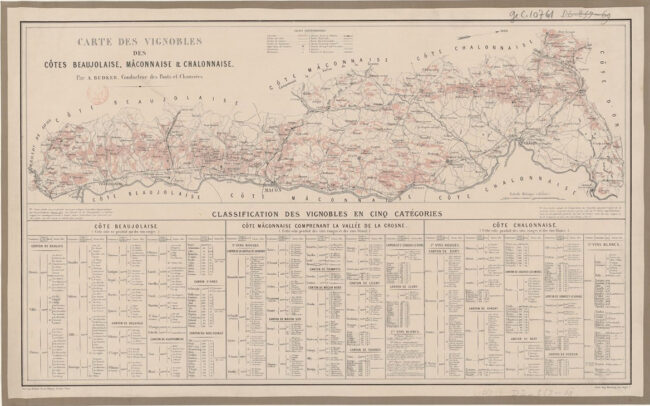
Lieux-dits of the “Beaujolais hillside” identified on the 1869 Budker map, Bibliothèque Nationale de France
- - -
Posted on 2025.01.09 in Morgon, France, Beaujolais, Wine-Aid Packages | Read more...
Wine Like Any Other: Small Scale Vignerons Unlock Champagne and Catalunya Sparkling Wine’s Full Depth and Diversity of the Regions’ Terroir
Saturday Sips: In-Store Tasting: Bubbles (What Else?) to Ring In the New Year
 It’s easy to think of Champagne as a spiritual substance; after all, it was created by monks and the very airiness of its identity seems celestial. The cornerstone of biodynamics is a view of the vineyard, and its subsequent produce, as a singular organism capable of self-healing and self-propagation. Natural material alone sustains the soil; chemical fertilizers and pesticides are forbidden and range of animals creating a rich, fertile environment for the vines to thrive in.
In the fertile environment of our Birmingham storefront, we invite all of our customers to sample some of our prized Champagnes from our favorite sub-regions, which may not get the same love as the prestige Houses, but which are defining Champagne Nouveau—the wave of the future. Join us as our guests on Friday, December 27 and Saturday, December 28 to toast that future.
Cheers!
Elie
At this tumultuous year’s end, we offer a cerebral celebration—a roster of sparkling wines that not only possess soul, but a sophisticated modern mindset. Vignerons in France and Spain have recalibrated their thinking on effervescence, combining age-old wisdoms and updated technologies to create wines that revel in the simple joy of personal expression.
Globally, winemakers are facing the inevitable upheaval of changing markets and changing climates, and to cope, a younger generation has adopted a new way of viewing the old narrative. In Champagne especially, the focus is shifting from uniformity to specificity, and improved farming has become ultra-important in a region that had long disregarded it. Terroir trumpets are being sounded as never before by men and women who, a decade ago, weren’t even making Champagne. As the old guard slowly yields ground, the future of the region is far different than its past might have suggested.
A similar cataclysm of thought is happening in Cava. Unlike Champagne, Cava refers to a style, not a place (namely, Spanish sparkling wine produced via the traditional Champagne method), but that style is undergoing a metamorphosis. Rising above its existential crisis as a cheap fizz meant to lubricate bottomless brunches, a new wave of enólogos are rebelling against the high-volume, low-quality juggernaut that has represented Cava production in the past. They are refining their approach to both agriculture and cellar to create unclassifiable sparkling wines that combine savory depth with the raw energy of innovation.
In 2025, we will continue our quest to reveal the mysteries of such sparkling wines, a style that is meant for contemplation and much as celebration. It is remarkable to watch a wine with roots in the past leaf out into the future.
A Sense of Clarity: Recalibrating Champagne’s Wines
‘Vin Clair’ is a term that even has Champagne aficionados scurrying for the wine dictionary, but it’s being spoken with increasing frequency in tasting rooms throughout Champagne. It means ‘clear wine’ and is the raw stuff that exists before the bubbles, and with each passing vintage, the ‘stuff’ is becoming less and less raw. Usually made in small batches, it is the fermented must from sub-regions, crus, vineyards and small parcels that serve as the palette from which the cellar master draws color for the final blend.
In this era, the characteristics of the individual barrels is coming into greater focus as blending—however common it remains in Champagne—is slowly become somewhat passé to cutting-edge cellar masters eager to express individual terroirs. These are the récoltants—grape growers who produce wine from their own fruit.
In the past, vin clairs were best left as a forethought, not worth sampling for anyone but a blender; for the most part, they tended to be shockingly sharp with acidity and as informative to the palate as lemon juice despite being the backbone from which the world’s greatest Champagnes are built. But climate change is working a strange magic in wine country, and in Champagne, that translates into consistently warmer vintages. The region’s dual climate influences, continental and oceanic, exaggerate this effect, bringing more extreme weather. But in warmer growing seasons—those not beset by storms—the ‘framework’ vin clairs are more palatable, and better reflect their places of origin. This is a phenomenon that coincides with the consumer and the grower/producer’s fascination with individual terroirs and has led to a movement away from homogenous ‘house style’ Champagnes toward wines that announce a clear sense of place. In addition, regions and grape varieties once marginalized by climatic conditions like altitude and latitude are now producing wines of considerable depth and quality.
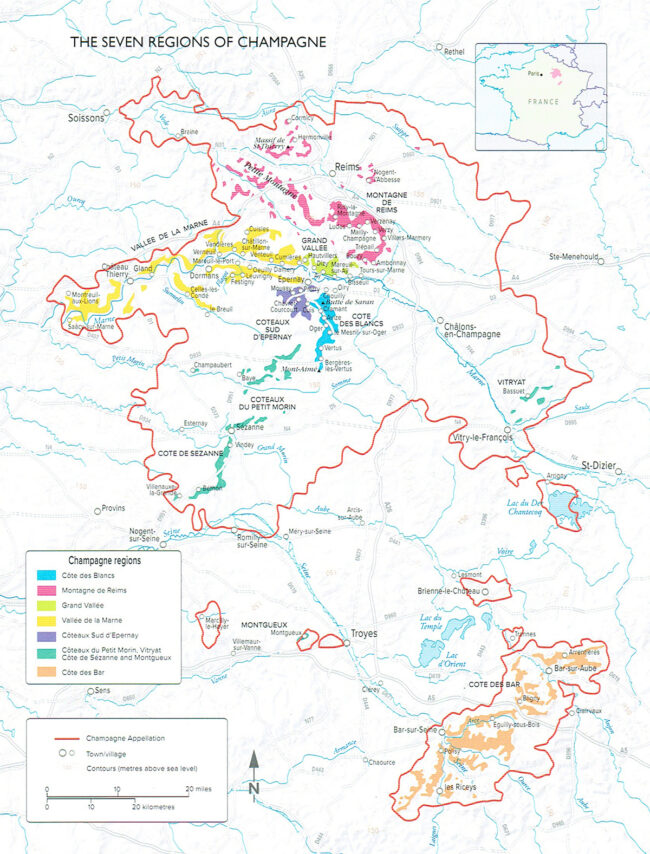
Côte-des-Bar: Champagne’s Rebel South
Since the Côte des Bar is the Aube’s only significant wine producing area, the two names are generally interchangeable in winemaking discussions. ‘Aube’ translates to ‘dawn’, so it is fitting that this district is Champagne’s rising star. In part this is because of the district’s push towards a culture of artisanal, experimental, terroir-driven Champagne. Situated further south than the other four regions, it is less prone to frost and the Pinot Noirs of the Aube are rich and fruit-driven. Although the district is devoid of Grand or Premier Cru vineyards, since the 1950s, grapes grown there have formed a vital backbone of the blend produced by many of the top Champagne houses.
Perhaps the lack of a historical reputation means that the AOP has less to lose, but the overall mindset of the region encourages mavericks, which in tradition-heavy Champagne is rarely seen. It is these independent winemakers that are primarily responsible for district’s mushrooming growth, which now makes up almost a quarter of the entire Champagne region.
The vines of the Côte des Bar can be found scattered patches within two main districts, the Barséquenais, centered on Bar-sur-Seine, and the Barsuraubois, centered on Bar-sur-Aube.
Helping to forge the region’s new identity is a crew of younger grower/producers, many of whom have traveled abroad and trained in other winemaking regions. As a result, they tend to focus more on individuality; single-variety, single-vintage, and single-vineyard Champagnes from the Côte des Bar are quite common. Not only that, but land remains relatively inexpensive, which encourages experimentation.
Even though many of Côte des Bar’s Champagnes are 100% Pinot Noir, styles can differ markedly from producer to producer, bottling to bottling and, of course, from vintage to vintage.

• Côte-des-Bar •
Villages Buxières-sur-Arce & Ville-sur-Arce
Champagne Vouette & Sorbée
Bertrand, Hélène and Héloïse Gautherot
Champagne Radicalism
Bertrand Gautherot is such a believer in site specific Champagne that he named his House after it—or rather, after them: Vouette and Sorbée are two of his favorite lieux-dits. Once a grower from Buxières-sur-Acre in the hills south of the medieval town of Troyes, he took a cue from friends Jérôme Prévost and Pierre Larmandier, first converting his vineyards to biodynamics (he received Demeter certification in 1998), then, in 2001, taking the massive step of bottling and releasing wine under his own label.
He knows what he has, too: “Unlike the vineyards in the north of Champagne,” he says, “with their fine chalky soils, the Côte des Bar is more like Chablis with dense, rocky, Kimmeridgian and Portlandian limestone clay soils.”
Pinot Noir had long dominated the region, but Bertrand has slowly expanded his plantings of Chardonnay. He farms about thirteen acres divided among six lieux-dits, with five of them located near his hometown of Buxières and one in the neighboring village of Ville-sur-Acre. A farmer to his core, in addition to the vines he raises chickens and cattle (which he refers to as ‘his marketing department’) and operates a nearly self-sustaining enclosed ecosystem.

Bertrand Gautherot, Vouette & Sorbée
Of the two prized plots he inherited from his father, Gautherot says, “Vouette is located immediately behind my house. It on a south-facing slope that transitions from Kimmeridgian limestone at the bottom to Portlandian at the top. After the 2014 vintage, I pulled out the Pinot Noir and replanted it Chardonnay. Sorbée is at the top of the hill where Vouette is situated and where the soils are entirely Portlandian. This is a more level site with a slight southwestern exposure. The Pinot Noir vines here are between 30 and 45 years old. For generations, the grapes grown here were used to make my family’s everyday drinking wine, so this site has never been commercially farmed.”
To best showcase the muscularity of these sites, Bertrand’s range is made entirely from hand-harvested grapes and fermented with indigenous yeasts in French oak barrels—fûts de chêne. Nothing is chaptalized, filtered or acidified; there are no cold macerations only a miniscule amount of SO2 is added right after the grapes are pressed. Bertrand prefers to make wines as transparent as possible, so he doesn’t use liqueur de l’expedition.
Having placed Buxières-sur-Acre on the wine map, Gautherot maintains that biodynamics—along with all farming techniques—is a tool, not a religion. “The culture of the vine is my passion,” he says. “but you don’t drink a wine because it’s biodynamic, you drink it because it’s good.”
 Champagne Vouette & Sorbée ‘Fidèle’, Côte-des-Bar Blanc-de-Noirs Brut-Nature ($99)
The name Fidèle indicates the faithfulness with which it expresses its places of origin. It shows bright, fruit-forward sparkle with a mineral undercurrent. It is 100% Pinot Noir from the lieux-dits Fonnet and Briaunes where vines average 25 years old; the final blend contains 5% reserve wine. It is fermented in oak on native yeasts before spending 20 months sur latte.
The wine was disgorged on November 2022 and dosed at 0 grams per liter.
 Champagne Vouette & Sorbée ‘Blanc d’Argile’, Côte-des-Bar Blanc-de-Blancs Brut-Nature ($125)
Pure Chardonnay from the Biaunes vineyard in the village of Ville-sur-Arce where Kimmeridgian marl dominates. At 15 years old, the vines are still young, accounting for the small production of this wine, which was hand-harvested and fermented in oak before spending 18 months on the lees. It has been likened to a Grand Cru Chablis with bubbles, showing a salty minerality underscored with apple and nougat. Disgorged September 2023 with zero dosage.
 Champagne Vouette & Sorbée ‘Blanc d’Argile’, Côte-des-Bar Blanc-de-Blancs Brut-Nature ($250) 1.5 L
The same wine as above, only in magnum size. Disgorged April 2024 with zero dosage.
Petite Montagne-de-Reims: The Expression of Terroir
In French, the word ‘petite’ often to refers to a ‘lesser’ commodity, but with La Petite Montagne, the reference is to elevation. This lower elevation means warmer weather, even in Champagne’s northerly climate, and in certain villages, the soils contain more sand, making it an ideal environment for growing Meunier.
Meunier accounts for approximately half of the plantings in the Petite Montagne, with Pinot Noir making up 35% and the rest Chardonnay. It is a growing conviction among growers of the modern era that Meunier is a Champagne grape whose time has come, especially as an age-worthy variety. Emmanuel Brochet of Villers-aux-Noeuds says: “People claim that Meunier ages too quickly, even faster than Chardonnay. I disagree. The curve of evolution is different. Meunier is quick to open and more approachable in youth, but then it becomes quite stable. Chardonnay tends to open later, but old Meunier remains very fresh and lively.”

• Petite Montagne-de-Reims •
Premier Crus Village Écueil & Les Mesneux
Champagne Lacourte Godbillon
Géraldine Lacourte and Richard Desvignes
Terroir Evangelism
The transition from simply growing grapes to becoming a winemaker who ferments their own crop is taking modern sensibilities by storm, but the family of Géraldine Lacourte took the leap in 1947. Géraldine says, “The Lacourtes on my father’s side and the Godbillons on my mother’s side once sold all their harvest to the major Champagne Houses. It was, perhaps, not a labor of love so much as a labor of survival—my grandmother talked about being in vineyards from five in the morning until eight at night, with the children joining them after school. Then in 1947, shortly after returning from the war, they began a new adventure: Producing and marketing champagne under the names Lacourte-Labasse and Godbillon-Marie. So popular was their wine that they were soon filling their customers’ car boots with bulk orders!”
Géraldine’s parents took the reins in 1968 and established the Champagne Lacourte-Godbillon label. “At first it was no more than a few thousand bottles. Bottling and disgorgement would be done at the back of a courtyard. But the most important thing was my father’s understanding that the best Champagne was made only from top quality work in the vineyard. His whole career was dedicated to this ethos.”

Géraldine Lacourte and Richard Desvignes, Champagne Lacourte Godbillon
In 2006, she and her husband Richard Desvignes left urban jobs and returned to their ancestral roots: “Our 21 acres of vineyards is planted 85% to Pinot Noir and 15% to Chardonnay, all of it in Écueil except for just 1.2 acres in the neighboring village of Les Mesneux. Our vines have an average age of 30 years.”
Richard explains, “Winemakers from all over the Montagne district have long bought Pinot Noir vine plants from Écueil. There was even a school here where they could learn how to graft these stocks. Up until a few years ago we bought our Pinot Noir plants from the local nursery, but going forward, we will be implementing our own ‘massale selection’ of the best plants for cuttings in our own parcels of vines, in order to preserve this heritage.”
The terroir is characterized by an incredibly diverse sub-soil. Some parts are predominantly sandy over the deep chalk, others composed of ‘sparnacian’ clay and shallow chalk at the bottom of the hillsides, similar to the soils of Les Mesneux.
Reframing Champagne: Single Village Premier Cru Écueil
Écueil is one of a string of Premier Cru villages that extend along the slopes of La Petite Montagne. The commune itself has a scant three hundred citizens and covers 1700 acres, of which slightly under four hundred are planted to grape vines. Unlike many of the surrounding villages, Écueil is a Pinot Noir stronghold; Pinot Noir represents 76% of the commune’s production, the remainder being split equally between Chardonnay and Pinot Meunier.
The growers of Écueil are often the lords of tiny holdings, many passed down through generations; they cultivate them meticulously and are deeply connected to their land. As a result, they can boast an intellectual understanding every corner of their vineyards and the personal nuances of the family terroir. To blend away these subtleties with adulterations from other plots, other villages, seems almost silly to those of us who appreciate the reflection of origin.
Single village Champagnes, or ‘monocrus,’ are coming into vogue for this very reason.
The vineyards of Écueil are mostly east-facing, but the several lieux-dits have more southerly exposures. These highly-prized sites have a considerable percentage of sand mixed in with the clay, offering the wines power, lift and elegance. An individual vineyard may have select plots as soils vary from sand atop deep chalk at the top of the slope to clay over shallow chalk at the bottom.
 Champagne Lacourte Godbillon ‘Terroirs d’Ecueil’, Petite Montagne-de-Reims Premier Cru Écueil Extra-Brut ($58)
85% Pinot Noir and 15% Chardonnay grown on the characteristic silty loam soils of Écueil. The wine is a blend of vintages; 47% from 2020, which spent nine months on the lees, and 53% reserve wine from 2019 and 2018. The wine is crisp and racy with acidity, showing notes of citrus, brioche toast and lime zest.
It was bottled July 2021, disgorged on January 2024 and dosed at 3.5 grams per liter, with production at 36,300 bottles.
 Champagne Lacourte Godbillon ”Terroirs Épanouis #2’, Petite Montagne-de-Reims Premier Cru Écueil Extra-Brut ($99)
‘Épanouis’ is a dual meaning word, both of which apply: It translates to ‘blossoming’ and ‘contented.’ 85% Pinot Noir, 15% Chardonnay using a base of 44% 2016 reserve, which spent nine months on the lees enhanced with 56% reserve wine from 2015 and 2014. The wine is aromatic with a powerful nose showing toasted almonds and candied fruits, broad and sublime on the palate.
Bottled in July 2016; disgorged January 2024 and dosed at 1.5 grams per liter. A scant production of one thousand bottles.
 Champagne Lacourte Godbillon ‘Mi-Pentes’, Petite Montagne-de-Reims Premier Cru Écueil Blanc de Noirs Extra-Brut (Sold Out)
‘Mi-Pentes’ is a French term meaning ‘mid-slope,’ and this is the location of the vines that make up this pure Pinot Noir from Écueil. The wine is a blend of 66% wine from the 2020 vintage which spent nine months on the lees (44% in large oak foudres) and the rest from 2019 reserve.
Bottled in July 2021, using the old ‘tirage sur liège’ method, in which (instead of crown caps) the bottles are sealed with natural cork for their all-important second fermentation; the porosity of the cork allows the wine to mature longer on the lees and thus develop more complexity over a considerable period. Flecks of amber in the hue reflect barrel contact; the wine shows peach, nectarine and toasted nuts.
Disgorged in May 2024 and dosed at 2.5 grams per liter.
Production: 4650 Bottles
 Champagne Lacourte Godbillon ‘R’, Petite Montagne-de-Reims Premier Cru Écueil Rosé Extra-Brut ($64)
‘R’ for rosé; 100% Pinot Noir with 6% vin rouge. 55% from the 2021 vintage, which spent nine months sur-lie—40% in large oak barrels—blended with 45% 2020 reserve wine. It was bottled in July 2022 and disgorged May 2024 with 3 grams per liter dosage. The wine shows spicy notes of cinnamon, nutmeg and ginger mingling with blood orange and raspberries.
Production: 5360 Bottles

Precise Champagne: Écueil’s Single Parcels, Lieux-dits
The ‘parcellaire’ approach takes microscopic expressions of a single village even further; site-specific Champagnes celebrate the terroir of an individual vineyard, or even a named portion of a single vineyard, a lieu-dit. In Burgundy, this is common practice; in Champagne (lacking the pervasive marketing tactics of the Grand Marques) it remains an anomaly.
But the consumer will-out, and if these wines take hold of the public’s imagination as firmly as they have done in Burgundy, this style may well dictate the future, especially among those of us who insist that wine reflect the minutia of the soil in which it originates.
The Écueil lieux-dits mentioned above consist of the following:
Les Aillys; a vineyard site immediately to the north of the village itself. Most of the site is south-facing on a gentle slope.
Les Chaillots; a vineyard site in the northern part of Écueil, northwest of the village itself, on the border to Sacy. The site is located in the upper part of the slope, but is rather flat.
Derrière Moutier; an east-facing site situated in the slope immediately above the graveyard, to the west and northwest of it.
Les Gillis; a southeast-sloping vineyard site in the southern part of Écueil, on the border to Chamery. The site is located mid-slope, just above/west of the D26 road.
Les Hautes Vignes; a southeast-facing vineyard site in the southern part of Écueil. It is located immediately above/west of the D26 and borders to Les Gillis in southwest.
Le Mont des Chrétiens; a southeast-sloping vineyard site in the southern part of Écueil, on the border to Chamery. The site is located in the upper part of the slope, close to the edge of the forest, and borders Les Gillis, among others.
 Champagne Lacourte Godbillon ‘C.’, 2016 Petite Montagne-de-Reims Premier Cru Écueil Extra-Brut ($139)
100% Sélection Massale Pinot Noir from the lieu-dit Les Chaillots planted in 1966, a plot prized for its sandy surface and tuffaceous subsoil. The wine was bottled in July, 2017 using the old tirage sur liège method and disgorged on May 9, 2023 with 1.5 grams per liter dosage, and bottled with cork and staple. Rich and refined with notes of fig leaf, black tea and fresh spices blended into a firm, structured palate.
Production: 1658 bottles; 30 Magnums.
 Champagne Lacourte Godbillon ‘C.H.V.’, 2019 Petite Montagne-de-Reims Premier Cru Écueil Blanc de Blancs Extra-Brut ($105)
‘C.H.V.’ indicates the two lieux-dits sources, Les Chaillots and Les Hautes Vignes, where dual soil types—sables (Les Chaillots) and argiles légères (Les Hautes Vignes) bring their unique personalities to the wine. 100% Chardonnay from the 2019 vintage, vinified in oak barrels, and bottled using gravity, without filtration or fining and aged with cork and staple. Bottled in July 2020, tirage sur liège; disgorged January 2024 and dosed at 2.5 grams per liter. Clean and intense with warm, rich aromas of brioche and roasted almonds and on the palate, honey and minerals on a sustained finish.
Production: 2009 Bottles
 Champagne Lacourte Godbillon ‘C.H.V.’, 2016 Petite Montagne-de-Reims Premier Cru Écueil Blanc de Blancs Extra-Brut 1.5 Liter ($247)
2016 was a rollercoaster vintage, but drawing from the twin lieux-dits of Les Chaillots and Les Hautes Vignes, the House has put together a beautiful Champagne, here in Magnum. Unfiltered, unfined and malo blocked. 100% Chardonnay with nine months sur-lie, 40% in large oak casks. The wine was bottled in July, 2017 and disgorged in October, 2023 with a dosage of 2 grams per liter; it exhibits aromas of warm, freshly-baked bread, lemon oil, white flowers and hazelnuts.
Production: 50 magnums

Premier-Cru Duality: Villages Écueil and Les Mesneux
Les Mesneux is located just below the northwestern part of the Montagne de Reims slope just south of the Reims beltway and rail line. Unlike Pinot-heavy Écueil, Mesneux leans toward Meunier with about 60% of the 118 planted to this varietal; Pinot Noir makes up 33% with the rest Chardonnay. Mesneux terroir is clay-limestone and sandy-loam and produces wines that are known for their delicate precision and focused tension.
 Champagne Lacourte Godbillon ‘Millésime’, 2018 Petite Montagne-de-Reims Premier-Cru Écueil & Premier-Cru Les Mesneux Extra-Brut ($79)
2018 was a legendary vintage in Champagne; this blend of Premier Cru villages show the prolonged summer heatwave in the concentrated aromatics of the nose. 60% Pinot Noir and 40% Chardonnay, the wine spent nine months on the less, 40% of it in 228 liter casks. It was bottled in July, 2019 and disgorged December 14, 2023 and dosed at 2 grams per liter. It displays the elegance and weight of the vintage with crisp fruitiness and spiced notes of cinnamon, licorice and pepper.
Production: 900 Bottles
 Champagne Lacourte Godbillon ‘Millésime’, 2013 Petite Montagne-de-Reims Premier-Cru Écueil & Premier-Cru Les Mesneux Extra-Brut ($173) 1.5 Liter
Millésime, of course, is a Champagne term for vintage and indicates that 85% of the grapes came from that specific harvest. 47% Pinot Noir and 53% Chardonnay, 25% fermented in oak from the difficult, but ultimately redeemed 2013 vintage. The grapes had their origin in the estate’s vines in Écueil and Mesneux; the wine was bottled in March 2014 and disgorged in May, 2024 and dosed at 2.5 grams per liter. It shows fruity notes of apples and apricots along with fresh almonds and hazelnuts and hints of coriander seed to add a touch of complexity.
Production 296 magnums.
 Champagne Lacourte Godbillon ‘M.A.M.’, 2016 Petite Montagne-de-Reims Premier-Cru Écueil & Premier-Cru Les Mesneux Brut-Nature ($139)
100% Pinot Noir. The abbreviation ‘M.A.M’ signifies the double-barrel terroirs; the lieu-dit Mont Âme is distinguished by its chalky and calcareous soil, contributing to the minerality and Les Migerats, whose rich clay brings plumminess of the fruit into focus. From the 2016 harvest—a tricky vintage that was ultimately better for Pinot Noir than Chardonnay—which spent nine months on the lees. Bottled in July, 2017; disgorged on May 9, 2023 with zero dosage, finished with cork and staple. The wine shows sweet notes of plum tarts and ripe drupes with a refreshing and persistent roundness.
Production: 1834 Bottles, 30 Magnums.

Catalunya
La Vall del Riu Anoia in Alt Penedès
Over the past century and a half, no wine region has seen its product more compartmentalized than Spain. For the most part, red meant Rioja, white was Penedès, rosé was Navarra and sparkling was Cava. Sherry was… well, Sherry.
Over the past fifty years, all of those convenient ‘boxes’ has experienced its share of upheavals, but the most dynamic may be the re-envisioning of sparkling wine—primarily because it was once viewed as the ‘easiest’ of Spanish wines to understand. Lacking the gustatory nuance and intricate classifications of French Champagne, Spain’s response to this market was simple, refreshing bubbles so ludicrously inexpensive that party stores and mini-marts stocked it.
You’ve come a long way, bebé:
A hundred and fifty years after its inception, the Cava industry devolved into a volume-oriented D.O. with low viticultural standards and no geographical distinction in terms of climate and soils. This made the vinous landscape ripe for a new breed of producer intent on raising the bar—even if it meant leaving the Denominación de Origen altogether.
One of the most celebrated growing regions, the Anoia river valley in the Penedès, has long been seen as having the stuff to create truly great Cava; the soils, formed by sandstone and clay, sit on calcareous bedrock created from marine fossils. This allows for a water reserve that helps vines through dry spells. The river basin, the ‘Conca del Riu Anoia’ produces sparkling wines with a marked mineral and saline character and a very fine mesh of bubbles. Within this small region (surrounding the valley between the Anoia and Foix Rivers in eastern Penedès), new-wave Cava makers have discovered that the individual character of local villages and vineyards are capable of expressing these characteristics in a unique and identifiable way. Combined with tightened regulations—among which are the use of indigenous varieties only, extended lees time and restricted vineyard yields—these new sparkling wines are ideal not only for celebrating landmark dates on your calendar, but are their own celebration of youthful passion and commitment.

• Alt Penedès, La Vall del Riu Anoia •
Villages Torrelavit & Sant Sadurní d’Anoia
Celler Casajou
Laia Esmel and Jaume Vilaseca
The Vineyard as The Protagonist
A common theme found in the stories of young winemakers in Penedès is a return to their roots. Laia Esmel, along with her partner Jaume Vilaseca, did exactly that: “For us it is vital to be connected to the rural essence and nature to make vibrant wines,” Laia says. “That is why, after years of gathering experience traveling and meeting exceptional personalities, we decided to return to the place of our childhood, Sant Jaume Sesoliveres, a rural town in the valley of the Anoia River between Montserrat and the Mediterranean Sea.”
The move came in 2020, so they are still new to the game. “We consider the vineyard to be the protagonist in our adventure,” Jaume shares. “Many times in nature, things seem to be out of order, without explanations and without clear answers. Accepting this reality is the first step to understanding our terroir and working in harmony with it. We strive to produce vintage wines that are an authentic expression of the soils and climate we have. In doing so, we can celebrate the elegance and complexity of nature, even in its apparent lack of order.”

Laia Esmel, Celler Casajou
The winery is split into two projects: Casajou is focused on making precise, elegant Champagne-method sparkling wines. And with their friend Oriol, they are making ‘pétillant naturel’ wines from newly-planted vines under the label Celler Dumenge. Pét-nats are made in a manner that predates the so-called traditional method used in Cava; rather than inducing a second fermentation in the bottle to create the bubbles, as Champagne producers do, makers of pét-nat simply bottle the wine before the initial fermentation has ended.
A Zen-like respect for the natural and almost childlike fascination with viticulture is the thread that runs through Laia and Jaume’s conversations. Laia says, “We believe in giving the grapes all the time they need to become a free wine, and we work at all times to guide them until they are bottled. Pruning, work in the vineyard, soil regeneration, harvest day or spontaneous fermentation; we are aware of every step of the process of making our sparkling wines, interfering only in what is essential to help nature, and not to hinder it.”
Jaume adds, “We consider that bottled wine is the final result of a careful and laborious process. We make sure to give our best at every stage of its preparation. However, once in the bottle, the evolution process continues. We know this doesn’t mean it’s finished, because like a person, wine keeps changing over time. It will go through different phases and have its ups and downs, but despite everything, it will always shine with vitality and complexity. As sparkling wine makers, we pride ourselves on having transported a landscape in a glass.”
 Celler Casajou ‘Vinya la Caldereta’, 2020 La Vall del Riu Anoia ‘Sant Sadurní d’Anoia’ Brut-Nature ($39)
A limited release of just 5,000 bottles, Casajou’s Vinya la Caldereta originates in a four-acre vineyard located on a small south-facing hillside in Sant Sadurní d’Anoia. Dominated by sandy-calcareous soils, it was planted in 1963 to Xarel·lo. This wine is 95% old vine Xarel·lo and 5% Macabeu. Following a manual harvest that began on August 21, 2020, the grapes were pressed and the ‘flower must’ alone was used, representing only 40% of the yield. ‘Flower must’ is a Cava regulation that refers to the first part of the grape pressing process; it is considered the highest quality must, since the Cava Designation of Origin limits the amount of must that can be obtained from each kilogram of grapes. For Laia and Jaume, the remaining must goes into the elaboration of Els Talls. In Caldereta, the two varieties co-ferment in stainless steel tanks with indigenous yeasts and undergo several hours of maceration with the skins. In the traditional method, the wine undergoes a second fermentation in the bottle and rests on its lees until disgorgement. It shows bright orchard fruit complemented by floral undertones and hints of Mediterranean spice.
 Celler Casajou ‘Vinya la Teixonera’, 2021 La Vall del Riu Anoia ‘Torrelavit’ Rosé Brut-Nature ($39)
La Teixonera vineyard is named after a small river near the town of Torrelavit, whose name itself is a portmanteau of Torre and Lavit—two proximate communes in the Alt Penedès who joined forces. The vineyard was planted to Garnatxa Negra—current vines are ten years old. 100% Garnatxa Negra, the wine is redolent with raspberries, earth, and a slight touch of brine. 1140 bottles were filled.
 Celler Casajou ‘Els Talls’, 2021 La Vall del Riu Anoia Brut-Nature ($36)
Els Talls represents a co-fermentation of Xarel·lo (80%) from La Caldereta and Garnatxa Negra (20%) from La Teixonera following a year’s maturation. The clay soils of La Teixonera reflect fruit and depth while the calcareous soils of La Caldereta introduce the electric tension of Xarel·lo. Like the origin, the wine is a delightful blend of apple and citrus, A scant 1300 bottles produced.
RECENT ARRIVALS
A great wine may begin life in the vineyard and end at the dinner table among appreciate fans, but it is the human touch in the middle that defines the creation. That’s why, when we celebrate new arrivals to our shelves, we find it a source of endless fascination to look at the women and men who are the wine’s elaborators; the skilled vignerons who coax powerful statements from basic produce.
With these new arrivals, we’ll consider the personalities of the cellar masters who may, with certain candor, be considered an indispensable part of various Champagne terroirs—some of which may be more familiar than others.
The Grande Montagne de Reims
Located between Reims and Épernay, the Montagne de Reims is a relatively low-lying (under a thousand feet in elevation) plateau, mostly draped in thick forest. Vines find a suitable home on the flanks, forming a horseshoe that opens to the west. So varied are the soils, topographies and microclimates here that it is not possible to speak of the region in any unified sense. Grande Montagne de Reims, which contains all of the region’s Grand Cru vineyards, covers the northern, eastern and southern slopes of the viticultural area, and Pinot Noir plantings dominate at 57%, followed by Chardonnay (30%) and Meunier (13%). Its vineyards face a multitude of directions, and soil type varies by village, giving rise to a breadth of Pinot Noir expressions, as well as exceptional Chardonnay.
Champagne Marguet
Benoît Marguet

Benoît Marguet, Champagne Marguet
Champagne Marguet has been a bellwether for innovation since 1883, the year that Émile Marguet began to graft his vines onto American rootstocks in the face of the impending invasion of phylloxera. Alas, so ridiculed was the notion throughout Champagne that Marguet wound up tearing out the grafted vines and promptly declared bankruptcy.
Ratchet forward a century and a half: In 2006, Émile Marguet’s distant scion Benoît Marguet joined forces with Hervé Jestin, the former chef de cave of Duval-Leroy, and began to produce a special homeopathic and biodynamic super-cuvée called ‘Sapience’, first released in 2013. Being on the cutting edge of trends has finally paid dividends. Today, Benoît farms 25 acres of vines, all using biodynamic practices. Most are owned by Marguet himself while the rest are leased from relatives. Among them are eight different lieux-dits with an average vine age of 42 years; each is bottled under the name of the plot and reflects the minute soil differences that exist throughout his holdings as well as the massale-select varieties he suits to his various terroirs—among them Les Crayères, Les Bermonts, Le Parc and Les Saints Rémys.
The Vallée de la Marne
In strictly geographical terms, the Marne Valley extends from the city of Tours-sur-Marne to Château-Thierry. It stretches over sixty miles and thorough two départements, the Marne and the Aisne, all the way to the limits of Seine-et-Marne. As its name indicates, the Marne Valley follows the river, a landscape of rolling hills and small villages. Vines are planted on both banks although those on the north side benefit from a more favorable southern to eastern sun exposure. The most famous villages are located at the eastern end of the valley around the city of Épernay, a ranking that reflects the importance given to the presence of chalk in the soil. Chardonnay and Pinot Noir dominate the vineyards of the eastern end of the region, and the major Champagne houses located here include Billecart-Salmon or Philiponnat in Mareuil-sur-Aÿ, Deutz and Bollinger at Aÿ and Jacquesson in Dizy. West of Châtillon-sur-Marne, chalk tends to be found more deeply buried in the ground; the top soil is made of calcareous clay and clay marls. Meunier is the grape of choice in this part of the valley and it here that a new generation of experimental winemaker has flocked in order to deepen their own (and by proxy) our understanding of this variety.
Champagne Françoise Bedel
Françoise Bedel

Françoise Bedel and son, Champagne Françoise Bedel
Champagne Françoise Bedel: In a small estate that is closer to Paris than to Reims, Françoise Bedel has managed a remarkable feat: She has turned an acute family illness into a paradigm shift for much of the Champagne region.
From the village of Crouttes-sur-Marne, nestling the banks of the Marne River, Bedel discovered homeopathic medicine while trying to find a cure for her son Vincent’s hitherto untreatable condition. Vincent, now her winemaker, made a marked improvement, and this how Françoise’s journey to biodynamic viticulture began. In 1982, at a time when virtually no one in the wine world had even heard about it, let alone employed it, she realized that the health of the body and the health of the vineyard may be interchangeable concepts.
The 22 acres that make up Champagne Françoise Bedel are spread out on either side of the Marne, Crouttes-Sur-Marne, Nanteuil-Sur-Marne, Charly-Sur-Marne, and Villiers-Saint-Denis. Here vines are between 30 and 70 years old, and each plot boasts different subsoils, allowing for blending according to the terroirs and the elaboration of terroir-specific cuvées.
“These Champagnes are the expression of a rigorous method that brings out and enhances the qualities and particularities of the earth, the vines and the fruit,” Bedel says. “Because I love plants, life in contact with nature, and passing on a healthy land to the next generations, I have been cultivating my vineyard organically since 1998 on the entire estate.”
She is, in fact, only the second generation to tend these vineyards. Her parents, Fernand and Marie-Louise Bedel, turned over a portion of the estate to her in 1979 and with her son Vincent Desaubeau, who has now taken over as winemaker, she forges the future.
She says, “Biodynamics is way of thinking—about the earth, about ourselves, about wine.”
The Coteaux Sud d’Épernay
The Coteaux Sud d’Épernay is fairly evenly balanced between Meunier at 46.7% and Chardonnay at 40.9%, with Pinot Noir making up the remainder. Somewhat simplified, it can be said that Chardonnay is most common in Épernay and in the valleys of Le Mancy and Le Darcy in the north and east, while Meunier prevails in the valley of Le Cubry (excluding Épernay) in the center and west. Sandwiched between two powerhouse wine regions (Côte des Blancs and Vallée de la Marne), the Coteaux has an identity removed from either one. Its terroir is different from the clay-heavy soils of the Marne and it lacks the pure chalk of that puts the ‘blanc’ in the Côte des Blancs. In short, these Champagnes are uniquely situated to offer the best of both worlds. As a result, the Coteaux Sud d’Épernay has long fought for recognition as entity unto itself, not necessarily a sub-region of its big brothers on either side.
Champagne Laherte Frères
Aurélien Laherte

Aurélien Laherte, Champagne Laherte Frères
Champagne Laherte Frères: When trying to demystify the mysterious—and to ground the ethereal—words like ‘alchemy’ (the ancient pseudoscience of spinning gold from base metals) may seem problematic. And yet, under the nimble hands of Aurélien Laherte, the full range of Champagne’s ‘next-level’ magic takes center stage.
‘Next-level’ because Laherte is one of the most progressive young winemakers in the Coteaux Sud d’Epernay, a sub-region sandwiched between the Côtes des Blancs and the Vallée de la Marne. A champion of organics and biodynamics, Aurélien produces a lineup of blended and single-vineyard Champagnes that expresses the unique identities of his terroirs.
The quest for perfection is a keystone in the plans of every winemaker, but in Champagne, where warming temperatures are created consistently better harvests and a return to a natural approach is making terroir more and more transparent, the luck of the draw is shifting to the skills of the Cellar Master. Knowing when to blend and when to let an individual lieu-dit shine through is among the most valuable tools in the chest, and when deployed correctly, allows the vintner to create wines worth their weight in gold.
Champagne Pascal Lejeune
Pascal and Sandrine Lejeune

Pascal and Sandrine Lejeune, Champagne Pascal Lejeune
The permutations of Champagne are as varied as its terroir, but in the exploration, facts keep popping up in triads: In the favored grapes (Pinot Noir, Chardonnay, Meunier), in styles (Blanc de Noirs, Blanc de Blancs, Rosé) and in varying level, in dosage (Brut, Sec and Doux). There are strata in each of these categories, of course, but you get the picture.
Now the trio of Pascal, Sandrine and Thibaut Lejeune (a dad, mom and son team) from the Coteaux Sud d’Épernay, are excelling in the production wines from three categories: Village level, lieu-dit (monoparcellaire) level and a cépage made of grapes from the three villages where they grow fruit, Épernay, Moussy and Vinay.
Beating swords into ploughshares is a Biblical injection that Pascal Lejeune takes literally—he left his career in the military and gave himself to the vine. It didn’t hurt that he fell in love with a Champagne grower’s daughter: Pascal’s wife Sandrine hails from a family that has been growing grapevines in Moussy (where more than half of the vineyard’s grapevines are located) on the south-facing slopes of Épernay since 1910. Originally a side operation, not an essential part of the family’s activities, Sandrine’s great grandfather Edmond played an active part in creating the Moussy cooperative.
In 1995, when Pascal and Sandrine took the reins, their aim was to usher in a new era by enlarging the vineyard area into nearby terroirs, and by enriching the range of offerings via new cuvées: As a brand, Champagne Pascal Lejeune was born.
Says Pascal, “I believe I have a responsibility and commit myself collectively to our business and our terroir in order to perpetuate and monitor developments for our children and future generations. This requires a sincere respect for people, nature, our vines, our soils, and careful work in order to obtain quality grapes. To offer you the best that nature offers us, our vintages are very different, there is something for every occasion and taste… Nature does things well!”
This commitment to nature has been proven out over the past 17 years; Lejeune was one of the first producers in Champagne to plant specially-selected grass species between vine rows. Manual techniques are used for pruning, trellising and debudding. “The benefits of this special care can be observed,” says Sandrine. “Biodiversity is maintained, the soils are protected, the erosion is limited, and as the grapevine roots develop, the phytosanitary products have been significantly reduced.
The Coteaux du Petit-Morin
It’s all quiet on the western front—primarily because the Champagne-producing villages of Petit-Morin are located exclusively on the eastern front. This has traditionally been négociant country, where growers sell their grapes rather than produce wine. Although Coteaux du Petit-Morin is only fifteen miles from Épernay, it remains rural and true to its roots, where the vineyards are surrounded by open field and forested hillsides. The region is frequently lumped in with the Côte de Sézanne or labeled ‘Val de Petit-Morin’ named after the river that has its source in the Val-des-Marais commune, part of the Côte des Blancs. But Olivier Collin of Ulysse Collin (the area’s largest producer) prefers to call his home-base ‘Coteaux du Petit-Morin’ after the hillsides on which the vines grow; he defines the territory in specific terms: “Côte de Sézanne begins at the villages of Broyes and Allemant, south of Villevenard. We run from Soulières in the north to Villevenard in the south, up to Vert-Toulon in the east. As you can see, we are quite unique from either Sézanne or Côte des Blancs”
Champagne Hubert Noiret
Nathalie and Jean-Michel Noiret

Nathalie and Jean-Michel Noiret, Champagne Hubert Noiret
Champagne Hubert Noiret: The transition from wine growing to wine marketing, from selling your grapes to producers to becoming the producer yourself, often takes many generations. Such was the case with Hubert Noiret, a Champagne house in Villevenard commune of Petit-Morin formed in 2003 by Nathalie and Jean-Pierre Noiret, whose families have been tending vineyards since the 18th century. Indeed, it is a background that has served the couple well.
Says Nathalie: “We find that the ancestral techniques of our grandparents who used natural materials have been forgotten and replaced by chemistry. Used on a large scale, it has unbalanced the human environment and plant diversity in the name of comfort. Our life journey has made us understand that chemistry has limited human and plant life and created a phenomena of resistance, which is why since 2011, we gradually rebalance the natural forces of life on all our plots via biodynamics. We reuse materials of natural origin at very low doses: copper against mildew and sulfur against powdery mildew—both essential for the protection of the vineyard and the production of great Champagne.”
Jean-Pierre adds, “From a very young age, we followed our parents closely, but to try to understand what nature wants to give us, I would need at least 3 lifetimes. Ours is a profession of patience, where every detail counts to achieve excellence. We are blessed to be in a region of Champagne rich in a Neolithic past with a very diverse and varied geology. We move from the peat of the Marais de St. Gond to chalk, from marls to white and green clays, from sandy loams to clay loams; a geological palette of incredible richness, lending a character and a style to our Champagnes.”
The Côte-des-Blancs
Soil chemistry may be nuanced—acidity combined with alkalinity, macronutrient and micronutrient availability, et al., but its effects on grape growing is profound. The Côte des Blancs sits upon an exceptionally pure chalk bedrock, which combined with mostly east-facing slopes, creates an ideal environment for growing Chardonnay. The resulting wines are unparalleled in poise and finesse. Even with this overview, the individual villages that pepper the 8000 acres of Côte des Blancs vineyards each bring their own unique gift to the Champagne party. As a result, it is fairly easy to differentiate styles and subtleties between the communes, and broadly, between those of the north and south. Wines from the northern Côte des Blancs villages, with more clay in the chalk, produce richer wines with recognizable weight while those of the south, with lighter topsoil, are piercing, fine-grained wines with a characteristic minerality that is often described as ‘salinity.’
Champagne Pertois-Moriset
Cécile and Vincent Bauchet

Vincent Bauchet, Champagne Pertois-Moriset
Champagne Pertois-Moriset: When young couples marry, their first order of business is often creating a family. In the case of Yves Pertois and Janine Moriset, who wed in 1951, it was to build a winery. Having both been raised in the business, they set up shop in Mesnil-Sur-Oger and drew fruit from fifty acres of prestigious vineyards split between Côte-des-Blancs and Côte de Sézanne.
Today the estate is run by their granddaughter Cécile, who, with her husband Vincent Bauchet, has worked diligently to improve all aspects of the inheritance, technically and ecologically. “The estate works while remaining attentive to the biodiversity that surrounds it,” Cécile maintains. “If the years allow it, no chemical inputs are applied on the vine; the vines are naturally grassed in winter, and in summer the soil is ploughed. All mechanical work is carried out with a 100% electric tractor.”
Vincent adds, “Respecting House legacy, we created a pressing center in 2009. It is equipped with two stainless-steel membrane presses, two thermo-regulated stainless-steel tanks, and a vat room for barrels and big oaks. These facilities contribute to a healthy pressing, a fermentation at controlled linear temperature, a malolactic fermentation deliberately blocked on most of the cuvées, and an ageing on fine lees throughout the winter. Our wine is bottled in June/July in order to give the wine time to fully develop in tanks and barrels. The bottles then rest on the cellar, at least 20 months for the main vintages, and much longer for the vintages, thus guaranteeing that our wines reflect the unique flavors of their terroir.”
Côte-des-Bar
Perhaps the lack of a historical reputation means that the Côte-des-Bar has less to lose, but the overall mindset of the region encourages mavericks, which in tradition-heavy Champagne is rarely seen. It is these independent winemakers that are primarily responsible for district’s mushrooming growth, which now makes up almost a quarter of the entire Champagne region. The vines of the Côte des Bar can be found scattered patches within two main districts, the Barséquenais, centered on Bar-sur-Seine, and the Barsuraubois, centered on Bar-sur-Aube.
Champagne Dosnon
Davy Dosnon

Davy Dosnon, Champagne Dosnon
Champagne Dosnon: Helping to forge the region’s new identity is a crew of younger grower/producers, many of whom have traveled abroad and trained in other winemaking regions. As a result, they tend to focus more on individuality; single-variety, single-vintage, and single-vineyard Champagnes from the Côte des Bar are quite common. Not only that, but land remains relatively inexpensive, which encourages experimentation. Even though many of Côte des Bar’s Champagnes are 100% Pinot Noir, styles can differ markedly from producer to producer, bottling to bottling and, of course, vintage to vintage. Half an hour north of Chablis, in and around the villages of Avirey and Lingey, Davy Dosnon tends a patchwork of vines intermixed with forest and fields of grain. Having been born and raised among these rolling hills, he is descended from growers who spent centuries identifying the rockiest and most suitable places to grow vines. In fact, he preserves many of their tools and records in his cellar.
Davy studied viticulture in Dijon and worked in top Burgundy wine houses before moving back to the village of Lingey, intending to reassemble his family’s vineyards. Here the terroir is starkly different from northern Champagne and its famed chalky soils; in the Aube the terroir is closer to that of Chablis—clay over Kimmeridgian and Portlandian limestone, soils produce wines of great delineation, power and purity.
Central to Dosnon’s modus operandi is fermenting entirely in former Puligny-Montrachet barrels. Dosages are very low (if any) and the wines benefit from the restraint. None are fined or filtered.
Oak in Champagne remains controversial; when done at all, it must be done gently, without drawing attention to itself. In Dosnan’s cellar, it is meant to add creaminess, complexity and weight, not tannins.
“We practice sustainable viticulture in order to meet the quality requirements of the House,” says Davy Dosnon. “The plots are thus grassed to promote microbial life in the soil; the soils are scratched and plowed for aeration and no chemical fertilizers are added. The House also uses the permanent Cordon de Royat pruning sizes for Pinot Noir and Chablis sizes for Chardonnay. This short pruning allows for a better control of yield. Topping and high trimming are also carried out in June to control the vigor of the plants. We always hand-harvest, seeking bunches with optimum maturity.”
Dosnon uses a traditional vertical press for crushing, pointing out that this configuration reduces the movements of the bunch to a strict minimum during extraction and allows finer, less stained and perfectly clear juices to be obtained.
- - -
Posted on 2024.12.27 in Saturday Sips Wines, France, Spain DO, Champagne, Wine-Aid Packages, Cava | Read more...
Featured Wines
- Notebook: A’Boudt Town
- Saturday Sips Wines
- Saturday Sips Review Club
- The Champagne Society
- Wine-Aid Packages
Wine Regions
Grape Varieties
Aglianico, Albarín Blanco, Albillo, Aleatico, Alicante Bouschet, Altesse, Arcos, Aubun, Auxerrois, barbera, Beaune, Bonarda, Cabernet Franc, Cabernet Sauvignon, Caino, Caladoc, Carcajolu-Neru, Carignan, Chablis, Chardonnay, Chasselas, Chenin Blanc, Cinsault, Cortese, Corvina, Corvinone, Cot, Erbamat, Ferrol, Fiano, folle Blanche, Frappato, Friulano, Fromenteau, Fumin, Garganega, Garnacha, Gewurztraminer, Godello, Grenache, Grolleau, Jacquère, Lambrusco, Lladoner Pelut, Loureira, Macabeo, Macabou, Maconnais, Malvasia, Malvasia Nera, manseng, Marsanne, Melon de Bourgogne, Mencía, Merlot, Mondeuse, Montanaccia, Montepulciano, Morescola, Morescono, Moscatell, Mourv, Mourvèdre, Muscadelle, Nebbiolo, Nero d'Avola, Palomino, Parellada, Pecorino, Persan, Petit Meslier, Petit Verdot, Pinot Auxerrois, Pinot Blanc, Pinot Meunier, Pinot Noir, Poulsard, Prieto Picudo, Rondinella, Rose, Roussanne, Sangiovese, Sauvignon Blanc, Savignin, Semillon, Souson, Sparkling, Sylvaner, Syrah, Tannat, Teroldego, Timorasso, Trebbiano, Treixadura, trepat, Trousseau, vaccarèse, Verdicchio, Viognier, ViuraWines & Events by Date
- September 2025
- August 2025
- July 2025
- June 2025
- May 2025
- April 2025
- March 2025
- February 2025
- January 2025
- December 2024
- November 2024
- October 2024
- September 2024
- August 2024
- July 2024
- June 2024
- May 2024
- April 2024
- March 2024
- February 2024
- January 2024
- December 2023
- November 2023
- October 2023
- September 2023
- August 2023
- July 2023
- June 2023
- May 2023
- April 2023
- March 2023
- February 2023
- January 2023
- December 2022
- November 2022
- October 2022
- September 2022
- August 2022
- July 2022
- June 2022
- May 2022
- April 2022
- March 2022
- February 2022
- January 2022
- December 2021
- November 2021
- October 2021
- September 2021
- August 2021
- July 2021
- June 2021
- May 2021
- April 2021
- March 2021
- February 2021
- January 2021
- December 2020
- November 2020
- October 2020
- September 2020
- August 2020
- July 2020
- June 2020
- May 2020
- April 2020
- March 2020
- February 2020
- January 2020
- December 2019
- November 2019
- October 2019
- September 2019
- August 2019
- July 2019
- June 2019
- May 2019
- April 2019
- March 2019
- February 2019
- January 2019
- December 2018
- November 2018
- October 2018
- September 2018
- August 2018
- July 2018
- June 2018
- May 2018
- April 2018
- March 2018
- February 2018
- January 2018
- December 2017
- November 2017
- October 2017
- September 2017
- August 2017
- July 2017
- June 2017
- May 2017
- April 2017
- March 2017
- February 2017
- January 2017
- December 2016
- November 2016
- October 2016
- September 2016
- August 2016
- July 2016
- June 2016
- May 2016
- April 2016
- March 2016
- February 2016
- January 2016
- December 2015
- November 2015
- October 2015
- September 2015
- August 2015
- July 2015
- June 2015
- May 2015
- April 2015
- March 2015
- February 2015
- January 2015
- December 2014
- November 2014
- October 2014
- September 2014
- August 2014
- July 2014
- June 2014
- April 2014
- March 2014
- February 2014
- January 2014
- December 2013
- November 2013
- October 2013
- September 2013
- August 2013
- July 2013
- June 2013
- May 2013
- April 2013
- March 2013
- February 2013
- January 2013
- December 2012
- November 2012
- October 2012