
Thomas Jefferson’s Burgundy
Featured Wine
Bachelet-Ramonet (Chassagne-Montrachet “Morgeot” Premier Cru 2011)
~$62/bottle – SOLD OUT
 Thomas Jefferson was the principal author of the Declaration of Independence, he also loved the wines of Burgundy. When he embarked on a three-month grand tour of France in 1787, he claimed the journey was for his health. And what better salve for the soul than beginning that journey with a week-long visit to the Côte d’Or?
In celebration of Jefferson’s achievements, his affinity for Burgundy (particularly Côte de Beaune), and the upcoming Independence Day, we’ll be sampling wines from Burgundy all week long.
From inexpensive red and white Burgundy wines for grilling on the patio to exceptional Grand Cru Burgundy wines, we have it all. We may not have hot dog buns or pickles for your barbecue, but we do have one of the best selections of Burgundy in the world.
Domaine Bachelet-Ramonet (Chassagne-Montrachet “Morgeot” Premier Cru 2011) – SOLD OUT
In Chassagne-Montrachet, the family-owned estate of Bachelet-Ramonet produces benchmark white Burgundy. Since taking over the estate from his father-in-law, Jean Bachelet, winemaker Alain Bonnefoy, who runs the domaine with wife Marie-Paule and son Arnaud, has overseen a shift to even more focused work in the vineyards and the cellar. Believing wine is made on the vines first, Bonnefoy has established a natural approach to viticulture and its on display in his taut, elegant wines. The 2011 Morgeot is a from a Premier Cru vineyard in Chassagne-Montrachet. It’s a wine with richness and loads of complexity that’s drinking well now but will continue to develop in the cellar for years to come.
Domaine Jean-Claude Regnaudot (Maranges “Les Clos Roussots” Premier Cru 2013) – SOLD OUT
Didier Regnaudot’s very old Pinot Noir vines grow out of the steep hillsides in deep clay and fossilized limestone on the southernmost edge of the Côte de Beaune. The wine comes from a 1.3 acre plot in the premier cru vineyard of Les Clos Roussots from vines planted in 1969 and 1974. Grapes are hand harvested and sorted in the vineyard. Fermentation takes place in stainless steel tanks and the wine is aged in oak barrels (40% new) for one year before being bottled unfined and unfiltered. Aromas of cherries, cocoa and cinnamon precede a mouthful of ripe fruit followed by a long and wiry finish. It’s a dark and structured red Burgundy and a lot of wine for the price.
Domaine Darviot-Perrin “Les Magnys” (Bourgogne Blanc 2011) – SOLD OUT
Thomas Jefferson was so into Meursault that, according to local Burgundy lore, he once purchased an entire year’s crop of Goutte d’Or. Darviot-Perrin’s wine is from very old Chardonnay vines in the lieu-dit “Les Magnys” which is contiguous with the Meursault vineyard of En L’Ormeau. The wine exudes aromas of ripe yellow fruits and a touch of spice and dry stone. A sip is concentrated and rich with honey and butter and finishes with mouthwatering minerals. It’s a Meursault by another name (and a lesser price).
- - -
Posted on 2015.07.01 in France, Burgundy | Read more...
A New Look at Rioja
~$14 Artuke (Rioja 2013) – SOLD OUT
~$21 Artuke “Pies Negros” (Rioja 2011) – SOLD OUT
Join us this Saturday to sample two singular red wines from a rising star in Rioja, Spain’s most well known winemaking region. Both wines fit for upcoming 4th of July holiday gatherings in their own unique ways.
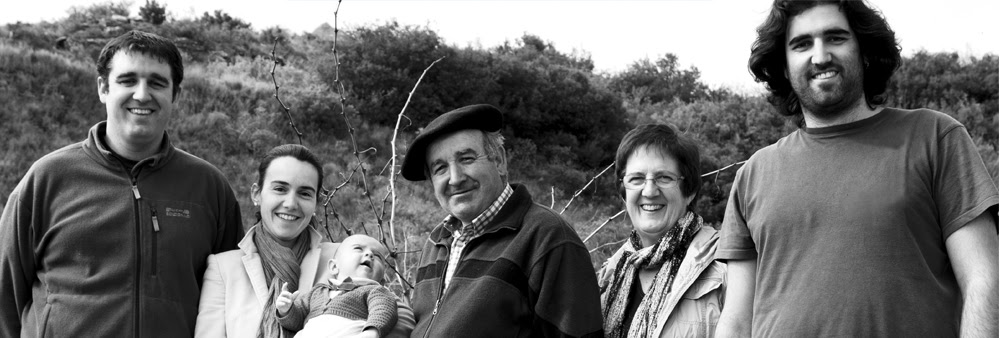
With less than 55 total acres of vineyards, Artuke Bodegas y Viñedos is most certainly a family affair. Artuke is the contraction of the names of Arturo and Kike de Miguel Blanco, brothers and third generation viticulturalists in the historical Basque province of Álava. Although their father still helps with vineyard maintenance, and their mother will have a plate of food at the ready for family members and visitors alike, it’s the two young men who have completely remade the winery to focus on small vineyard plots in and around their village of Abalos in the high elevation foothills of the Cantabrian Mountains.
Their wines reveal the characteristics of the Alavesa sub-zone, the northernmost of the three Rioja sub-zones, where the cooling influence of the Atlantic Ocean meets the warmer interior. This unique climate has the effect of ripening Tempranillo grapes with slightly thinner skins, yielding wines with superb fruit and freshness.
Artuke (Rioja 2013)
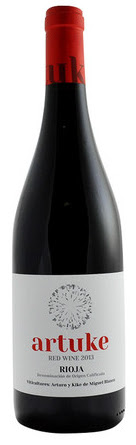 An ideal wine for summer sipping, Artuke is produced using a wine-making technique called carbonic maceration. Full clusters of grapes are fermented to enhance aromatics while creating light, fresh, fruity wines. Carbonic maceration was a tradition before Rioja was known for its barrel-aged reserva wines. There is minimal tannic structure (the grippy finish that’s desired in many types of red wines) which allows the wine to take a deep chill (serve at 55º). A blend of 95% Tempranillo and 5% Viura aged in cement, Artuke is all bright red berries after a burst of violets and cinnamon on the nose. It’s exceptionally versatile pairing with food: grilled tuna, pretty much anything made with zucchini, fried chicken, gooey cheese sandwiches, pizza, turkey burgers…you get the idea.
Pies Negros (Rioja 2011)
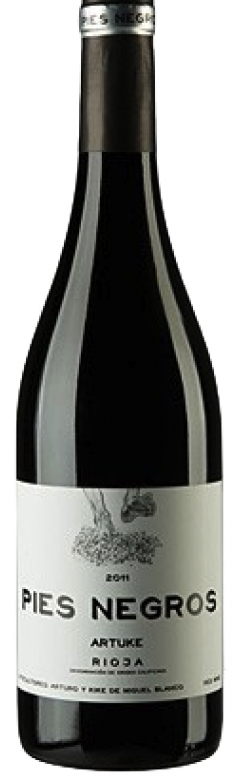 If grilled or roasted meat is on the menu, the mature fruit and structure of Pies Negros is a wine you’ll want to pour. The blend is 90% Tempranillo and 10% Graciano from vines as old as 95 years. Pies Negros means Black Feet, a reference to the archaic method of crushing the grapes using one’s feet – a method that the brothers are determined to use to this day, as they believe the gentle crushing helps to maintain the purity of the fruit. After fermentation, the wine is aged for 14 months in a combination of new and older oak barrels, resulting in a wine that’s full of dark red fruits and a touch of spice with a firm finish.
- - -
Posted on 2015.06.24 in Saturday Sips Wines, Spain DO, Rioja DOC | Read more...
Give Dad the Gift of Burgundy
~$40 Domaine Darviot-Perrin “Les Magnys” (Bourgogne Blanc 2011, Chardonnay) – SOLD OUT
~$26 Domaine Jean-Claude Regnaudot (Maranges “La Fussière” Premier Cru 2013, Pinot Noir) – SOLD OUT
Dads like grilling and power tools. Dads like driving past rest areas until you threaten physical harm. Dads like frequent flyer miles and free t-shirts and yelling at the television.
Dads love Burgundy.
We have Burgundy. From clean, crisp, inexpensive, stainless steel fermented white Burgundy perfect for pairing with broiled perch to white burgundy from world famous vineyards that are full of rich aromas, flavors and textures. We have everyday red Burgundy that takes a chill and works well for sipping on the patio. And we have the world’s finest Premier and Grand Cru red Burgundy, many with the concentration and structure to match a well-marbled beefsteak.
Join us this Saturday to sample a red and white wine that clearly uphold Burgundy’s stature as one of the most prominent winemaking regions in the world. Both wines are from family estates where fathers had a crucial role in the development of the domaine.
If neither of these wines fit your vision for Father’s Day celebrations, we’ll have one that does. Dad deserves it.
Domaine Darviot-Perrin “Les Magnys” (Bourgogne Blanc 2011)
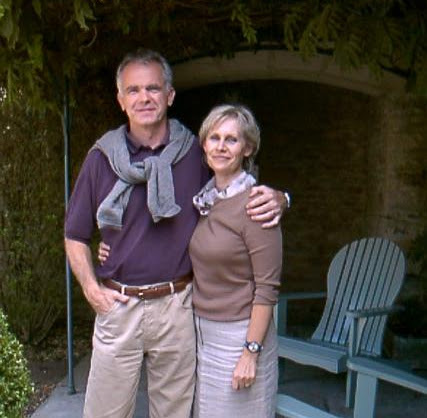 Husband and wife team Didier and Geneviève Darviot own several parcels in some of the premier vineyards of Meursault, Volnay, and Chassagne-Montrachet. Didier learned how to make wine from Geneviève’s father, Pierre Perrin, a legendary winemaker in Meursault and Volnay. Their first bottling was in 1989 and due to their meticulous work in the vineyards and cellar they quickly gained an international reputation for the quality of their wines.
The couple owns a half acre of very old Chardonnay vines in the lieu-dit “Les Magnys” contiguous with the Meursault vineyard of En L’Ormeau. The wine exudes aromas of ripe yellow fruits and a touch of spice and dry stone. A sip is concentrated and rich with honey and butter and finishes with mouthwatering minerals. It’s a Meursault by another name (and a lesser price).
Domaine Jean-Claude Regnaudot (Maranges “La Fussière” Premier Cru 2013)
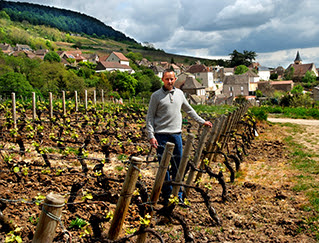 Didier Regnaudot’s very old Pinot Noir vines grow out of the steep hillsides in deep clay and fossilized limestone on the southernmost edge of the Côte de Beaune. One of the top producers in Maranges, Didier is the fourth generation to manage his family’s property in the town of Dézize-les-Maranges where he learned precision vineyard management and winemaking from his father, Jean-Claude.
The wine comes from a 2.5 acre plot from the premier cru vineyard of La Fussière from very old vines, the oldest planted in 1930. Grapes are hand harvested and sorted in the vineyard. Fermentation takes place in concrete tanks and the wine is aged in oak barrels (40% new) for one year before being bottled unfined and unfiltered. Aromas of cherries, cocoa and cinnamon precede a mouthful of ripe fruit followed by a long and wiry finish. It’s a dark and structured red Burgundy and a lot of wine for the price.
- - -
Posted on 2015.06.17 in France, Saturday Sips Wines, Burgundy | Read more...
World-Class Corsican – Clos Canarelli
Clos Canarelli
2014 Biancu Gentile White ~$40/bottle
2014 Corse Figari White ~$40/bottle – SOLD OUT
2013 Corse Figari Red ~$35/bottle
Despite the island of Corsica being France’s most southerly vineyard area, it is surprisingly not its hottest. Height and wind modify the realities of latitude, demonstrated by the remarkable freshness of the best of Corsica’s white wines, and the almost Burgundian grace of its best reds.
 Possesing abundant freshness, complexity, and aromatic intensity, the wines from Yves Canarelli are some of the most celebrated and sought after from the island. He has always championed the restoration of native Corsican grapes. While the French government remains slow to approve bottlings of some of the oldest of these heirloom varieties, often reducing them to the “Vin de France” designation, Yves nevertheless began tearing out entire vineyards of imported varieties and replanting with native vines like Biancu Gentile shortly after taking over the family domaine in 1993.
Clos Canarelli’s vines are located in the granite and red alluvial soil near the tiny, remote village of Tarabucetta, on the southern tip of Corsica in the appellation of Corse Figari. The ever-constant wind from the Gulf of Figari makes for challenging growing conditions, perhaps explaining why Yves Canarelli is one of only a handful of plucky producers there. Indeed, those ferocious winds help to keep the vines free from excess moisture and pests. Yves utilizes both organic and biodynamic viticulture. In the cellar, he prefers deliberate fermentations using indigenous yeasts. These wines not only advertise Corse Figari’s terroir, they exhibit the intrigue of world-class wine.
2014 Biancu Gentile White
Once widely grown in Corsica and famed for its aromatic complexity, Biancu Gentile was later neglected and left on the brink of extinction. At the time of its resurrection, it is estimated there was only a single acre left under vine. Now, with the help of Yves’ 1.2 acre vineyard, the future of this variety is undeniable.The Biancu Gentile is aged in concrete eggs on its lees to coax out the richer texture and notes of exotic fruits, citrus, flowers and Mediterranean breezes.
2014 Corse Figari White
Yves Canarelli’s Figari White earned him the nickname of “Le Roi du Vermentinu” from the French press. 100% Vermentinu (Vermentino in Italy, Rolle in southern France) from 13 acres of granitic soil is raised in large foudre and some older, neutral barrels. The Wine undergoes partial malolactic fermentation to create balance with the rich white fruit, melon, and resinous herbs.
2013 Corse Figari Red
A blend of mostly Niellucciu (closely related to the Italian Sangiovese) with around 15% each of Syrah and Sciacarellu. The grapes are from 19 acres of granitic soil, it’s all raised in foudre for close to 18 months, and then bottled unfiltered. Ripe, red fruits blend with notes of the herbal maquis shrubland that grows on the hills of Corsica. A layered finish seems to last for days.
- - -
Posted on 2015.06.10 in France, Saturday Sips Wines, Corsica | Read more...
Vigne Marina Coppi “Fausto”
Vigne Marina Coppi “Fausto” (Colli Tortonesi 2011, Piedmont)
~$50/bottle — Only 6,600 bottles produced. – SOLD OUT
Colli Tortonesi is a stone’s throw from the well-known region of Gavi in the easternmost part of Piedmont that links up with the Oltrepò Pavese in Lombardy. Production has been dominated by fizzy white wine made from Cortese grapes but there is a movement at hand to bring Timorasso, a grape that was only retrieved from obscurity in the past 15 years and has the most character of all Piedmont’s native white varieties, the recognition it deserves.
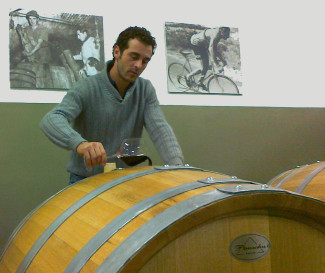
Francesco Bellocchio is at the forefront of that movement. His winery, Vigne Marina Coppi, was established in 2003 after the purchase of an 11 acre vineyard in the hamlet of Castellania that was once owned by his grandfather, a legendary cyclist who from 1940-1953 won the Giro d’Italia five times, the Tour de France twice, and the World Championship.
Bellocchio’s Timorasso grapes grow in the rich limestone soils of the single vineyards Gabetto and Montagnina that are situated mid-slope with an incline of almost 35 degrees. It’s an ideal micro-climate, with cooling breezes from the Adriatic Sea yet protected from the cold northerly winds. Hand-harvested in the early morning to preserve freshness, the grapes are gently pressed and fermented in temperature controlled stainless tanks for eight months with manual batonnage (stirring on the lees to enrich body and bouquet).
The result is “Fausto,” a full-bodied white wine named in honor of his grandfather. Its multi-layered aromatics include crushed stone and dried flowers. A sip fills the mouth with more layers of sappy white fruit and brine and a long, fresh finish. It’s clearly a wine that will develop in the cellar for at least another three to five years if not longer.
- - -
Posted on in Piedmont, Italy | Read more...
Featured Wines
- Notebook: A’Boudt Town
- Saturday Sips Wines
- Saturday Sips Review Club
- The Champagne Society
- Wine-Aid Packages
Wine Regions
Grape Varieties
Albarino, Albarín Blanco, Albarín Tinto, Albillo, Aleatico, Aligote, Arbanne, Aubun, Barbarossa, barbera, Biancu Gentile, bourboulenc, Cabernet Franc, Caino, Calvi, Carcajolu-Neru, Carignan, Chardonnay, Chasselas, Cinsault, Clairette, Cortese, Corvina, Counoise, Dolcetto, Erbamat, Ferrol, Friulano, Fromenteau, Gamay, Garnacha, Garnacha Tintorera, Gewurztraminer, Graciano, Grenache Blanc, Groppello, Juan Garcia, Lambrusco, Loureira, Macabeo, Macabou, Maconnais, Malbec, manseng, Marcelan, Marsanne, Marselan, Marzemino, Mondeuse, Montanaccia, Montònega, Morescola, Morescono, Moscatell, Mourv, Mourvèdre, Muscat, Natural, Nebbiolo, Niellucciu, Parellada, Patrimonio, Pedro Ximénez, Persan, Petit Meslier, Petit Verdot, Pineau d'Aunis, Pinot Blanc, Pinot Gris, Pinot Meunier, Pinot Noir, Pouilly Fuisse, Pouilly Loche, Prieto Picudo, Riesling, Rondinella, Rousanne, Roussanne, Sagrantino, Sauvignon, Sauvignon Blanc, Savignin, Sciacarellu, Semillon, Serine, Sparkling, Sumoll, Sylvaner, Syrah, Tannat, Tempranillo, Teroldego, Timorasso, Trebbiano, Trebbiano Valtenesi, Ugni Blanc, vaccarèse, Verdicchio, Vermentino, Xarel-loWines & Events by Date
- September 2025
- August 2025
- July 2025
- June 2025
- May 2025
- April 2025
- March 2025
- February 2025
- January 2025
- December 2024
- November 2024
- October 2024
- September 2024
- August 2024
- July 2024
- June 2024
- May 2024
- April 2024
- March 2024
- February 2024
- January 2024
- December 2023
- November 2023
- October 2023
- September 2023
- August 2023
- July 2023
- June 2023
- May 2023
- April 2023
- March 2023
- February 2023
- January 2023
- December 2022
- November 2022
- October 2022
- September 2022
- August 2022
- July 2022
- June 2022
- May 2022
- April 2022
- March 2022
- February 2022
- January 2022
- December 2021
- November 2021
- October 2021
- September 2021
- August 2021
- July 2021
- June 2021
- May 2021
- April 2021
- March 2021
- February 2021
- January 2021
- December 2020
- November 2020
- October 2020
- September 2020
- August 2020
- July 2020
- June 2020
- May 2020
- April 2020
- March 2020
- February 2020
- January 2020
- December 2019
- November 2019
- October 2019
- September 2019
- August 2019
- July 2019
- June 2019
- May 2019
- April 2019
- March 2019
- February 2019
- January 2019
- December 2018
- November 2018
- October 2018
- September 2018
- August 2018
- July 2018
- June 2018
- May 2018
- April 2018
- March 2018
- February 2018
- January 2018
- December 2017
- November 2017
- October 2017
- September 2017
- August 2017
- July 2017
- June 2017
- May 2017
- April 2017
- March 2017
- February 2017
- January 2017
- December 2016
- November 2016
- October 2016
- September 2016
- August 2016
- July 2016
- June 2016
- May 2016
- April 2016
- March 2016
- February 2016
- January 2016
- December 2015
- November 2015
- October 2015
- September 2015
- August 2015
- July 2015
- June 2015
- May 2015
- April 2015
- March 2015
- February 2015
- January 2015
- December 2014
- November 2014
- October 2014
- September 2014
- August 2014
- July 2014
- June 2014
- April 2014
- March 2014
- February 2014
- January 2014
- December 2013
- November 2013
- October 2013
- September 2013
- August 2013
- July 2013
- June 2013
- May 2013
- April 2013
- March 2013
- February 2013
- January 2013
- December 2012
- November 2012
- October 2012